





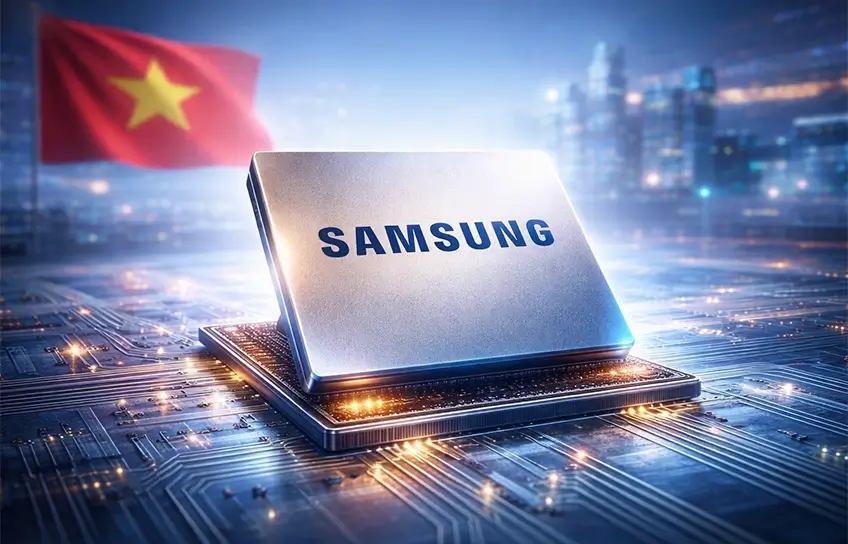
Samsung Electronics is planning to build a chip packaging and testing facility in northern Vietnam, according to people familiar with the matter, in a move that would mark a significant expansion of the South Korean tech giant’s semiconductor footprint in Southeast Asia.
The company plans a $4 billion outlay to build the plant in Thai Nguyen province, executing the investment in several phases. The first phase alone will involve a $2 billion outlay.
Vietnam’s Finance Ministry confirmed it is working on a memorandum of understanding with Samsung on plans for a semiconductor project, though it did not provide further details. A representative of Samsung declined to comment.
Samsung has not officially confirmed the figures, and the company has yet to announce a timeline for the project.
A Long-Standing Presence, Now Going Deeper
Samsung entered Vietnam in 2008 with a facility in Bac Ninh and has since built out what is now its largest smartphone production base, including a major complex in Thai Nguyen launched in 2013.
The company has invested more than $23.2 billion in Vietnam and created 90,000 jobs for Vietnamese workers, according to government figures as of 2024, making it the country’s largest foreign investor and largest exporter.
Recent investments have been accelerating. In 2022, Samsung put $920 million into its Thai Nguyen operations, bringing the total capital invested in its Samsung Electro-Mechanics factory there to $2.3 billion. Earlier this year, the company pledged a further $1.2 billion to produce high-end electronic circuit boards in the same province.
The proposed chip packaging plant would mark a further step into higher-value semiconductor activity, moving beyond the assembly and smartphone manufacturing that has defined the company’s presence in the country.
Trade Tensions and Supply Chain Shifts Driving the Move
The planned investment also reflects a broader industry trend. Global supply chains have been gradually diversifying away from China, partly to navigate trade tensions and tariff pressures under US President Donald Trump’s policies, with Vietnam maintaining strong export momentum and emerging as a preferred alternative for electronics manufacturing.
The move comes as the global semiconductor industry experiences strong momentum driven by artificial intelligence demand, which has significantly increased the need for advanced chip production and packaging capabilities. News Samsung and its global peers are expanding at a rapid pace to meet rising demand for chips that go into data centers and gadgets running AI services.
Vietnam Courts the Semiconductor Industry
The Samsung investment, if confirmed, would align closely with Vietnam’s own national ambitions in the chip sector.
In recent years, the Vietnamese government has been working to move the country away from its image as a low-cost manufacturing hub and toward higher-value industries. To attract private investment, the government is offering some of the highest incentives globally, including full exemptions on land use and rental fees for strategic projects. Eligible semiconductor ventures can also benefit from a four-year corporate income tax holiday, followed by a 50% tax reduction for the next nine years.
The government is also investing directly. A state-funded semiconductor facility in Hanoi broke ground in January 2026 and is expected to be operational by 2030. The plant will focus on small-scale, high-tech chips aimed at supporting domestic industries and reducing Vietnam’s dependence on global supply chains.
As Vietnam’s largest exporter, Samsung sits at the heart of the country’s manufacturing ecosystem, anchoring a vast supply chain that spans smartphones, components, and increasingly higher-value activities such as displays and research and development. The company has been instrumental in helping transform Vietnam into a global electronics hub, drawing in a network of suppliers and boosting industrial capacity.
Samsung and the Vietnamese government will release further details once they finalize the memorandum of understanding and submit it to the Prime Minister for approval.


