


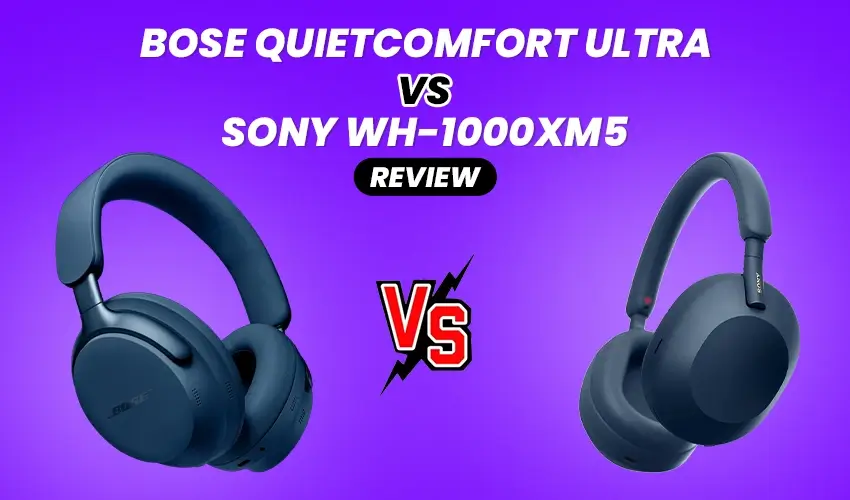
If you’re in the market for premium noise-canceling headphones, you’ve likely narrowed it down to two industry leaders: Bose and Sony. Choosing between their flagship models can feel overwhelming, but after extensive real-world testing, this Bose QuietComfort Ultra vs Sony WH-1000XM5 comparison will help you make an informed decision.
Premium audio has evolved beyond simple sound quality and noise cancellation. Today’s decision involves spatial audio, adaptive technologies, and sophisticated app ecosystems.
When comparing the Bose QuietComfort Ultra and Sony WH-1000XM5, you’re choosing between two distinct philosophies on what makes the perfect listening experience.
Quick Comparison Table
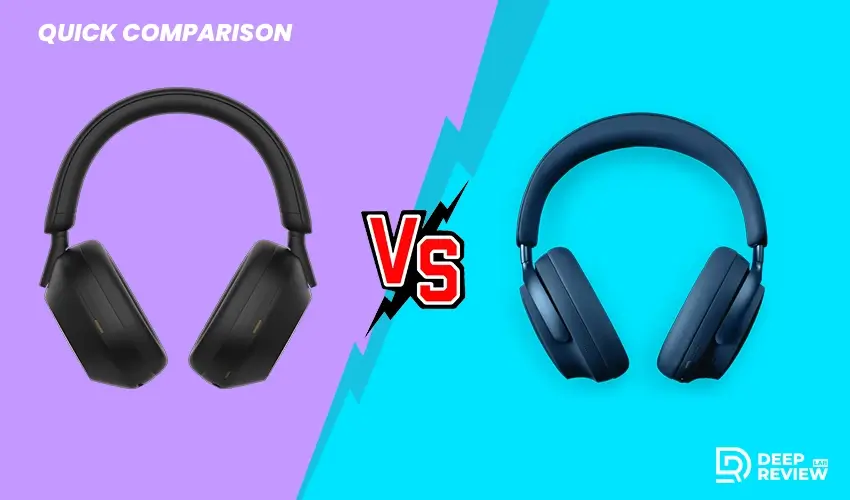
| Feature | Bose QuietComfort Ultra | Sony WH-1000XM5 |
| Price | $429 | $399 |
| Battery Life (ANC On) | 24 hours | 30 hours |
| Weight | 250g | 250g |
| Noise Cancellation | Excellent (8 mics) | Excellent (8 mics) |
| Drivers | Custom | 30mm Carbon Fiber |
| Bluetooth | 5.3 | 5.2 |
| Codec Support | aptX Lossless, AAC | LDAC, AAC |
| Folding Design | Yes | No |
| Quick Charge | 3 hrs / 15 min | 3 hrs / 3 min |
| Spatial Audio | Immersive Audio | 360 Reality Audio |
Design and Build Quality
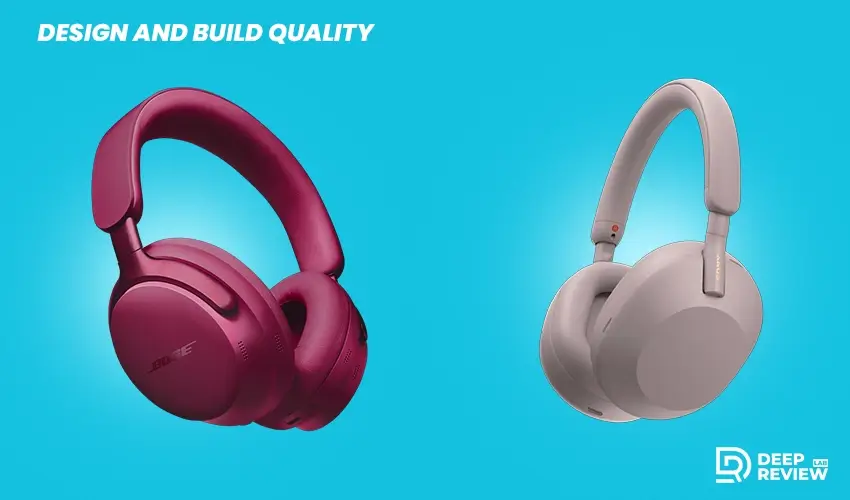
The first thing you’ll notice when unboxing either of these headphones is the attention to detail in their construction. The Bose QuietComfort Ultra features a premium design with soft-fit leather materials and a refined aesthetic that screams sophistication.
The headband uses a stepless adjustment mechanism that allows for precise fitting without any clicking sounds. The earcups rotate flat, making them incredibly portable and easy to store in the Bose QuietComfort Ultra case. At 250 grams, they feel substantial but not heavy.
Sony’s Modern Redesign
Sony took a different approach with the WH-1000XM5. They completely redesigned the look from their previous generation, opting for a sleeker, more modern appearance. The headphones weigh in at a nearly identical 250 grams but distribute that weight slightly differently. The earcups don’t fold flat like the Bose, which means the Sony WH 1000XM5 case is noticeably larger.
However, Sony compensated for this with materials that feel equally premium, featuring soft-fit leather and a seamless, almost futuristic design language.
Build Quality Comparison
Both headphones feel durable enough for daily use, though the Bose edges ahead slightly in perceived build quality. The materials used on the QuietComfort Ultra have a more luxurious feel, and the folding mechanism adds a layer of portability that frequent travelers will appreciate.
Sony’s redesign eliminated many of the weak points from earlier models, resulting in a sturdy pair of headphones that should withstand years of regular use.
Comfort for Extended Listening Sessions
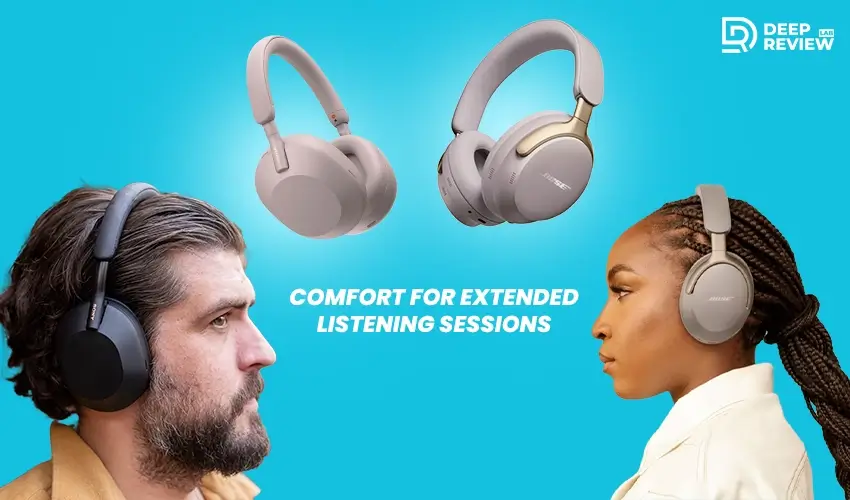
Comfort becomes critically important when you’re wearing headphones for hours at a time, whether you’re working from home, traveling, or simply enjoying your favorite albums. Both manufacturers understand this, but they’ve achieved comfort through different means.
Bose’s Plush Comfort Approach
The Bose QuietComfort Ultra lives up to its name when it comes to comfort. The plush earcups create a gentle seal around your ears without applying excessive pressure.
The headband distributes weight evenly across the top of your head, and even after wearing them for four or five hours straight, I experienced minimal fatigue. The ear cushions are deep enough that most ears won’t touch the drivers, which can be a common complaint with shallower designs.
Sony’s Lightweight Feel
Sony’s WH-1000XM5 also excels in the comfort department, though some users report that the earcups feel slightly shallower than the Bose. If you have larger ears, you might occasionally feel them brushing against the inner padding.
However, the headband on the Sony extends further, which is beneficial if you have a larger head. The clamping force feels slightly lighter than the Bose, which some people prefer for all-day wear.
Real-World Comfort Testing
In real-world testing across multiple-hour listening sessions, both headphones proved comfortable enough that I sometimes forgot I was wearing them. The Bose feels more plush and cushioned, while the Sony feels lighter and less present on your head.
Your personal preference between a snug, well-cushioned fit versus a lighter, more minimal presence will determine which you find more comfortable.
Noise Cancellation Performance
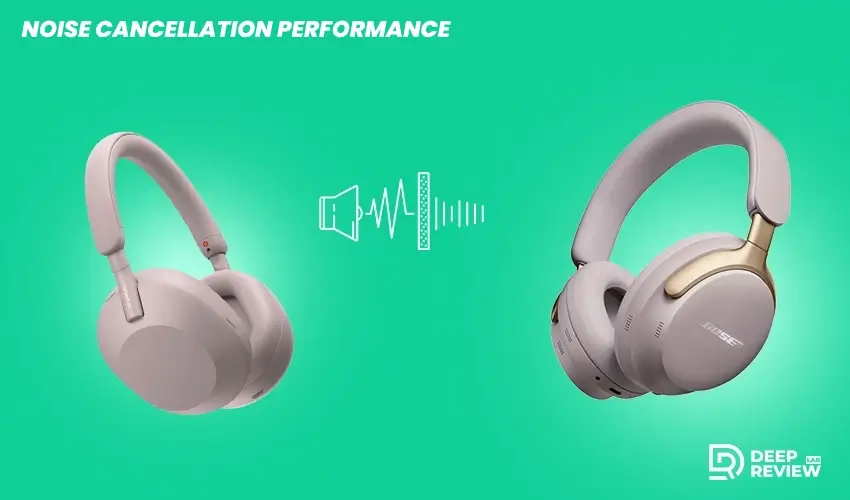
This category represents the main reason most people invest in premium headphones. Both Bose and Sony have built their reputations on industry-leading active noise cancellation, and these flagship models push the boundaries of what’s possible with ANC technology.
Bose’s Eight-Microphone System
The Bose QuietComfort Ultra employs an eight-microphone system with advanced feedback and adaptive feed-forward noise reduction. In practical terms, this translates to exceptional performance across a wide range of environments.
During testing on airplanes, the Bose effectively eliminated the constant drone of jet engines, making them nearly inaudible. In busy coffee shops, conversations happening just feet away became muffled to the point of being imperceptible.
Even in my home office with an HVAC system that produces a steady hum, the Bose created an almost eerie silence.
Sony’s Dual-Processor Approach
Sony’s WH-1000XM5 takes a similar approach with eight microphones, but uses two dedicated processors to handle the noise cancellation algorithms. The result is noise cancellation that rivals and in some frequency ranges surpasses the Bose.
The Sony excels particularly with mid-range and high-frequency sounds. Construction noise, keyboard typing, and human voices get filtered out with impressive effectiveness.
Some reviewers have noted that the Sony has a slight edge with sudden sounds like door slams or announcements, though in my testing, both performed admirably.
Transparency and Ambient Modes
The transparency or ambient modes on both headphones deserve special mention. The Bose offers customizable levels of awareness through its Aware Mode, which can be adjusted in ten stages.
This granular control means you can fine-tune exactly how much environmental sound you want to let in. The Sony’s Ambient Sound Control is equally sophisticated and can automatically adjust based on your activity, whether you’re walking, sitting, or commuting.
If forced to choose a winner in noise cancellation, the Bose QuietComfort Ultra takes a marginal lead, particularly in overall quietness. However, the difference is so small that most users would be thrilled with either option. Both represent the absolute pinnacle of ANC technology available today.
Sound Quality and Audio Performance
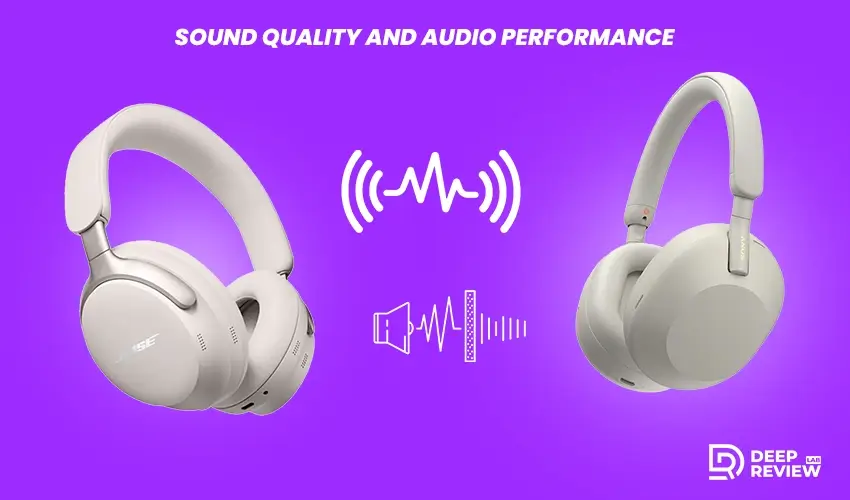
Sound quality is deeply subjective, but there are objective measurements and general characteristics worth discussing. Out of the box, both headphones lean toward a bass-forward sound signature that emphasizes modern music genres like pop, hip-hop, and electronic music.
Bose’s CustomTune Technology
The Bose QuietComfort Ultra features proprietary active EQ and CustomTune technology that automatically analyzes your ear shape and adapts the sound accordingly. This personalization creates a listening experience that can feel more natural and balanced compared to generic tuning.
The bass response is powerful but can feel slightly bloated on certain tracks. Fortunately, the Bose Music app includes a three-band equalizer that allows you to tame the low end if needed.
Immersive Audio Feature
The QuietComfort Ultra also introduces Immersive Audio, Bose’s take on spatial audio technology. When enabled, it creates a soundstage that extends beyond the headphones, placing audio elements in a three-dimensional space around you.
The effect works with any audio source, not just content specifically mixed for spatial audio. You can choose between Still mode, where audio stays fixed in space as you move your head, or Motion mode, where audio follows your head movements.
Sony’s Carbon Fiber Drivers
Sony’s WH-1000XM5 uses newly designed 30-millimeter drivers with carbon fiber composite material for the diaphragms. This construction aims to deliver enhanced high-frequency clarity while maintaining solid bass response.
Like the Bose, the out-of-box tuning emphasizes bass, which some listeners find muddy or overwhelming. The Sony Headphones Connect app provides a more sophisticated equalizer with adjustable bands, giving you finer control over the sound signature.
Sound Comparison After EQ
Many reviewers note that with proper EQ adjustments, both headphones can achieve excellent sound quality that approaches audiophile territory. The Sony tends to offer slightly more detail and clarity in the midrange and treble after EQ tweaking.
Meanwhile, the Bose provides a warmer, more enveloping sound that some listeners prefer for extended listening sessions.
Codec Support Details
For codec support, the Bose QuietComfort Ultra supports aptX Lossless through Snapdragon Sound, but this requires an Android phone with a Qualcomm Snapdragon processor. The Sony supports LDAC, which is more widely available on Android devices.
iPhone users will be limited to AAC on both headphones. In real-world listening, the differences between these codecs are subtle and unlikely to be noticeable unless you’re listening to high-resolution audio files with excellent source equipment.
Battery Life and Charging
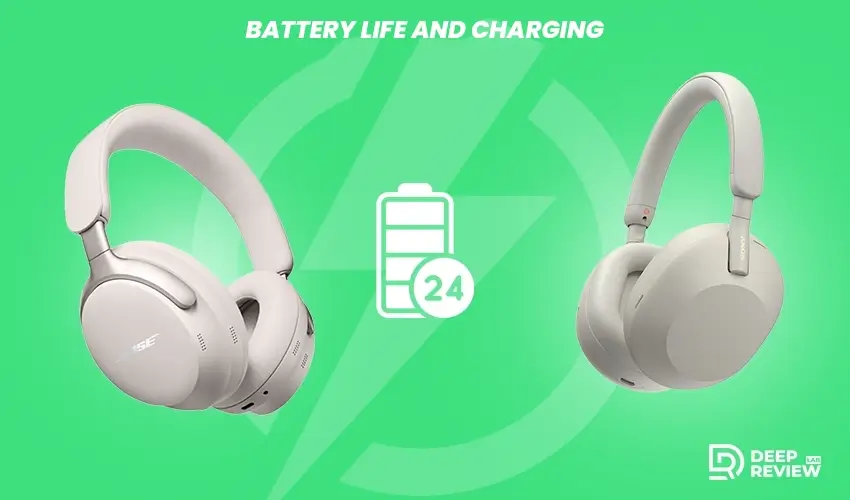
Battery performance can make or break the user experience, especially for frequent travelers or people who forget to charge their devices regularly.
Bose Battery Performance
The Bose QuietComfort Ultra battery life offers up to 24 hours of playback with noise cancellation enabled. If you activate Immersive Audio, that drops to approximately 18 hours.
A 15-minute quick charge provides about three hours of listening time, which can be a lifesaver when you’re rushing to catch a flight. The headphones charge via USB-C and take about two hours for a complete charge.
Sony’s Superior Battery Life
The Sony WH-1000XM5 battery life pulls ahead significantly in this category with up to 30 hours with ANC enabled, or 40 hours with ANC turned off. This six-hour advantage over the Bose means you can go longer between charges, potentially a full week or more for average daily use.
The Sony also features quick charging, delivering three hours of playback from just three minutes of charging. Full charging takes approximately three and a half hours.
For anyone who travels frequently or simply doesn’t want to worry about charging regularly, the Sony’s superior battery life is a tangible advantage. The difference between 24 and 30 hours might not seem enormous, but in practice, it can mean the difference between charging twice a week versus once a week.
Features and Smart Capabilities
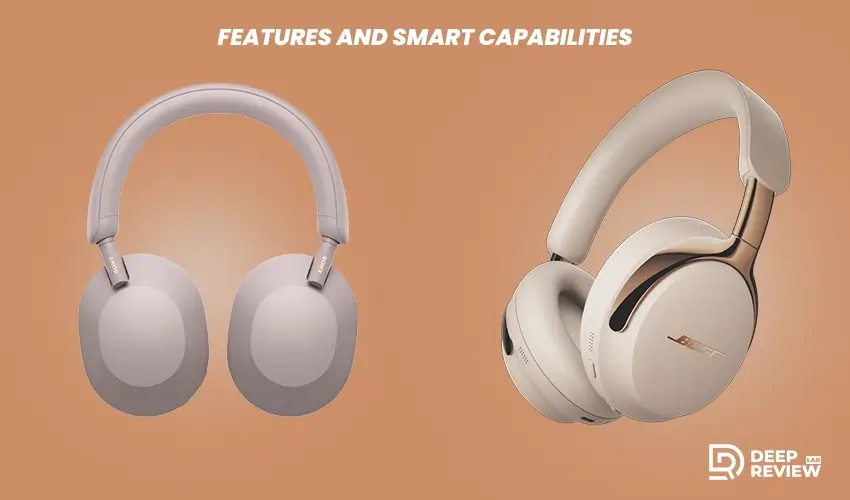
Modern premium headphones are as much about features as they are about core audio performance. Both models pack impressive technological capabilities, though they emphasize different aspects.
Bose Connectivity and Features
The Bose QuietComfort Ultra supports multipoint connectivity, allowing you to connect to two devices simultaneously. This feature arrived through a software update, so earlier units needed updating to access it.
The headphones also support Bluetooth 5.3 for stable connections and include wear detection that automatically pauses playback when you remove them.
One unique Bose feature is SimpleSync, which lets you pair the headphones with compatible Bose soundbars. This allows you to watch TV at your own volume without disturbing others, a genuinely useful capability for shared living spaces.
The Spotify Tap shortcut lets you jump directly into your favorite playlists with a long press on the volume strip. If you need help getting started, the Bose QuietComfort Ultra manual provides detailed setup instructions.
Sony’s Smart Features
Sony’s WH-1000XM5 also offers multipoint connectivity and Bluetooth 5.2. The Adaptive Sound Control feature automatically adjusts noise cancellation and ambient sound based on your activity and location, learning your habits over time.
The Speak-to-Chat function automatically pauses music and enables ambient sound when you start talking, a convenient feature when someone approaches you for a quick conversation.
Control Systems Compared
The Sony WH-1000XM5 controls include sophisticated touch controls on the right earcup, with intuitive gestures for volume, playback, and skip functions. The Bose uses a combination of buttons and a capacitive volume slider, which some users find more reliable than pure touch controls.
This is especially true when wearing gloves or in wet conditions. Both headphones support voice assistants including Google Assistant and Amazon Alexa. The Sony includes Google Fast Pair and Microsoft Swift Pair for easier connection to compatible devices.
For those wondering how to connect their devices, entering Sony WH 1000XM5 pairing mode or Bose QuietComfort Ultra pairing mode is straightforward through the respective companion apps.
App Experience and Customization
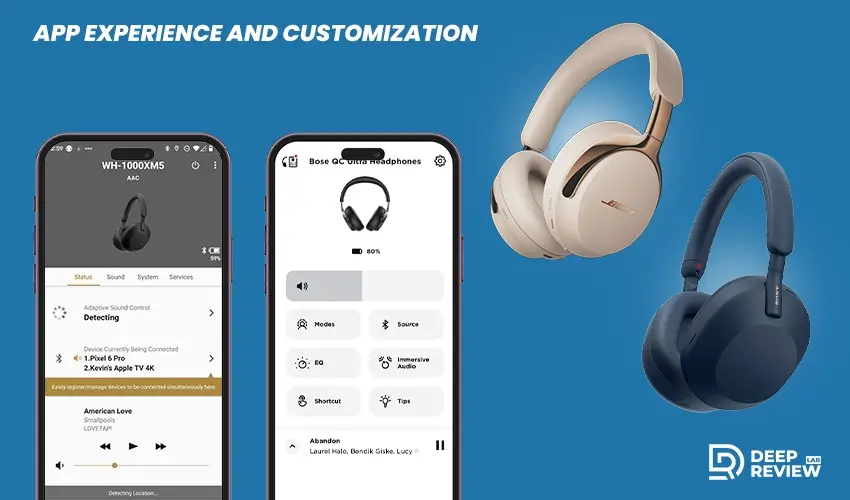
The companion apps for both headphones play a crucial role in unlocking their full potential and customizing the experience to your preferences.
Bose Music App
The Bose Music app maintains a minimalist design that prioritizes simplicity. You can adjust the three-band equalizer, configure Immersive Audio settings, customize button shortcuts, and manage connected devices.
The interface is straightforward and easy to navigate, though audiophiles might wish for more granular EQ control. Firmware updates can be done through the app or via a web-based tool, giving you options if you prefer not to use the mobile app.
Sony Headphones Connect App
Sony’s Headphones Connect app offers a more feature-rich experience with additional customization options. The equalizer provides more bands for precise tuning, and you can save custom presets.
The Adaptive Sound Control settings are more detailed, allowing you to define specific locations and activities with custom sound profiles. The Sony WH-1000XM5 manual, accessible through the app, provides comprehensive guidance on all features.
The app also tracks your listening habits and provides recommendations through the Safe Listening feature.
Both apps are well-designed and functional, but the Sony app edges ahead for users who want deeper customization and control. The Bose app will satisfy most users with its clean interface and essential features.
Price and Value Proposition
Price often becomes the deciding factor when choosing between similarly capable products. In the bose quietcomfort ultra vs sony wh-1000xm5 comparison, the Bose QuietComfort Ultra typically retails for around $429, while the Sony WH-1000XM5 comes in at approximately $399.
That $30 difference isn’t substantial in this price bracket, but it can matter when deals and sales are factored in.
Where to Buy and Deals
Both headphones frequently go on sale, with retailers like Sony WH-1000XM5 best buy, Sony WH-1000XM5 target, and Sony WH-1000XM5 costco often offering competitive pricing during major shopping events. The Sony often drops to around $300 and the Bose reaches approximately $330 during these sales.
For budget-conscious shoppers, Sony WH-1000XM5 refurbished units can provide additional savings while maintaining quality performance. Given the Sony’s longer battery life, more detailed sound after EQ adjustments, and lower price point, it represents slightly better value for most people.
Value Beyond Specifications
However, value isn’t purely about specifications. If you prioritize the most effective noise cancellation, prefer a more compact carrying case, or want the most comfortable fit, the extra cost of the Bose might feel worthwhile.
Similarly, if you’re already invested in the Bose ecosystem with a compatible soundbar, the integration capabilities add value beyond the raw specifications.
Bose QuietComfort Ultra: Pros & Cons
Pros:
- Industry-leading noise cancellation performance
- Exceptionally comfortable for extended wear
- Compact folding design with smaller carrying case
- Premium build quality and materials
- Immersive Audio creates engaging spatial sound
- CustomTune technology personalizes audio
- SimpleSync works with Bose soundbars
Cons:
- Shorter battery life (24 hours vs Sony’s 30)
- More expensive than Sony
- Fewer EQ bands in the app
- Immersive Audio drains battery faster
- Less detailed sound out of the box
Sony WH-1000XM5: Pros & Cons
Pros:
- Exceptional 30-hour battery life
- Lower price point ($399)
- More detailed sound after EQ adjustments
- Sophisticated app with extensive customization
- Superior call quality and microphone performance
- Adaptive Sound Control learns your habits
- Faster quick charging (3 hours from 3 minutes)
Cons:
- Larger carrying case (doesn’t fold flat)
- Slightly shallower earcups
- Noise cancellation marginally behind Bose
- Touch controls can be finicky in some conditions
- Bass-heavy tuning requires EQ adjustment
Who Should Choose the Bose QuietComfort Ultra
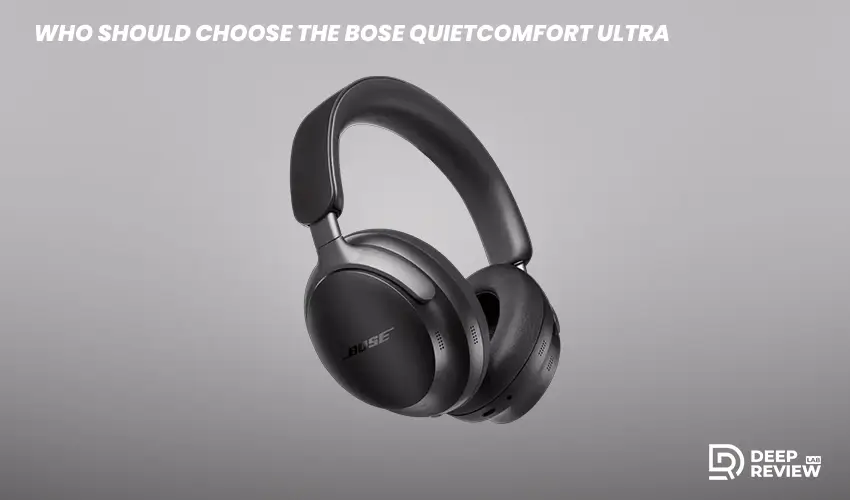
The Bose QuietComfort Ultra makes the most sense for several specific use cases. If your primary concern is achieving the absolute quietest environment possible, particularly for air travel or noisy commutes, the marginally superior noise cancellation tips the scales in Bose’s favor.
When comparing bose quietcomfort ultra vs sony wh-1000xm5, the compact folding design and smaller case make these headphones ideal for frequent travelers who value portability.
Best for Premium Experience
The Immersive Audio feature, while not essential, provides an interesting spatial audio experience that some users genuinely enjoy. If you appreciate a warmer, more bass-forward sound signature right out of the box, the Bose tuning might align better with your preferences.
This means you won’t need extensive EQ tweaking.
The QuietComfort Ultra also suits anyone who values premium build quality and materials. The overall fit and finish feel slightly more refined than the Sony, which might appeal to those who view their headphones as both a functional tool and a fashion accessory.
It’s worth noting that Bose also offers the Bose QuietComfort Ultra wireless earbuds and Bose Ultra Quietcomfort Earbuds for those who prefer a more compact form factor, along with accessories like the Bose QuietComfort ultra earbuds case for added protection.
Who Should Choose the Sony WH-1000XM5
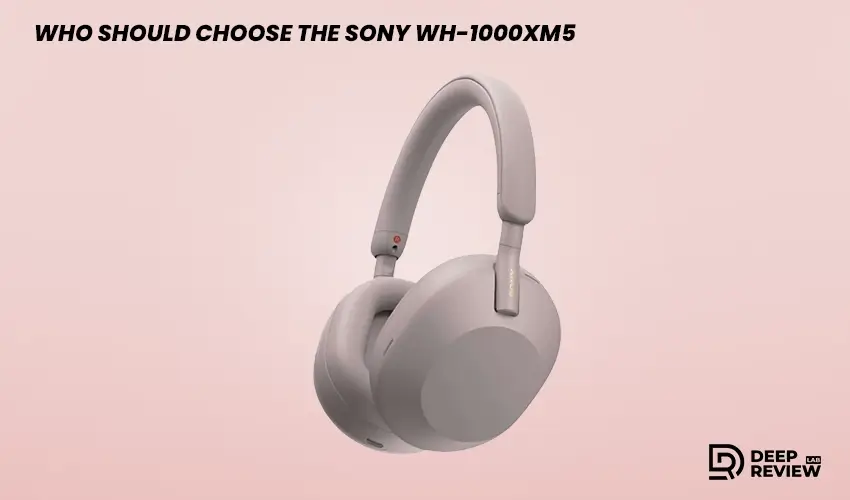
The Sony WH-1000XM5 represents the better choice for several distinct user profiles. If battery life ranks high on your priority list, the six-hour advantage over the Bose can’t be ignored. Comparing the bose quietcomfort ultra vs sony wh-1000xm5 shows that Sony offers longer battery life and slightly more detailed sound after EQ adjustments
For people who frequently forget to charge their devices or who take extended trips, this difference is meaningful.
Best for Value and Features
The more affordable price point makes the Sony an obvious choice for budget-conscious buyers who don’t want to compromise on quality. The slight edge in sound quality after proper EQ adjustment will appeal to audio enthusiasts who plan to spend time fine-tuning their listening experience.
Sony’s more sophisticated app and features like Adaptive Sound Control create a more intelligent, automated experience that learns your preferences over time. If you value technology that adapts to your lifestyle rather than requiring manual adjustments, the Sony delivers that experience better.
Ideal for Professionals
The sony wh-1000xm5 mic quality and more effective Speak-to-Chat function make the Sony headphones better suited for professionals who take frequent video calls or need reliable hands-free communication. Many reviews Bose QuietComfort Ultra earbuds highlight the differences in call quality between Bose’s various product lines.
However, for over-ear headphones, Sony maintains a slight edge in this department.
Conclusion
After extensive testing, both the Bose QuietComfort Ultra vs Sony WH-1000XM5 deliver exceptional audio experiences that justify their premium prices. The Sony offers better value with longer battery life, superior call quality, and a lower price point, making it the better choice for most people.
However, the Bose wins on pure noise cancellation, comfort, and portability with its folding design. You can’t go wrong with either, your decision should simply align with whether you prioritize Sony’s practical advantages or Bose’s premium refinement. Both represent the pinnacle of consumer audio technology and will serve you well for years to come.
