


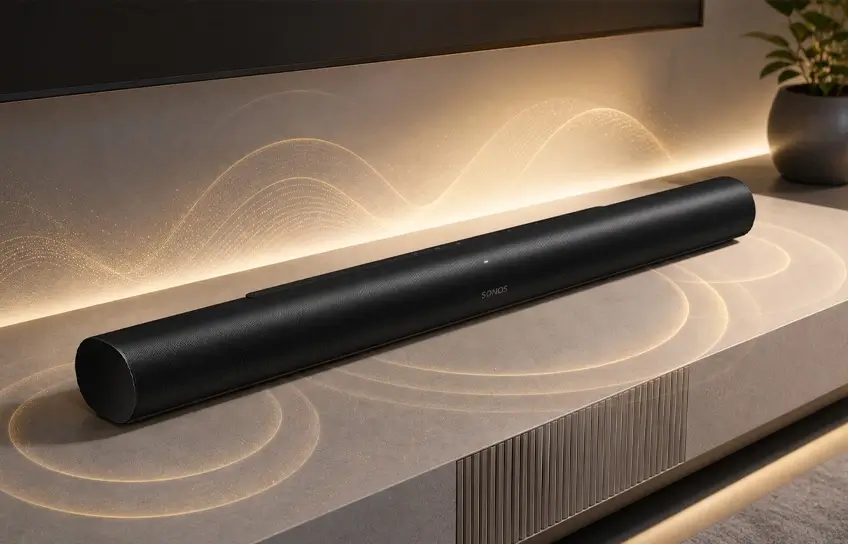
Sonos has been building premium wireless speakers for over two decades, but nothing in its lineup has pushed the boundaries of what a single soundbar can do quite like this one. The sonos arc ultra arrived in late October 2024 as the company’s most ambitious home audio product to date, packing 14 drivers, a proprietary bass technology, and a 9.1.4 channel configuration into a single sleek bar.
The sonos arc ultra soundbar is not a minor refresh of what came before it. Sonos rebuilt the internals from scratch to push performance further than any previous model without requiring a room full of extra speakers. This post breaks down what changed, who it makes sense for, and whether the price is worth it.
Sonos Arc Ultra Full Specifications
| Specification | Details |
| Channels | 9.1.4 |
| Total Drivers | 14 (7 tweeters, 6 mid-woofers, 1 Sound Motion woofer) |
| Amplifiers | 15 Class-D digital amplifiers |
| Audio Formats | Dolby Atmos, Dolby TrueHD, Dolby Digital Plus, Dolby Digital, Stereo PCM, Multichannel PCM |
| Dimensions (W x H x D) | 46.38 in x 2.95 in x 4.35 in (117.8 cm x 7.5 cm x 11 cm) |
| Weight | 13.01 lbs (5.9 kg) |
| Wi-Fi | 802.11a/b/g/n/ac/ax (Wi-Fi 6) |
| Bluetooth | Bluetooth 5.3 (AAC, SBC) |
| Connections | HDMI eARC, Ethernet, Optical (via adapter) |
| Streaming | Spotify Connect, Tidal Connect, Apple AirPlay 2 |
| Voice Control | Sonos Voice Control, Amazon Alexa |
| Room Calibration | Trueplay (Quick and Advanced, iOS and Android) |
| Colors | Black, White |
| Release Date | October 29, 2024 |
| Price | $999 to $1,099 |
What Makes This Soundbar Different From Everything Else

The original Sonos Arc, released in 2020, was already considered one of the best single-bar soundbars on the market. So when Sonos set out to replace it, the challenge was not just making it louder or adding more drivers.
It was about rethinking the internal architecture entirely. The sonos arc ultra release date was late October 2024, and since hitting shelves it has taken a fundamentally different approach to how sound is produced and distributed throughout a room, starting with the speaker layout and running all the way down to how bass is physically generated inside the cabinet.
A Speaker Configuration Built for Real Immersion
When you look at the sonos arc ultra specs, the 9.1.4 channel configuration is easier to understand than it looks. The “9” refers to nine speakers aimed at ear level, covering the front and sides. The “1” refers to a built-in woofer dedicated to bass. The “4” refers to four upward-firing speakers that bounce sound off your ceiling to create height effects above you.
Together, these 14 drivers work as a coordinated system to wrap sound around you from multiple directions, all from a single bar sitting beneath your television.
This matters because spatial audio formats like Dolby Atmos are designed with exactly this kind of setup in mind. When a filmmaker mixes a scene with rain falling from above or a helicopter flying overhead, those sounds are encoded with height information. The Arc Ultra is built to decode and deliver that information in a way that actually lands where it was intended.
The Technology Behind the Bass
Bass has historically been the weakest point of any single-bar soundbar, and for good reason. Sonos addressed this directly by introducing a proprietary technology called Sound Motion, which uses a four-motor, dual-membrane woofer inside the bar.
Traditional woofer drivers rely on a single heavy motor, which takes up significant space and limits how much a manufacturer can pack into a slim soundbar cabinet. Sound Motion replaces that single motor with four smaller, lighter ones working in opposing corners. The result is a driver that can move considerably more air and produce deeper, more defined bass than a standard design of the same physical size.
This engineering choice has real consequences for listeners. Bass notes hit with more force and decay more cleanly. Explosions in action films feel physical rather than just loud. Music with heavy low-end content, whether that is hip-hop, electronic, or orchestral, comes through with texture and weight that most soundbars simply cannot deliver on their own.
How It Performs in Real Use

Numbers and engineering only matter if the listening experience actually backs them up. Every serious sonos arc ultra review makes the same point: what matters most is how the soundbar actually behaves when you sit down with your favorite content.
Movies and TV Shows
For movie watching, the Arc Ultra places audio effects with real precision rather than just pushing sound forward from the bar. In scenes with directional action, sounds follow objects across the screen and into the space around you. Height effects land above you when the content calls for it. Dialogue comes through clearly and stays anchored to the center of the screen regardless of what else is happening in the mix.
Sonos also updated the front speaker array specifically to improve vocal clarity. A Speech Enhancement setting in the app lets you dial in additional dialogue emphasis when needed, which is particularly useful for content with dense or fast-moving conversation.
Music Listening
This is where the Arc Ultra pulls ahead of most soundbars in its class. The driver layout is richer and more balanced, so music sounds three-dimensional rather than flat. Stereo recordings spread naturally across the room. Dolby Atmos music mixes, which are increasingly common on platforms like Apple Music, take things further, with instruments appearing above and around you rather than just in front.
If you already use Sonos speakers elsewhere in your home, the Arc Ultra connects into that setup without any friction. You can group rooms, queue music across the house, and run everything from the Sonos app.
Features Worth Knowing Before You Buy

Trueplay Room Calibration
Every room has different acoustic properties depending on its size, shape, furniture, and wall materials. Trueplay is Sonos’s room calibration system that measures these properties and adjusts the soundbar’s output accordingly.
Among the sonos arc ultra features that received meaningful upgrades, Trueplay is now available to both iPhone and Android users, which was not the case with the original Arc. The advanced version involves slowly moving your phone through the room while the soundbar emits test tones, capturing how sound behaves in your specific space. It takes a few minutes but makes a noticeable difference, especially in rooms with hard surfaces or unusual layouts.
Bluetooth Connectivity
Earlier Sonos soundbars famously lacked Bluetooth, which frustrated users who wanted to quickly play audio from their phone without going through the app. The Arc Ultra adds Bluetooth 5.3, making it easy to connect any device directly when you want a simple, quick playback option. This is a small change on paper but a meaningful one in daily use.
Expanding the System Over Time
The Arc Ultra is designed to grow with you, and the upgrade path makes a real difference here. Adding the Sonos Sub 4 pushes the bass from impressive to something you can physically feel during action scenes or heavy music.
The Sub 4 also frees the Arc Ultra’s built-in woofer to focus more on the mid-bass range, which improves overall balance across the full frequency spectrum.
Adding a pair of Era 300 speakers as rear channels changes the experience even more dramatically. Without rear speakers, the Arc Ultra creates a convincing illusion of surround sound using psychoacoustics and wall reflections.
With the Era 300s in place, audio elements actually originate from behind and beside you, not just the front. Voices feel like they are in the room and effects track around your seat rather than just across the front wall. The full kit costs well past $3,000 combined, so it is worth deciding upfront how far you plan to take the system.
Few Honest Limitations
The soundbar has only one HDMI port, which connects to your TV via the eARC standard. There is no HDMI passthrough, which means you cannot run a gaming console or streaming device directly through the soundbar.
The sonos arc ultra dimensions measure 46.38 inches wide, 2.95 inches tall, and 4.35 inches deep, so it sits comfortably beneath most modern televisions. If your TV has limited HDMI 2.1 ports, you will likely give one up to the Arc Ultra, which is worth thinking through before buying if you own multiple gaming consoles.
The Sonos app has had a rough stretch following a troubled update rollout, and while it has improved considerably, some users still encounter occasional bugs. Day-to-day use of the soundbar itself, including volume control via your TV remote and playback through Spotify or Apple Music, does not depend heavily on the app.
People who tweak settings regularly will run into friction. Basic daily use like volume control and streaming works fine without opening the app at all.
Finally, the price is simply high. At just under $1,100, this is a premium product by any measure. It competes at the top of the single-bar soundbar category, and for many people, a less expensive option will do the job perfectly well.
Who Should Actually Consider It
The Arc Ultra is the right choice if you are buying a premium soundbar for the first time, moving up from a mid-range bar, or starting a new home theater setup. It handles movies and music better than most standalone soundbars, and sounds strong right out of the box with no extra hardware needed.
The sonos arc ultra price sits at around $999 to $1,099 depending on where you buy it, which is a serious spend. For that you get a soundbar that skips the need for a separate subwoofer, works inside the full Sonos multiroom setup, and holds its own against far more complex speaker systems.
If you already own the original Sonos Arc and it still sounds good to you, there is no rush to replace it. The Arc Ultra is better across the board in bass, clarity, and music, but not so dramatically that it justifies swapping out a working bar. A smarter first move for existing Arc owners would be adding the Sonos Sub 4 to the current setup and saving the soundbar upgrade for later.
Pros and Cons
Pros
- Deep, powerful bass without a separate subwoofer
- Full Dolby Atmos spatial audio support
- Clearer dialogue than the original Arc
- Trueplay tuning now available on Android and iOS
- Bluetooth 5.3 connectivity finally included
- Outstanding music performance
- Clean, minimal design
- Expandable with Sonos Sub and rear speakers
Cons
- No HDMI passthrough, only one eARC port
- No DTS:X support
- Sonos app has occasional bugs
- High price tag
- No remote control included
Conclusion
Sonos took its best soundbar and fixed the things that actually bothered people about it: loose bass, average music performance, and no Bluetooth. The Arc Ultra does all three noticeably better. At around $1,000 it is not a casual purchase, but for what it delivers on its own without any extra hardware, it is hard to find a stronger single-bar option right now.
