


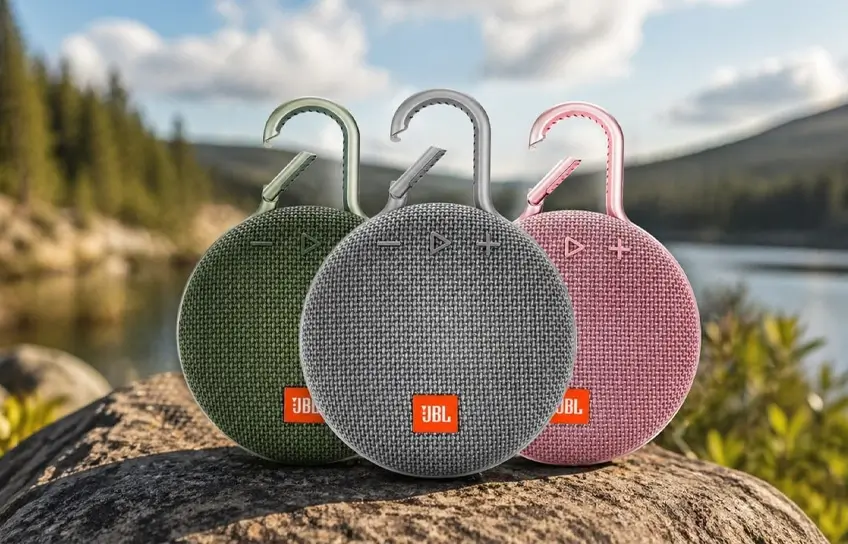
I’ll be honest with you. When I first saw the JBL Clip 3 sitting next to bigger, flashier speakers, I almost skipped past it. It looks like a hockey puck with a metal clip. Nothing about it screams “buy me.” But once you actually use it for a week, take it to the beach, hang it from your backpack, and forget it is even there until it pumps out surprisingly good sound, something changes. You stop caring how it looks and start wondering how you managed without one.
The JBL Clip 3 is not trying to be your home stereo replacement. It is the speaker you grab when you want music with you everywhere, without thinking about it too hard. At around 40 to 50 dollars, it punches well above what the price tag suggests, and it has held up against newer, more expensive competition in ways that frankly surprised me.
In this jbl clip 3 review, we cover the design, sound, battery life, and how it stacks up against the Clip 4 and the Bose SoundLink Micro, so you can figure out whether it is the right pick for you.
JBL Clip 3 Specifications
| Specification | Details |
| Speaker Output | 3 watts (RMS) |
| Driver Size | 40mm full-range driver |
| Frequency Response | 100Hz – 20kHz |
| Bluetooth Version | 4.1 |
| Bluetooth Range | Up to 30 feet (10 meters) |
| Bluetooth Profiles | A2DP 1.2, AVRCP 1.5, HFP 1.5 |
| Battery Capacity | 1000 mAh |
| Battery Life | Up to 10 hours (12+ in real tests) |
| Charging | Micro-USB, approx. 3 hours |
| Water Resistance | IPX7 (submersible up to 1 meter) |
| Weight | 240g (8.5 oz) |
| Dimensions | 141 x 97 x 46 mm |
| Colors Available | 11 color options |
| Inputs | 3.5mm auxiliary input |
| Speakerphone | Built-in mic with noise cancellation |
| App Support | None |
| Release Year | 2018 |
Design and Build Quality

Pick up the jbl clip 3 bluetooth speaker and the first thing you notice is how solid it feels. It is a flat, round disc slightly bigger than a hockey puck, with a tight fabric mesh grille on the front and a rubberized shell covering the rest of it. The grip is good, it does not feel slippery or fragile, and the grille holds up to being tossed around in a bag without picking up scratches.
The biggest design upgrade over the older Clip 2 is the metal carabiner that runs all the way around the outer edge of the speaker. It is not just a clip anymore. It acts as a full bumper, so when the speaker inevitably gets knocked off a table or dropped on a trail, the carabiner takes the impact rather than the speaker body. Practically speaking, you can clip it onto a backpack strap, a belt loop, a bicycle handlebar, a tent pole, or a gym bag handle without worrying about it coming loose.
It comes in 11 colors, from standard black and white to bolder picks like teal, mustard yellow, and a warm sand tone. The sand and teal colors tend to sell out online before the others, so if either of those is your pick, it is worth buying sooner rather than waiting.
Waterproofing You Can Actually Trust
The jbl clip 3 waterproof rating is IPX7, which means the speaker can go fully underwater, up to one meter deep, for up to 30 minutes and come out fine. That covers practically every real-world scenario: rain, poolside splashes, shower steam, kayaking, beach trips where it gets knocked into the water. You do not need to baby it around moisture.
The charging port and aux input are tucked behind a rubber flap on the bottom edge. It clicks shut tightly and is easy to peel open with a fingernail. If you use the speaker regularly in gritty environments like sand or mud, it is worth giving that flap a quick clean now and then. Sand buildup around the seal can slowly reduce how well it closes, and that is the last thing you want before a beach trip.
Sound Quality: Impressive for Its Size

Given the jbl clip 3 release date was back in 2018, you might expect it to sound dated next to newer compact speakers. It does not. Independent tests have clocked its output at around 83.7 decibels SPL at one meter, which is a strong number for a 3-watt driver. The passive radiator behind the grille does a good job giving the sound a bit of body and fullness that a bare driver this size simply would not produce on its own.
Where it really shines is in the midrange. Vocals come through with a warmth and clarity that makes podcasts, acoustic tracks, and anything with prominent guitars sound genuinely good. It does not harden or get harsh at mid-level volumes the way cheaper compact speakers tend to. Treble is mostly controlled, though on a few tracks with sharp hi-hats or bright synths you might catch a slight edge. It is not something that bothers you on most music.
It gets loud enough for a small group at the beach or around a campsite without any trouble. Somewhere between 60 and 70 percent volume is where the speaker sounds its best, which is also where the passive radiator kicks in most noticeably. Push it past 85 or 90 percent and the sound starts thinning out.
What About the Bass?
Here is where you need to be realistic about what a speaker this size can do. The bass is there in the upper registers and it gives the sound enough warmth to avoid sounding tinny, but anything below 100Hz is pretty much gone. Bass-heavy tracks, think trap, EDM, or anything with a deep kick drum, sound noticeably thin. The Bose SoundLink Micro, which costs about twice as much, handles the low end better and sounds fuller on complex tracks at high volume. If bass is a priority for you, the Bose is worth the extra money. If you mostly listen to pop, rock, podcasts, or acoustic music, the Clip 3 is more than enough.
Battery Life That Goes the Distance

JBL says 10 hours. The reality is usually better. The jbl clip 3 battery life in real-world testing comes in closer to 12 hours at moderate listening volumes, which is more than enough for a full day out. At full blast it drops to around 5 or 6 hours, but most people are not running it at maximum volume for hours on end anyway.
It charges through a Micro-USB port and takes about 2 to 3 hours to go from dead to full. No USB-C here, which is a small but fair gripe in 2024. There is also no battery level indicator on the speaker itself, so you cannot glance at it and know how much charge is left. A bit annoying, but after a while you just develop a habit of plugging it in at the end of the day.
Features and Connectivity

Pairing it the first time takes about five seconds. After that, the speaker remembers your phone and reconnects automatically every time you switch it on. No digging through Bluetooth menus, no repairing. You just turn it on and it connects. Bluetooth 4.1 gives you a reliable range of around 30 feet, which covers most practical uses without signal drop.
All three controls, play/pause, volume up, and volume down, sit right on the front face of the grille. You can reach them without unclipping the speaker from your bag, which sounds like a small detail but saves a surprising amount of frustration. There is a built-in microphone with noise and Echo cancellation for hands-free calls and voice assistant use. Call quality is decent, nothing impressive, but good enough when you need it. Siri, Google Assistant, and Alexa all work through the mic.
There is no jbl clip 3 app and no built-in EQ, so the sound profile you get out of the box is the sound profile you are keeping. If you want to tweak the audio, a third-party EQ app on your phone can help. On the upside, it still has a 3.5mm aux input on the bottom, which is something the Clip 4 quietly dropped. That matters if you ever want to wire it up to a non-Bluetooth source.
Who Is This Speaker For?
Honestly, it is a great fit for anyone who wants music to follow them around without a second thought. Hikers, cyclists, beach regulars, campers, people who bring a speaker to a picnic or a rooftop hangout. The clip makes it attachable to almost anything, the waterproofing means weather is not a concern, and the battery means it is unlikely to die on you mid-trip.
At home it works well in smaller rooms, particularly kitchens and bathrooms. The driver fires upward when the speaker is laid flat, which spreads the sound broadly around the room instead of projecting it in one direction. That actually suits background listening very well. It fills the space evenly rather than pointing at a single spot.
Where it falls short is for people who want real bass, or who need to fill a large outdoor space with sound, or who want to link multiple speakers together. For any of those, you need to spend more. But for everyday portable use, there is very little in this price range that beats it.
How Does It Compare to the Competition?
The jbl clip 3 price sits at around 40 to 50 dollars these days, sometimes lower on sale. The Bose SoundLink Micro runs closer to 99 dollars. For twice the price, the Bose gives you noticeably better bass and handles loud, complex music more comfortably. If sound quality is the main thing, Bose wins that comparison. But for most people who want a reliable, rugged, everyday speaker that sounds good without fuss, the Clip 3 is the smarter buy.
The Clip 4 is worth a mention too. It has USB-C charging, a slightly updated design, and an IP67 rating that adds dust resistance. But real-world tests show the Clip 3 actually lasts longer on a charge, and it still has the aux input that the Clip 4 removed. If you find the Clip 3 at a good price, there is little reason to pay extra for the Clip 4 unless USB-C or dust protection specifically matters to you.
Pros and Cons
Pros
- IPX7 waterproof, survives full submersion up to 1 meter
- 240g and pocket-sized, genuinely easy to carry all day
- Metal carabiner wraps the whole body and doubles as a bumper
- Vocals and mids are clean and clear, measured at 83.7 dB SPL
- Real-world battery hits 12+ hours, beats the rated 10
- Still has a 3.5mm aux input, the Clip 4 and Clip 5 dropped it
- 11 color options, including sand, teal, and mustard yellow
- Auto-reconnects to your phone the moment you turn it on
Cons
- Bass drops off quickly below 100Hz, not great for hip-hop or EDM
- No battery indicator, so you never quite know how much is left
- Still uses Micro-USB, not USB-C
- No app, no EQ, what you hear is what you get
- No JBL Connect+, you cannot pair it with other JBL speakers
- The carabiner latch can get a bit stiff after heavy outdoor use
- Cranked to max, the sound starts to strain and distort
Final Verdict
The Clip 3 earns its reputation the honest way. Not through flashy specs or a long features list, but by being consistently good at the things that matter most for a speaker you take everywhere. It is tough, it is genuinely waterproof, the battery lasts longer than advertised, and the sound is clear and balanced enough to enjoy every day.
It is not for everyone. If you need deep bass or serious volume for a crowd, this is not your speaker. But if you want something compact, dependable, and priced fairly, you will be hard pressed to find a better option in this category. Years after its launch, the Clip 3 is still one of the first speakers I would recommend to anyone asking for a no-fuss portable option. That alone says a lot.
