


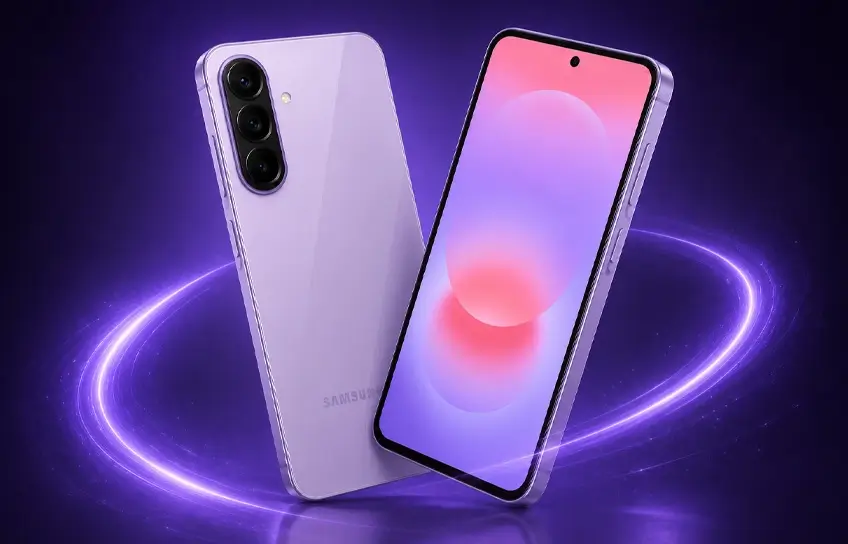
Most phone reviews start by telling you what a phone is. This one starts with what it isn’t. The Samsung Galaxy A37 5G is not trying to compete with flagship phones. It’s not chasing benchmark records. It won’t impress anyone at a spec-sheet comparison. What it does instead is quietly get almost everything right for $449, a price that felt reasonable last year and feels slightly harder to swallow in 2026, given the $50 hike over the A36.
Still, after living with the Galaxy A37 5G as a daily driver, the case for it is stronger than the specs suggest. The display is genuinely excellent. Battery life is class-leading. And six years of guaranteed Android updates on a sub-$500 phone changes the value math in ways most buyers haven’t fully calculated yet.
Design and Build Quality

Pick up the A37 and your first thought will probably be that it feels better than $449. The Gorilla Glass Victus+ on both the front and back is the same glass Samsung uses on phones twice the price, and it shows. After a week of being tossed on desks, pulled in and out of pockets without a case, and set face-down on tables, the review unit picked up zero visible scratches on either panel.
The frame is plastic, not metal. That’s the A57’s job. Samsung isn’t pretending otherwise, and the plastic actually works in the A37’s favor in one specific way: it keeps the weight down to 196g, which is comfortable enough for one-handed use over long stretches. The A57 feels slightly more premium in hand, but the A37 doesn’t feel cheap. That distinction matters.
Four color options are available: Awesome Charcoal, Awesome Lavender, Awesome White, and Awesome Graygreen. The naming is as cheesy as it sounds, but the Lavender and Graygreen colorways are legitimately attractive in person. Charcoal is the safe choice if you plan to use a case.
Samsung Galaxy A37 5G Specifications
| Spec | Galaxy A37 5G |
| Display | 6.7″ FHD+ Super AMOLED, 120Hz, 1,900 nits peak |
| Chipset | Exynos 1480 (4nm), AMD Xclipse 530 GPU |
| RAM | 6GB / 8GB / 12GB (varies by region) |
| Storage | 128GB or 256GB UFS 3.1, no microSD |
| Main Camera | 50MP f/1.8, 1/1.56″ sensor, OIS |
| Battery | 5,000mAh, 45W wired only |
| Water Resistance | IP68 (1.5m for 30 minutes) |
| Software | Android 16, One UI 8.5 |
| OS Support | 6 major upgrades + 6 years security patches |
| Starting Price | $449 (US) |
One design decision worth flagging: the bottom bezel is noticeably thicker than the top, left, and right bezels. It’s a small thing, but once you notice it, you keep noticing it. It won’t affect how you use the phone, though it does undercut the premium appearance Samsung is clearly aiming for.
IP68 is a genuine upgrade over the A36’s IP67 rating. The A37 can handle submersion up to 1.5 meters for 30 minutes. Bath-time scrolling, rainy commutes, kitchen counters near the sink, all covered without anxiety.
Display

The 6.7-inch Super AMOLED panel on the A37 is where Samsung earns its money at this price. Colors are vivid without crossing into cartoonish territory, contrast is strong, and the 120Hz refresh rate makes everything from scrolling through Instagram to navigating menus feel noticeably smoother than 60Hz phones in the same bracket.
Brightness is where the A37 genuinely pulls ahead of rivals. At 1,900 nits peak and 1,200 nits in High Brightness Mode, it holds up better outdoors than most competing panels. Dark mode apps do lose some legibility in direct sunlight, though this is a common AMOLED trade-off and not unique to Samsung. Still, the Vision Booster feature helps by automatically adjusting the display’s output based on ambient light conditions.
When it comes to streaming, the screen is genuinely enjoyable. YouTube, Netflix, and Prime Video all look excellent in HDR. The bezels aren’t symmetrical, but the actual viewing area is large, and the panel quality is high enough that most buyers won’t find anything to complain about.
Finally, there’s one thing that won’t show up in specs: the display glass feels smooth and responsive under the finger in a way that cheaper AMOLED panels don’t. It’s a small tactile detail that nevertheless adds to the overall impression that this phone is better made than its price implies.
Performance

The Exynos 1480 chip inside the A37 is a 4nm processor first introduced in 2024. Samsung has reused it here, which is a legitimate cost-saving measure and worth knowing upfront. In raw benchmark terms, it trails the Snapdragon 7s Gen 4 found in competing phones like the Xiaomi Redmi Note 15 Pro Plus.
Here’s how it stacks up in testing:
| Benchmark | Galaxy A37 5G | Redmi Note 15 Pro Plus | Vivo V70 |
| AnTuTu Score | 1,053,896 | 1,055,895 | 1,437,195 |
| Geekbench Single-Core | 1,150 | 1,261 | 1,314 |
| Geekbench Multi-Core | 3,468 | 3,272 | 3,982 |
| PCMark Battery (hrs) | 11.8 | 14.2 | 15.6 |
Those numbers tell a clear story: the A37 is mid-pack in performance and toward the bottom in battery efficiency compared to rivals with larger cells. What the numbers don’t capture is that for daily tasks, the gap is smaller than it looks. Social media, WhatsApp, YouTube, email, and casual navigation all run without friction. The phone doesn’t stutter on routine tasks.
Where you’ll notice the Exynos 1480’s limits is in gaming. Call of Duty: Mobile at Very High graphics settings averaged 57.7 frames per second in 30-minute sessions, with peak device temperature staying under 34.1°C. That’s playable. BGMI at HDR + Ultra settings averaged 38.7 fps, which some players will find acceptable and others won’t. If competitive mobile gaming is part of your daily routine, the A37 is not your phone. If you play for 20 minutes at lunch, it handles the job.
One practical note: there’s some stutter during initial setup while the phone downloads app updates and runs background optimizations. Give it a day to settle before judging performance. After that initial period, day-to-day use is smooth enough that most buyers won’t think about the chipset again.
The in-screen optical fingerprint reader needs attention during setup. Registering your fingerprint once often produces inconsistent unlock performance. Re-registering a second time, immediately after the first, resolves the issue almost completely. Do it during setup and save yourself the frustration later.
Camera

The Galaxy A37 5G has three cameras on the back. In practice, you’ll use one of them the vast majority of the time.
50MP main camera (f/1.8, OIS, 1/1.56″ sensor)
This is where the A37 earns its camera reputation. The larger sensor compared to the A36 is a real upgrade, not marketing language. In practice, daylight shots produce accurate colors with strong dynamic range and a fast shutter speed that handles movement well, including close-up shots of flowers or kids running around. Samsung’s processing leans saturated and punchy, which means photos look immediately appealing without any editing.
Red and green tones in particular come out vivid and eye-catching. Meanwhile, low-light performance holds up better than you’d expect at this price. Night mode retains dark sky tones naturally rather than washing them out, though darker areas of the frame do show visible grain. Compared to the Pixel 10a, Samsung’s low-light shots are more vibrant but less technically accurate.
The Pixel, on the other hand, produces better white balance and more detail in shadow areas. The A37, by contrast, produces photos that most people will prefer to post immediately without touching. Neither phone is objectively better, they’re simply making different choices.
8MP ultra-wide camera (f/2.2)
This is where the A37 falls short relative to rivals. The ultra-wide lens tends to add cooler, duller tones compared to the main camera, which creates an inconsistent look when you switch between lenses mid-shoot.
On top of that, detail rendering is soft, admittedly typical for 8MP ultra-wides, but still disappointing when competing phones at similar prices offer 12MP ultra-wide sensors. That said, for casual group shots and wide landscapes, it’s usable. However, for anything where ultra-wide quality actually matters, it remains a clear weak point.
5MP macro camera (f/2.4, fixed focus)
Fixed-focus macro lenses are a frustration at any price. You physically move the phone backward and forward to find the focal point, which is fiddly, and the 5MP resolution limits how much detail the shots actually contain. In good lighting with a steady hand, results are decent. In any other conditions, they aren’t. Most buyers will stop using this lens within a week. It exists to fill the spec sheet, and Samsung knows it.
12MP front camera
Better than expected. Super HDR video for selfies is a genuine feature, producing good skin tone accuracy and clean background separation in portrait mode. The front camera is one of the A37’s quiet strengths that rarely gets highlighted in reviews.
Camera comparison: Galaxy A37 5G vs Google Pixel 10a
| Scenario | Galaxy A37 5G | Google Pixel 10a |
| Daylight color | Vibrant, punchy, saturated | Neutral, accurate, natural |
| Low-light detail | Good, some visible grain | Better texture, more shadow detail |
| White balance | Occasionally warm | Consistently accurate |
| Ultra-wide quality | Soft, cooler tones | Noticeably sharper |
| Out-of-camera result | Better for direct sharing | Better for post-processing |
| Selfie video | Strong HDR support | Solid but less HDR-focused |
Software
Samsung has confirmed six major Android OS upgrades for the Galaxy A37 5G, taking it from Android 16 through Android 22 (via SamMobile, March 2026). Security patches are also covered for six years, meaning software support runs through 2032.
At $449 across six years of guaranteed updates, the cost works out to roughly $75 per year. No rival at this price matches it except Google’s Pixel 10a, which commits to seven years. Every Chinese competitor in this bracket, from Xiaomi to Vivo to POCO, offers three to four years of OS updates at most.
Software support comparison:

| Phone | Pre-installed OS | OS Updates | Security Updates |
| Galaxy A37 5G | Android 16 / One UI 8.5 | 6 years | 6 years |
| Google Pixel 10a | Android 16 | 7 years | 7 years |
| Nothing Phone 4a | Android 16 | 3 years | 4 years |
| Redmi Note 15 Pro Plus | Android 16 | 4 years | 6 years |
| Vivo V70 | Android 16 | 4 years | 6 years |
One UI 8.5 itself is worth discussing. It’s visually polished, with a revamped floating bottom navigation bar across first-party apps, a redesigned Clock app with gradient backgrounds, and repositioned search bars in Settings and Calendar that are genuinely easier to reach one-handed. These aren’t dramatic changes, but they show a software team paying attention to daily usability rather than just adding features.
AI features available on the A37:
- Circle to Search with Google (multi-object search from your screen)
- Object Eraser in the Gallery app (borrowed from the Galaxy S-series)
- AI Edit Suggestions for photos
- Voice Transcription for calls and recordings
- AI Select and Read Aloud
- Bixby with natural language understanding and live web search
- Gemini Live (long-press the power button)
- Perplexity AI integration (lighter than on the Galaxy S26 series)
What the A37 doesn’t get: Now Brief, Now Nudge, the enhanced Photo Assist tool, and the full agentic AI capabilities introduced with the Galaxy S26 series. These stay exclusive to Samsung’s flagship lineup. For most buyers, none of those missing features will register in daily use.
Pre-installed bloatware does appear on the second home screen page. Remove it on day one. It takes under five minutes and the experience improves noticeably once it’s gone.
Battery Life

The 5,000mAh battery is not the largest in the segment. The Redmi Note 15 Pro Plus and Vivo V70 both carry 6,500mAh cells, and in PCMark testing they score 14.2 and 15.6 hours respectively against the A37’s 11.8 hours. On paper, the A37 loses that comparison.
In practice, the A37 delivered over a day of battery backup in real-world testing, finishing most days with around 20% charge remaining after five to six hours of screen-on time. That testing covered Instagram scrolling, YouTube and Prime Video streaming, WhatsApp, and camera use, with location, Bluetooth, and mobile data running throughout.
Engadget’s video rundown test produced a more striking result: 29 hours and 10 minutes of continuous local video playback. That’s one hour longer than the Pixel 10a (28 hours) and just one hour shorter than the Galaxy S26 Ultra, a phone that costs nearly three times as much.
45W Super Fast Charging 2.0 brings the battery to 60% in 30 minutes. A full charge takes roughly one hour in testing. No charger ships in the box, which is genuinely annoying at $449 and worth factoring into your budget if you don’t have a USB-C charger already. Wireless charging is not supported, which is one of the more noticeable absences at this price tier.
Galaxy A37 5G vs. The Competition

| Feature | Galaxy A37 5G | Google Pixel 10a | Nothing Phone 4a | Moto G86 5G |
| Price (base) | $449 | $499 | ~$399 | ~$349 |
| Display | 6.7″ AMOLED 120Hz | 6.3″ OLED 120Hz | 6.67″ AMOLED 120Hz | 6.7″ AMOLED 120Hz |
| Chipset | Exynos 1480 (4nm) | Tensor G4 | Snapdragon 7s Gen 3 | Snapdragon 6 Gen 3 |
| Battery / Charging | 5,000mAh / 45W | 4,492mAh / 23W | 5,000mAh / 45W | 5,500mAh / 33W |
| OS Updates | 6 years | 7 years | 3 years | 3 years |
| Water Resistance | IP68 | IP68 | IP54 | IP68 |
| Wireless Charging | No | No | No | No |
| MicroSD Slot | No | No | No | Yes |
| Frame Material | Plastic | Aluminum | Glass + Plastic | Plastic |
The Pixel 10a is the honest benchmark for this price range. It has better camera accuracy, a cleaner UI, stronger AI software, and one additional year of OS updates. On the other hand, it costs $50 more and has a smaller screen and slower charging. So for buyers who edit photos, prefer neutral camera processing, or want the best AI-powered software in the mid-range bracket, the Pixel 10a is still the smarter buy.
The A37 closes the gap more than most reviewers acknowledge, particularly on display size, battery life, and charging speed. The Nothing Phone 4a is cheaper and undeniably more visually interesting. However, IP54 is meaningfully weaker than IP68, and three years of updates against six years is not a minor difference, especially for a phone you might keep for four or five years.
For buyers coming from the Samsung Galaxy S25 ecosystem or planning a long-term Samsung upgrade path, the A37 fits cleanly into One UI continuity. Its AI features and cross-device behaviors work best when paired with other Samsung products, and that ecosystem coherence is worth something that doesn’t show up in spec tables.
Who Should Buy the Galaxy A37 5G
Buy it if you:
- Want a phone supported through 2032 without paying flagship prices
- Stream a lot of content and want the best display quality under $500
- Need real IP68 water resistance, not IP54 splash protection
- Are upgrading from a Galaxy A34, A35, or A36 and want to stay in One UI
- Prefer photos that look great immediately without editing
- Don’t rely on wireless charging
Skip it if you:
- Play graphics-intensive games daily and need the best possible frame rates
- Shoot in RAW and process every photo in Lightroom or Lightroom alternatives
- Need a microSD card slot for local storage expansion
- Rely on wireless charging pads at home, in the car, or at a desk
- Are considering moving up to the Samsung Galaxy S25 Ultra, the full Galaxy AI suite and camera system are in a different category entirely
- Want the absolute best mid-range chip performance and are willing to look at alternatives like the POCO X8 Pro Max
Final Verdict
The Samsung Galaxy A37 5G is a phone that makes more sense the longer you think about it. The display is excellent. Furthermore, the battery outlasts almost everything at the price. Six years of software support on a $449 phone is a commitment that changes the real cost of ownership, and buyers should factor this in before defaulting to a cheaper alternative that gets dropped in three years.
The weaknesses are real and worth naming: the Exynos 1480 trails competing chips in benchmarks, the ultra-wide camera is average, the macro lens is filler, and the $50 price hike over the A36 stings given the modest upgrades. No wireless charging and no microSD slot are ongoing frustrations.
Yet none of those weaknesses are dealbreakers for the buyer this phone is genuinely built for: someone who wants a reliable, well-supported daily driver with a great screen and strong battery life, who isn’t chasing specs and doesn’t need the fastest phone in the room. For that buyer, the Galaxy A37 5G is a low-regret decision. For spec hunters and camera enthusiasts, however, it isn’t.
