


If you have ever finished mopping your floors only to feel like you barely made a dent, you are not alone. Traditional mops push dirty water around more than they actually clean, and even many modern floor cleaners fall short when it comes to tough, dried-on messes.
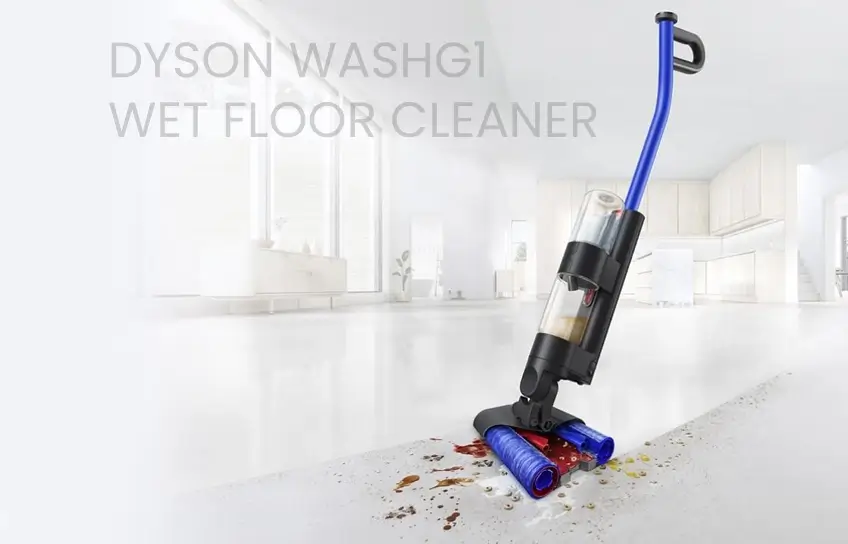
That is exactly why so many homeowners have been researching the dyson washg1, a cordless wet floor cleaner that replaces suction-based cleaning with a dual counter-rotating microfiber roller system designed to scrub, absorb, and separate solid debris from liquid waste simultaneously across sealed hard floor surfaces.
We tested this machine across multiple floor types, cleaning modes, and real-world mess scenarios to give you a performance-based verdict grounded in actual use.
Dyson WashG1 Quick Specifications
| Feature | Details |
| Type | Cordless wet floor cleaner |
| Weight | 10.8 lbs (empty) |
| Run Time | Up to 35 minutes |
| Floor Coverage | Up to 3,100 sq ft per charge |
| Clean Water Tank | 0.26 gallons |
| Dirty Water Tank | 0.21 gallons |
| Cleaning Modes | 3 levels + MAX setting |
| Self-Cleaning | Yes (140-second cycle on dock) |
| Floor Compatibility | Tile, vinyl, laminate, sealed hardwood |
| Warranty | 2 years (parts and labor) |
| Price | $699.99 |
What Makes This Cleaner Different

Unlike most wet floor cleaners that pair a single brush roll with an airflow-based suction motor, the Dyson WashG1 Wet Floor Cleaner uses two counter-rotating microfiber rollers fed by 26 pulse-modulated hydration outlets. The rollers scrub and absorb simultaneously while an internal nylon-bristle brush strips debris into a slide-out tray.
Dirty water is then pumped into a sealed tank, keeping clean and contaminated water fully separated throughout the cleaning cycle.
How It Performs on Real Messes

Sticky and Dried-On Stains
This is where the Dyson WashG1 Wet Floor Cleaner genuinely earns its price tag. Dried grape jelly, old cola spills, and weeks-old floor stains that had hardened onto the surface were removed within a few passes. The counter-rotating roller mechanism applies consistent downward pressure and bidirectional friction across the full width of the cleaning head, which breaks down dried residue more effectively than a single-direction brush roll or a passive microfiber mop pad.
On ceramic and porcelain tile, the cleaning performance was particularly strong. The rollers penetrate slightly into recessed grout lines, lifting surface-level soiling that a flat mop pad simply cannot reach. Deep-set grout staining from mineral deposits or long-term neglect will still require a dedicated grout cleaner, but for routine maintenance and moderate buildup, the WashG1 outperforms traditional wet mopping methods significantly.
Handling Larger Debris
One thing that genuinely surprised us is how the machine handles larger debris like leaves, pet hair, and food crumbs. While the Dyson WashG1 Wet Floor Cleaner is not a vacuum cleaner in the traditional sense, its brush system sweeps larger pieces into a slide-out debris tray rather than leaving them behind or tangling them in the rollers.
This means you do not always need to pre-sweep before you mop, which saves a real chunk of time during your cleaning routine.Very large or bulky debris may need a quick pre-clean with a separate vacuum. Dry cereal, for example, can challenge the rollers and occasionally get crushed rather than collected cleanly.
Floor Type Compatibility
The Dyson WashG1 Wet Floor Cleaner is compatible with ceramic tile, porcelain tile, vinyl plank, laminate, and sealed hardwood flooring. The moisture output across each cleaning mode is calibrated to avoid oversaturation, which makes it safer on water-sensitive surfaces like sealed wood when used on the lower hydration settings.
The cleaning head articulates to nearly 180 degrees, allowing it to navigate under low-clearance furniture without requiring you to move pieces out of the way. It is not rated for use on unsealed wood, natural stone without sealant, or any carpeted surface.
Design and Everyday Usability

Lightweight and Easy to Handle
At 10.8 pounds, the Dyson WashG1 Wet Floor Cleaner is marginally lighter than the Tineco Floor One S7 Pro at 11.5 pounds, but the more significant advantage is its narrower body profile. The slimmer chassis reduces the overall footprint during storage and makes single-hand maneuvering noticeably easier in tighter spaces like hallways and bathrooms. The loop-style handle distributes grip pressure evenly across the palm, which reduces hand fatigue during longer cleaning sessions.
The onboard LCD display shows real-time battery percentage, active cleaning mode, and water tank status in a single glance. Three hydration modes control the volume of water dispensed per cycle, ranging from a low-moisture setting suited for laminate and sealed wood to a high-output mode for tackling heavily soiled tile or grout. Switching between modes requires a single button press mid-clean, which means you can adjust output on the fly without stopping the machine.
Battery Life and Coverage

On the lowest hydration mode, the lithium-ion battery delivers up to 35 minutes of continuous runtime, with a maximum cleaning coverage of approximately 3,100 square feet per charge. Switching to the MAX power mode reduces runtime to roughly 15 to 20 minutes due to higher motor load and increased water pump activity.
A full recharge from empty takes approximately two hours. The battery module is fully removable from the main unit, which means you can charge it independently and store the cleaner in a cupboard rather than keeping the full machine docked and visible in your space.
Where It Falls Short

The Debris Tray Can Get Messy
The 500-micron mesh filter inside the debris tray separates solids from liquid during the cleaning cycle, but because the rollers stay wet throughout, collected debris becomes saturated quickly. Emptying the tray without spilling requires a steady hand, and any tilt of the cleaning head while the tray holds liquid will almost always result in a spill. It is a recurring maintenance issue you will face after every session involving solid debris.
Small Water Tanks
The clean water tank has a capacity of 0.26 gallons, and the dirty water tank holds 0.21 gallons. For a machine priced at $699, these are restrictive capacities. In practical terms, cleaning a standard one-bedroom apartment will require at least one full tank refill mid-session. Both tanks are housed in a single removable panel secured by a quick-release lever, which reduces the time spent swapping them.
However, the interruption to cleaning flow is still noticeable in larger spaces, and the stacked tank design can be awkward to grip and handle for users with smaller hands.
Streaking on Wet Spills
Streaking occurs on roughly half of fresh liquid spill cleanups, and the cause appears to be structural. A narrow plastic trim strip runs along the outer edge of the cleaning head on one side. When this strip contacts a liquid spill, it drags the fluid laterally rather than absorbing it, leaving a visible smear across the floor surface.
This does not affect performance on dry debris or dried-on stains, but for fresh spills it reduces first-pass efficiency. Switching to a higher hydration mode and making a second perpendicular pass typically resolves the streak, but it is an extra step that should not be necessary at this price point.
Pros and Cons
Pros
- Cleans wet and dry messes in a single pass
- Counter-rotating rollers remove tough, dried-on stains effectively
- Cordless and lightweight at just 10.8 lbsIntuitive controls with a clear LCD display
- Works on tile, vinyl, laminate, and sealed hardwood
- Self-cleaning cycle completes in just 140 seconds
- Removable battery for flexible charging
- No pre-sweeping required before mopping
Cons
- No traditional suction, so it cannot replace a full vacuum
- Small water tanks require refilling during larger cleans
- Debris tray gets soggy and can be messy to empty
- Occasional streaking on fresh liquid spills
- Expensive compared to rivals with more features
- No self-drying function, which can cause odor over time
- Who Should Buy This and Who Should Skip It
Who Should Buy This and Who Should Skip It
A cordless wet floor cleaner built for hard floors, but not for everyone. Here is a quick breakdown to help you decide.
Buy If
The Dyson WashG1 Wet Floor Cleaner is built for homes with primarily hard floor surfaces where a separate dry vacuum is already part of the cleaning routine. It suits pet owners, households with young children, and anyone frustrated by traditional mops leaving tacky residue behind. Its no-cord design, dried-stain performance, and Dyson ecosystem compatibility make it a reliable daily driver for hard floor maintenance.
Skip It If
Not the right fit if you need one machine to vacuum and mop across both hard floors and carpets. Skip it if your home exceeds 1,500 square feet and mid-session tank refills will disrupt your routine. Those with larger spaces may also find the lack of smart features like auto floor-detection or self-drying rollers a dealbreaker, Tineco and Dreame offer those at a comparable or lower price.
Is It Worth the Price?
The Dyson WashG1 Wet Floor Cleaner retails at around $699 to $750 depending on the retailer, placing it firmly in the premium tier of the cordless wet floor cleaner category alongside the Tineco Floor One S7 Pro and the Dreame H14 Pro, both of which include auto floor-detection sensors and self-drying roller technology.
Where the Dyson leads is in mechanical cleaning performance, build quality, and solid-liquid separation reliability. Where it trails is in sensor intelligence and post-clean maintenance ease. If deep cleaning hard floors with minimal setup is your primary need and you already own a dry vacuum, the WashG1 justifies its price. If you want automated adjustments and all-in-one functionality, a competitor at the same or lower price will serve you better.
Final Thoughts
The Dyson WashG1 Wet Floor Cleaner delivers genuine cleaning performance where it counts most. Its dual counter-rotating roller system, pulse-modulated hydration, and solid-liquid separation mechanism make it one of the more technically advanced wet floor cleaners available at this price range. The debris tray maintenance is messy, the water tanks are small for larger homes, and the absence of a self-drying function is a real gap compared to some competitors.
What it does offer is a machine that is fast to set up, easy to operate, and consistently effective on the kind of stubborn hard floor stains that defeat most standard mops. For homeowners with primarily hard floor surfaces who want a reliable, low-effort cleaning tool backed by a two-year warranty, the WashG1 is a well-engineered choice worth the investment.
