


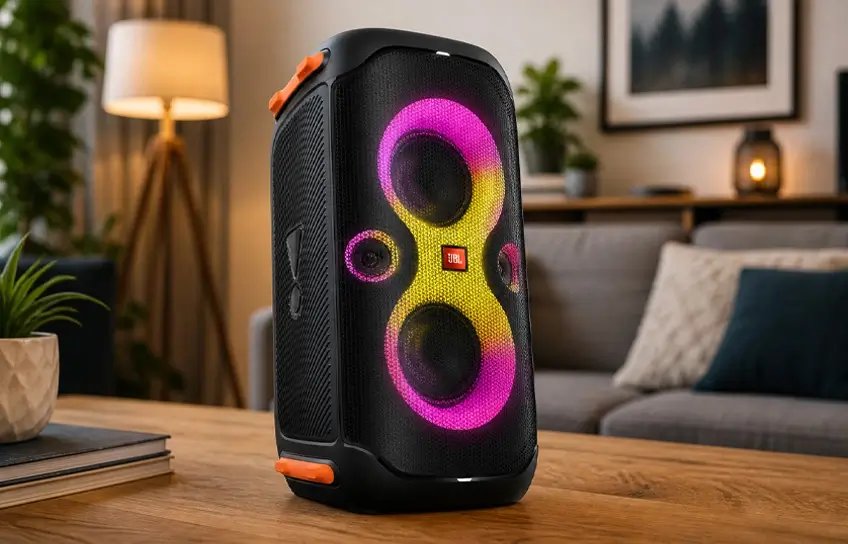
Finding a party speaker that actually delivers on its promises is harder than it sounds. The market is flooded with options that look great in product photos but fall apart the moment you push them past half volume. That is why the jbl partybox 110 stands out as something genuinely worth talking about.
It sits right in that sweet spot between portable convenience and serious sound output, making it one of the more interesting options available for anyone who wants a speaker that can carry a backyard gathering, a beach day, or even a small indoor event without breaking a sweat. This review takes an honest, detailed look at what this speaker offers, where it shines, and whether the price tag makes sense for the average buyer.
Quick Technical Breakdown
Before diving deeper into what this speaker can do in real life, here is a clean breakdown of the jbl partybox 110 specifications so you know exactly what you are working with. And if you want a quick side-by-side comparison with older models, the jbl partybox 110 specs table below covers everything from power output to Bluetooth range.
| Specification | Detail |
| Driver Type | Dynamic |
| Frequency Response | 45 Hz – 20,000 Hz |
| Maximum Power Output | 160W RMS |
| Transducers | 2 x 5.25″ Woofer + 2 x 2.25″ Tweeter |
| Bluetooth Version | 5.1 |
| Supported Codecs | A2DP, AVRCP |
| TWS Support | Yes |
| Bluetooth Range | Up to 10 meters (approx. 33 ft) |
| Battery Type | Lithium-Ion Polymer |
| Battery Life | Up to 12 hours |
| Charging Time | Approx. 3.5 hours |
| Waterproof Rating | IPX4 Splash-Proof |
| Weight | 10.84 kg (approx. 23 lbs) |
| Dimensions | 295 x 568 x 300 mm |
| Inputs | 3.5mm Aux, USB, 2 x 1/4″ Mic/Guitar |
| Mounting | Vertical, Horizontal, PA Pole Mount |
| App Support | JBL PartyBox App (iOS & Android) |
Build Quality and Design

The first thing you notice about this speaker is that it does not look cheap. It has a sturdy, well-built enclosure that feels like it was made to survive real use, not just sit on a shelf. If you are curious about the JBL partybox 110 weight, it comes in at around 23 pounds (10.84 kg), which is on the heavier side for a portable speaker, but two built-in handles make it easy enough to move around. You can stand it vertically, lay it on its side using the rubber feet, or even mount it on a standard PA speaker stand, which gives you a lot of flexibility depending on where you are setting up.
One of the more practical upgrades over its predecessor is the IPX4 water resistance rating. That means the speaker can handle splashes from any direction, making it a safe choice for pool parties or outdoor events where the weather might not fully cooperate. It is not designed to be submerged, so common sense still applies, but the added protection is a real quality-of-life improvement that many competing speakers in this price range skip entirely.
A Light Show That Earns Its Place
The RGB lighting system on this speaker is genuinely impressive for the price. Instead of the simple circular lights found on older models, this one features a fuller figure-8 light pattern around the woofers, smaller accent lights near the tweeters, and two strobe lights at either end of the speaker.
All of these sync to the beat of whatever you are playing, and you can choose from five different light motion patterns through the controls on top or through the companion app. If strobes are not your thing, you can turn them off individually through the app, which is a thoughtful touch. Whether you call it a fiesta speaker or, as Spanish-speaking users often refer to it, an altavoz jbl partybox 110, the visual experience it delivers is consistent and crowd-pleasing across any setting.
Sound Performance

All the lights and design features in the world mean nothing if a speaker sounds mediocre. Fortunately, this is not a concern here. When people look up the jbl partybox 110 watts rating, the answer is 160W RMS, which represents the kind of sustained power output that can fill a large backyard or a mid-sized indoor space with clean, full sound. It houses two 5.25-inch woofers and two 2.25-inch tweeters, covering a frequency response of 45 Hz to 20 kHz.
That range means you get a solid low end along with clear, crisp highs without the harshness that some consumer-grade speakers tend to add. The bass performance is particularly noteworthy. Out of the box, the speaker already leans slightly warm in the low end, which works well for hip-hop, EDM, and electronic music. For those who want even more punch, a two-level bass boost function lets you dial up the low end incrementally.
The lower setting is subtle and works beautifully across almost every music genre, while the higher setting is better suited for bass-heavy tracks where you genuinely want to feel the music as much as hear it. Outdoor use does cause the perceived bass to thin out a little, so having that boost option available is practically useful rather than just a gimmick.
Microphone and Guitar Input
On the back panel, there are two quarter-inch inputs, one for a microphone and one for a guitar, each with their own volume knobs. The microphone input includes a built-in reverb effect that adds a natural fullness to vocals without sounding overly processed.
If you are hosting a karaoke night or want someone to MC a backyard event, the setup is plug-and-play simple. The guitar input works cleanly too, making this speaker a capable option for small acoustic performances or casual jam sessions where a full PA system would be overkill.
Battery Life and Connectivity Options

The jbl partybox 110 battery life is one of its more compelling selling points. JBL advertises up to 12 hours of playback on a full charge, and real-world use confirms that figure is fairly accurate under moderate conditions. Running Bluetooth playback at varied volume levels with the light show active throughout, most users can expect around 10 to 12 hours before needing a recharge. At maximum volume, that number drops considerably, so planning around power access for marathon events is still a good idea.
When it comes to recharging, the included cable is a standard figure-8 AC power cord. If you ever misplace the original, a replacement jbl partybox 110 charger is easy to find since it uses a widely available connector type. Charging takes approximately 3.5 hours from empty to full, which is nearly twice as fast as the older PartyBox 100 model. Connectivity beyond Bluetooth is flexible and straightforward as well. There is a 3.5mm aux input for a wired connection, and a USB port that supports playback of MP3, WMA, and WAV files directly from a flash drive.
Pairing Two Speakers for True Stereo Sound
The True Wireless Stereo (TWS) mode lets you pair two speakers wirelessly. One handles the left channel, the other the right, creating a genuine stereo experience rather than duplicated mono output.
The light shows on both units stay synchronized, and adjusting the volume or bass boost on one unit affects both automatically. This makes the two-speaker setup a genuinely powerful option for larger spaces, and at two units under $800 combined, it becomes an interesting alternative to spending more on a single high-powered speaker.
The JBL PartyBox App

The free companion app for iOS and Android unlocks features that are not accessible from the speaker’s hardware controls. Through the app, you can fine-tune the light show by toggling individual lighting elements on or off, change the RGB color to a single static shade, or trigger freestyle lighting effects in real time.
A DJ Effects screen offers sounds like vinyl scratching, applause, and an airhorn, which are surprisingly fun additions for a casual house party. The app also handles firmware updates and shows the battery level as a precise percentage rather than a rough bar indicator, which is a small but genuinely useful improvement.
Pros
- 160W RMS output for large indoor and outdoor spaces
- Up to 12 hours battery life
- Built-in mic and guitar inputs for use as a portable PA
- TWS stereo pairing for left-right channel separation
- Bluetooth 5.1 up to 33 feet
Cons
- Heavy at 23 lbs
- Bass thins in open-air without boost
- Max volume cuts battery to 3–4 hours
- No EQ beyond two-level bass boost
Is It Worth the Price?
The JBL PartyBox 110 typically sits just under $400, and the value is strong. Compared to the JBL PartyBox 310, it costs notably less while offering a more dynamic light show, even if the 310 edges it out in raw power at 240 watts.
Against non-JBL alternatives in the same price range, the build quality, sound clarity, water resistance, and feature set here are genuinely difficult to match. For someone who wants a speaker that can handle a variety of settings, from a birthday party in the backyard to a small indoor gathering, the value proposition is solid.
It is worth being clear about what this speaker is not. It is not a replacement for a proper PA system at larger events, and its bass, while punchy and satisfying, does not reach the floor-shaking depths of larger units with 12-inch subwoofers. For most buyers who need a reliable, great-sounding, feature-rich portable speaker for everyday party and social use, though, those limitations rarely come up in practice.
Final Thoughts
This is a speaker that delivers where it counts. The sound is clear, balanced, and powerful enough for most real-world party situations. The build is solid, the battery life is generous, and the feature set, from the light show to the mic input to the TWS pairing, covers a wide range of use cases without overcomplicating anything.
If you are shopping for a party speaker under $400 and want something that will hold up over time and actually impress your guests, this is a genuinely strong choice that is hard to argue with.
