


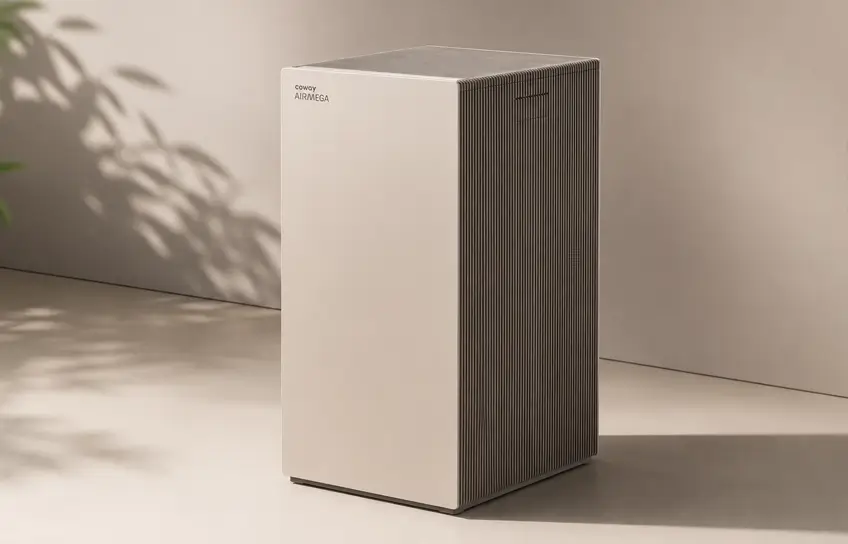
I’ll be honest with you. When the Coway Airmega ProX arrived at my door in a box roughly the size of a mini-fridge, my first thought was that I’d made a mistake ordering it. It looked enormous sitting in my hallway. My second thought, after running it for a few days in my open-plan living and dining area, was that I wished I’d bought it sooner.
I’ve been testing air purifiers for a while now, and the ProX is genuinely different from everything else I’ve used at this size. Not because of any single feature, but because of how well it handles a real, large, messy living space where the air quality changes constantly throughout the day.
This isn’t a spec-sheet rundown. I tested this thing through cooking smoke, a week of wildfire haze coming in through window gaps, pet dander from two dogs, and some dusty renovation work happening in an adjacent room. I want to tell you what actually happened and save you from making the wrong call when you spend close to a thousand dollars.
If you’re researching the best home air purifiers for a large space, read this first before you decide.
Coway Airmega ProX Specs
| Specification | Details |
| CADR (Dust) | 580 CFM |
| CADR (Smoke) | 568 CFM |
| CADR (Pollen) | 450 CFM |
| Coverage at 1 air change/hr | 4,253 sq ft |
| Coverage at 2 air changes/hr | 2,126 sq ft |
| Coverage at 4 air changes/hr | 1,063 sq ft |
| Particle Sensors | PM1, PM2.5, PM10 |
| Fan Speeds | 3 settings (Silent, Eco, Auto, Turbo modes) |
| Airflow Measured at 36 inches | 5.6 mph / 8.1 mph / 13.7 mph |
| Power Draw Per Setting | 12.2W / 27.0W / 62.4W |
| Noise Level Per Setting | 40.1 dB(A) / 43.3 dB(A) / 50.4 dB(A) |
| Filtration Stages | 3: Pre-filter, Activated Carbon, Dual HEPA |
| HEPA Particle Capture | 99.999% at 0.01 microns |
| Filter Lifespan | 12 months |
| Filter Replacement Cost | $199 per set / $179 per set buying two |
| Annual Energy Cost | $17.10 at lowest setting, $0.16 per kWh |
| Dimensions (W x H x D) | 18.9 x 36.6 x 24.3 inches |
| Weight | 52.9 lbs with lockable wheels |
| Available Colors | White, Mocha Beige |
| App or Smart Home | None |
| Warranty | 5 years (motor/electronics), 1 year (everything else) |
| List Price | $999 (typically $648 to $849 on Amazon) |
Design and Build

When I slid the ProX out of the box, the first thing I noticed was the size. It stands 36.6 inches tall and stretches 24 inches deep. Put it next to most air purifiers and it looks like a different category of appliance entirely.
But here’s the thing. The rectangular shape is actually more practical than the tower designs I’ve used before. It tucks into a corner cleanly without protruding into the room the way cylindrical units do. In my living space I pushed it into the corner between the kitchen island and the far wall, and it stopped being something I thought about within a day.
Coway makes it in white and mocha beige. I have the white version. It’s not trying to be a design statement and it doesn’t need to be. It just sits there and runs.
Moving 52.9 lbs sounds like a problem. It isn’t, on flat floors. The base has four lockable wheels and a hidden handle that pulls out from the side panel. Rolling it from my living area to the bedroom for testing took maybe 20 seconds. Stairs are a different situation. I moved it between floors once and needed help. On a single floor though, it goes wherever you need it without any real effort.
One thing I noticed pretty quickly: the side filter cover panels can pop loose when you grab the handles to lift the machine instead of rolling it. It doesn’t affect performance at all, but it’s a slightly cheap feeling moment on a $999 machine. Not a dealbreaker, just something to be aware of.
The power cord detaches from the unit, which makes storage easier than you’d expect. Small detail, but I’ve appreciated it a few times already.
The Control Panel

The control panel sits on top of the machine and it’s genuinely one of the better ones I’ve used. Everything you need to know is visible at a glance: current air quality, which mode the machine is in, and whether the filters need attention.
The air quality indicator is a colored LED dot. Blue means the air is clean. Light green is moderate. Yellow means things have gotten noticeably worse. Red means the air quality is bad enough that Coway recommends leaving the room. I’ve seen mine sit on blue almost constantly during normal days, jump to yellow immediately when I start cooking something strong, then drop back to blue within a few minutes as the machine catches up.
That dot is more useful in daily life than any app dashboard I’ve used. You walk past, glance over, and know exactly what’s happening in the room without opening anything.
The one limitation I’d flag is the fan speed situation. The ProX has three fan speeds. That’s it. Some competing units give you five or more, which lets you dial in a more precise balance between airflow and noise. Three settings is adequate, but if you’re particular about noise levels there’s less flexibility here than you might want.
No App, No Alexa, No Smart Home Anything

I want to address this clearly and honestly because it’s the thing that trips people up most when they’re deciding whether to buy.
The Coway Airmega ProX has no smartphone app. It does not work with Amazon Alexa, Google Assistant, or Apple HomeKit. You cannot check your air quality from another room, set a schedule, or adjust any setting without physically walking up to the machine and pressing a button.
In 2025, at this price point, that is a real gap. I won’t pretend otherwise.
The practical workaround I’ve been using: I plugged the ProX into a Kasa Mini smart plug. Because the machine always starts up in Auto mode when it receives power, I can use the smart plug app to turn it on and off remotely. I can’t change the mode or speed that way, but I can at least control when it runs from the couch or from another floor. It’s not a proper solution, but it fills the most basic scheduling gap.
If app control is something you rely on day to day, this machine will frustrate you. If you can live with walking over to it when you want to change anything, you’ll stop noticing the absence within a week.
How the Three-Stage Filtration Actually Works

Most reviews mention “three-stage filtration” and move on. I want to explain what each stage actually does because it changes how you think about the filter replacement cost.
Stage 1: The Pre-Filter
This is the outer layer that pulls out the large visible stuff first. Pet hair, dust clumps, fabric fibers, anything big enough to catch in a mesh. By capturing these before they reach the finer filters, the pre-filter extends the life of the more expensive components behind it. It’s washable and reusable, which is one of the few ways the ProX keeps its running costs from going even higher. I rinse mine every two or three weeks and hang it to dry.
Stage 2: Activated Carbon Layer
The carbon layer handles what your nose picks up but your eyes can’t see. Cooking odors, VOCs off-gassing from furniture and paint, cleaning product fumes, smoke smells. This is the stage that makes a room smell different after you run the machine. I noticed the difference clearly the first time I made a strong fish dinner with the ProX running. The smell cleared faster than it ever had with my previous purifier.
Stage 3: Dual True HEPA Filters
This is the core of the machine’s performance. Two full HEPA filters running simultaneously, each capturing particles down to 0.01 microns at 99.999% efficiency. For scale, a single pollen grain measures between 10 and 70 microns across. The ProX is catching particles hundreds of times smaller than pollen, including mold spores, bacteria, and the ultrafine smoke particles from wildfires that cause the most respiratory damage.
Using two filters instead of one isn’t marketing. Each filter handles part of the total air volume so neither one gets overloaded during high-demand periods. The cartridge design also includes a micro seal that forces air through the filter material rather than around the edges. That seal is more important than it sounds. Even a small gap lets unfiltered air bypass the media entirely, and a lot of cheaper purifiers have exactly this problem.
The Filter Cost Problem You Need to Know Before Buying
Here’s the thing nobody covers in enough depth: the Max2 filter is a bonded design. The HEPA layer and the activated carbon layer are fused together into a single unit. You cannot replace them separately.
Activated carbon depletes faster than HEPA media under normal home conditions, especially in kitchens or homes with pets. When the carbon layer stops absorbing odors effectively, you replace the entire Max2 filter including the HEPA component that likely still has months of useful life left in it.
That’s why the replacement cost is $199 per set. You’re not just replacing what’s worn out. You’re replacing everything regardless.
Competing purifiers with separate modular filters let you swap only the carbon when the odor absorption drops off, and change the HEPA on its own schedule. That flexibility can cut annual filter spending noticeably. The ProX doesn’t give you that option.
Budget $199 per year before you commit to this machine. It’s not optional and it comes around on schedule.
What Three Particle Sensors Actually Change
Most air purifiers ship with one sensor. Some have two. The ProX has three: PM1, PM2.5, and PM10. This matters more than it sounds like a spec-list item.
PM10 detects the larger particles, dust, pollen, pet dander, the stuff you can sometimes see floating in a beam of sunlight. PM2.5 catches the finer particles like smoke and combustion byproducts that travel deep into the lungs and drive most of the serious respiratory health concerns. PM1 picks up the ultrafine particles that a single-sensor machine misses entirely.
When the machine is running in Auto mode, it isn’t just detecting that something in the air has changed. It knows which particle size range has spiked and responds with the appropriate fan speed for that specific situation. A PM10 spike from vacuuming gets a different response than a PM2.5 spike from wildfire smoke drifting in under the door.
The result in practice is that the machine is faster and more accurate than anything I’ve used with a single sensor. During the renovation dust situation I mentioned earlier, the panel showed the particulate reading climb to 66 micrograms per cubic meter, the yellow light came on, the fan ramped up audibly and worked hard for a few minutes, then brought the reading back down to 2 micrograms per cubic meter before settling into Eco mode on its own. I didn’t touch anything.
Performance Testing

I want to give you the real picture here rather than summarizing the spec sheet again.
Renovation Dust Test
The renovation dust test was the most dramatic thing I put it through. Work was happening in a room one door away, sending plaster dust and paint particulates into the air throughout the day.
The ProX in Auto mode caught the spike every time the door opened, ran hard for several minutes, and cleared the reading back to clean before I noticed any irritation. I have mild dust allergies and I did not have a single reaction during the three days that work was happening.
Cooking Smoke Test
The cooking smoke test was more of a daily observation. I cook a lot and I cook things that smell strong. With my previous purifier, cooking odors would linger in the open-plan space for an hour or more.
With the ProX running, the air quality indicator returns to blue within about 8 to 10 minutes after finishing cooking, even after something like searing fish or frying spiced meat. The carbon stage is doing real work there.
Wildfire Haze Wee
The wildfire haze week was where the CADR numbers became tangible. We had about a week of poor outdoor air quality from fires a few hundred miles away. Running the ProX on Turbo for 20 minutes when the haze was visibly bad, then dropping it back to Auto, kept the indoor reading consistently clean. Without it running, I could smell the smoke inside with windows closed. With it running, nothing.
Noise and Power Consumption
Noise at each setting is something I measured myself. In my living space with ambient noise around 37 dB(A), the ProX came in at roughly 40 dB(A) on low, 43 dB(A) on medium, and 50 dB(A) on high. On high it’s audible but not disruptive. I’ve had much smaller purifiers that were louder at their top speed.
Power consumption matters for a machine running all day. At the lowest continuous setting the annual electricity bill is about $17. Running it harder more often will push that up, but even running Auto mode most of the day I’m well under $30 per year in electricity. For something moving this much air, that’s a low operating cost.
The Four Modes and When to Use Each One

Auto Mode is the one to leave it on. The three sensors read the room continuously and the fan speed responds in real time. You don’t think about it. It handles everything.
Eco Mode is what the machine drops into on its own when the air quality readings stay clean for an extended period. Fan speed and power draw both come down. This is what you’ll see it doing most of the time if your space is reasonably clean.
Silent Mode runs the fan at minimum speed regardless of what the sensors are reading. I use this at night in the bedroom. It’s the setting that produces just enough airflow to feel like the machine is doing something while making essentially no noise you’d notice over normal sleep sounds.
Turbo Mode is full power. I use it for about 20 minutes after cooking something strong, or when I first get home after the house has been closed up all day. It’s not meant to run continuously, but as a burst mode it’s the fastest way to get a large space cleared quickly.
Pros and Cons
Pros:
- Covers 4,253 sq ft, the highest I’ve tested at this price
- Dual HEPA, no ionizer, no ozone
- Triple-sensor Auto mode reacts faster and more precisely
- Quieter than expected at full speed: 50.4 dB(A) measured
- Five-year warranty on motor and electronics
Cons:
- No app, no Alexa, no Google Home, no HomeKit
- $199/year filters, no way to replace layers separately
- Too large for any space under 1,000 sq ft
How the Running Costs Add Up Over Three Years
The list price is $999 but that’s rarely what people actually pay. It regularly sells between $648 and $849 on Amazon. That matters for the math below.
| Purifier | Street Price | Annual Filters | Annual Energy | 3-Year Total |
| Coway Airmega ProX | ~$749 | $199 | ~$17 | ~$1,344 |
| Alen BreatheSmart 75i | ~$749 | ~$99 | ~$20 | ~$1,106 |
| IQAir HealthPro Plus | ~$899 | ~$370 | ~$15 | ~$2,009 |
| Levoit EverestAir | ~$349 | ~$80 | ~$15 | ~$589 |
The ProX is more expensive to run long term than the Alen 75i and significantly cheaper than the IQAir HealthPro Plus. But the Alen covers less area. The Levoit covers far less. If your space is large enough to actually need the ProX’s output, the comparison that matters isn’t the cheapest option. It’s the cost per square foot of effective coverage.
Running two Levoit EverestAir units to match the ProX’s coverage area in a large open space pushes total cost much closer to parity while adding another machine to manage.
ProX vs. Its Closest Competitors
If you’re deciding between the ProX and something else, here’s the honest comparison for the machines most people are actually cross-shopping.
| Feature | Coway ProX | Alen BreatheSmart 75i | IQAir HealthPro Plus |
| CADR (Dust) | 580 CFM | ~400 CFM | Not rated (HyperHEPA |
| Coverage at 2 air changes/hr | 2,126 sq ft | ~1,300 sq ft | ~1,125 sq ft |
| App or Wi-Fi | No | No | No |
| Voice Control | No | No | No |
| Noise at Full Speed | 50.4 dB(A) | ~52 dB(A) | ~48 dB(A) |
| Annual Filter Cost | $199 | ~$99 | ~$370 |
| Warranty (Motor) | 5 years | Lifetime | 2 years |
| Best Fit | Large open spaces | Mid-large rooms | Medical-grade filtration |
The Levoit Core 600S-P is worth considering if smart home integration matters to you and your space is under 1,000 sq ft. It does everything through an app and handles a single large room well. It just can’t cover what the ProX covers.
If you’re comparing options for a bedroom or smaller personal space, something like the Dyson Hot+Cool HF1 handles purification alongside heating and cooling in a compact footprint. Different use case entirely, but worth knowing about.
Filter Changes
I put this off in my head longer than I needed to. The actual process takes about five minutes and needs no tools.
Remove the outer pre-filter first, then grab the fabric pull tabs on each HEPA cartridge and slide them straight out. The new filters drop into the same slots and click into place. The panel indicator tells you when the time has come so there’s no guessing involved.
The only thing worth noting: buying two sets at once drops the per-set price from $199 to $179. If you know you’re going to be running this machine long term, buying ahead is the straightforward way to reduce the cost slightly.
Warranty Coverage
The ProX carries a five-year warranty on the motor and electronics. Those are the components that actually fail on air purifiers if something goes wrong early. Everything else, the housing and mechanical parts, is covered for one year.
A five-year motor warranty at this price point is a meaningful commitment and better than most competing units offer. It’s a decent signal that Coway expects this machine to run reliably for the long haul.
Who This Machine Is Actually Built For
The ProX was originally designed for commercial spaces. Coway built it with offices, medical waiting rooms, yoga studios, and busy retail floors in mind. But most people buying it are doing so for large homes, open-plan apartments, and finished basements where a standard room purifier simply runs out of horsepower.
I used it in my main living space, roughly 1,400 square feet of open kitchen, dining, and living area with high ceilings. That’s the environment I tested it in, and that’s the environment where it makes the most sense.
It’s a good fit for you if:
- Your living space is over 1,200 sq ft and a mid-range purifier hasn’t made a noticeable difference
- You have pets, cook frequently, or deal with wildfire smoke and need a machine that reacts fast and keeps up
- You or someone in your home has allergies or asthma and needs serious, consistent particle removal
- You’re running a small business or commercial space and want something built for high foot traffic
Skip it if:
- Your space is under 800 sq ft. You’d be paying for coverage you’ll never use, and a quieter smaller unit will do the job better in that context
- You want app control, scheduling, or smart home integration. The ProX has none of that and there’s no workaround beyond plugging it into a smart outlet
- You want to minimize ongoing costs. The filter bill is real and it comes around every year without exception
Conclusion
After six weeks of daily use across real cooking, renovation dust, wildfire haze, and two dogs worth of dander, the ProX is the best single-unit air purifier I’ve used in a large open space. The CADR numbers aren’t just impressive on paper. They translate into measurable, fast real-world performance that smaller units can’t replicate.
The absence of app control is a genuine frustration at this price. The $199 annual filter cost is non-negotiable and the bonded filter design means you pay it in full every year whether or not both layers are truly spent. Those are the two things I’d change if I could.
But on the actual job of cleaning the air in a large space consistently and quietly, nothing I’ve tested at this price does it better.
