


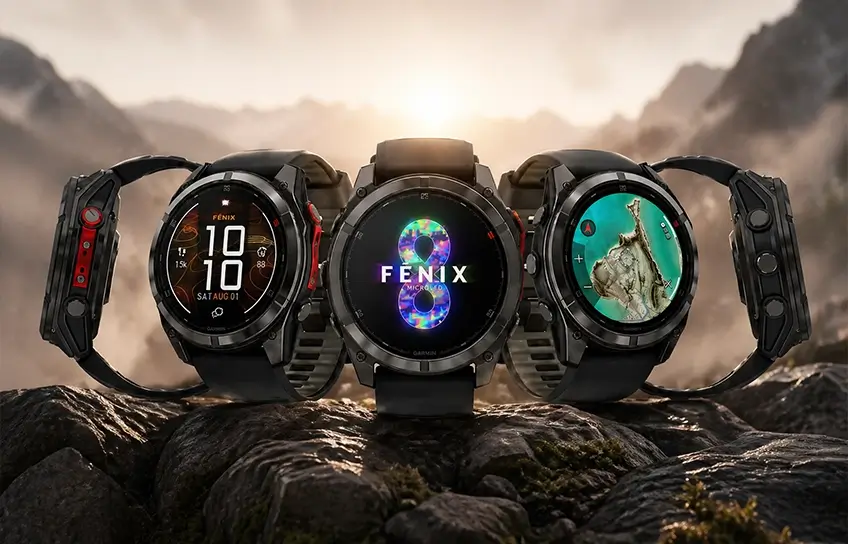
Spending over $1,200 on a watch is a big decision. And when a new version arrives with a “Pro” label and an even higher price, the obvious question is whether the upgrade is real or just clever marketing. The garmin fenix 8 pro sits at the top of Garmin’s lineup, and it brings two features the standard Fenix 8 does not have: built-in LTE cellular and satellite communication.
Those two additions change the watch’s entire value proposition, and whether the Pro is worth buying in 2026 depends almost entirely on whether those features matter to your life.
Garmin Fenix 8 Pro: Specs
| Specification | 47mm (AMOLED) | 51mm (AMOLED) | 51mm (MicroLED) |
| Price | $1,199 | $1,299 | $1,999 |
| Case Size | 47mm x 16mm | 51mm x 16.5mm | 51mm x 17.5mm |
| Weight | 56g | 65g | 68g |
| Display | 1.4in AMOLED | 1.4in AMOLED | 1.4in MicroLED |
| Resolution | 454 x 454px | 454 x 454px | 454 x 454px |
| Peak Brightness | ~2,000 nits | ~2,000 nits | 4,500 nits |
| Case Material | Titanium bezel | Titanium bezel | Titanium bezel |
| Screen Protection | Sapphire crystal | Sapphire crystal | Sapphire crystal |
| Water Resistance | 10 ATM / 40m dive | 10 ATM / 40m dive | 10 ATM / 40m dive |
| Storage | 32GB | 32GB | 32GB |
| Smartwatch Battery | 15 days | 27 days | 10 days |
| Always-On Battery | 8 days | 15 days | 4-5 days |
| GPS Battery | ~44 hours | 53 hours | 53 hours |
| GPS + LTE Battery | 21 hours | 21 hours | 21 hours |
| Connectivity | LTE-M, Satellite, Bluetooth, ANT+, NFC, Wi-Fi | LTE-M, Satellite, Bluetooth, ANT+, NFC, Wi-Fi | LTE-M, Satellite, Bluetooth, ANT+, NFC, Wi-Fi |
| GPS System | Multi-band, SatIQ | Multi-band, SatIQ | Multi-band, SatIQ |
| inReach Plan (starting) | $7.99/month | $7.99/month | $7.99/month |
What the Fenix 8 Pro Actually Adds Over the Standard Model
When you look at the garmin fenix 8 pro specs side by side with the standard Fenix 8, the hardware difference is smaller than the price gap suggests. Same titanium and polymer build, same sapphire crystal, same five physical buttons paired with a touchscreen, same GPS performance.
The Pro is about two millimeters thicker to accommodate the additional antenna hardware, and it loses about two days of battery life in smartwatch mode compared to the standard version. The screen on the Pro is brighter, and the 51mm model is available in a MicroLED version that is worth knowing about, though not necessarily worth the extra cost for most buyers.
The real difference is connectivity. The Fenix 8 Pro can function as a standalone communication device without a phone nearby. It can make and receive calls, send text messages, share your live location, and in a serious emergency, trigger an SOS to Garmin’s 24-hour response center. All of this works either through LTE when signal is available or through satellite when it is not. No other Garmin watch at this price does that.
Understanding the LTE Side of Things

How LTE Works on the Watch
The Fenix 8 Pro uses LTE-M, a low-power cellular standard built for wearables rather than phones. Since the garmin fenix 8 pro release date in late 2024, this has been the feature that separates it most visibly from everything else in Garmin’s lineup. The watch does not have its own phone number. Instead, Garmin assigns it an IP address and routes your messages and calls through their infrastructure. When someone texts you, Garmin delivers it to the watch.
When you call someone, the audio runs through the watch’s built-in microphone and speaker. Coverage depends on where you are. In most parts of North America and Europe, LTE-M works reliably. But the connection behaves differently depending on which mode you choose, and this is worth understanding before buying.
Auto LTE vs Always-On LTE
By default, the watch ships in Auto LTE mode. In this setting, the watch only checks for new messages when you manually open the messenger app or trigger a message check yourself. So if someone sends you an urgent text while you are out on a trail, you will not know about it until you actively check. That is a meaningful limitation that catches a lot of buyers off guard.
Switching to Always-On LTE makes the watch behave the way most people expect a connected watch to behave. Messages come through in real time, calls ring when they come in, and LiveTrack updates continuously. The trade-off is battery life.
With Always-On LTE active during a typical day that includes an hour of GPS activity, the watch drains roughly 35 to 40 percent per day, putting it closer to Apple Watch territory than classic Garmin territory. It is still better than most competitors, but the gap narrows considerably. For anyone buying the Pro specifically for connectivity, Always-On LTE is the only mode that makes practical sense. Just go in knowing what that costs in terms of battery.
The Satellite Side

Garmin markets the satellite feature under the inReach name, which is the same brand they use on their standalone handheld devices. The experience is meaningfully different though, and it matters.
Dedicated inReach handhelds use Iridium’s low-Earth-orbit satellite network, which covers the entire globe and delivers messages typically within a minute or two anywhere on Earth. The Fenix 8 Pro connects through Skylo, which uses geostationary satellites positioned about 22,000 miles above the equator. These satellites do not move, which means if you cannot get a connection where you are standing, you need to physically move to a better position rather than waiting for a satellite to pass over.
Coverage is solid across most of the continental United States, Canada, and Europe. If your adventures keep you in those regions, the satellite feature works well and adds genuine peace of mind. For expeditions to extreme high latitudes or truly remote polar regions, a dedicated inReach handheld still offers better reliability.
Connecting to the satellite requires pointing your wrist toward a specific part of the sky and holding steady while the watch locks on. Messages generally go through within 30 to 60 seconds in good conditions. It is a manual process each time, there is no automatic background tracking over satellite the way traditional inReach devices offer.
One more thing worth knowing: Garmin requires a paid subscription for all satellite features, including emergency SOS. Apple and Google include free emergency SOS satellite messaging on their satellite-capable devices. When you factor in the garmin fenix 8 pro price starting at $1,199 plus inReach plans from $7.99 per month, the total cost of ownership is meaningfully higher than it first appears. That ongoing cost adds up and should factor into any honest cost comparison.
Fitness and Navigation: Still Best in Class

Setting aside the connectivity features, the Fenix 8 Pro delivers the same exceptional sports tracking that has made the Fenix line a favorite among serious athletes and outdoor enthusiasts for years.
Training and Health Tracking
The depth of training data available is unmatched among consumer smartwatches. Beyond standard heart rate and GPS tracking, the watch provides VO2 max estimates, training load analysis, recovery time recommendations, race predictor tools for runners, daily workout suggestions, and a Body Battery score that gives a surprisingly accurate picture of how ready your body is for effort on any given day. The ECG app adds a layer of cardiac monitoring that is useful for anyone managing heart health alongside an active lifestyle.
Heart rate accuracy from the wrist sensor is strong enough for most workouts, and the watch supports ANT+ broadcasting so cyclists and gym users can push their heart rate data to compatible devices. For those who go deeper on data, the Garmin Connect app provides a level of analytical detail that no rival app currently matches.
Navigation
Garmin’s offline navigation remains ahead of the competition. The watch comes with preloaded TopoActive maps and supports full turn-by-turn routing without needing a phone. If you wander off trail, the watch can recalculate and guide you back. Multi-band GPS with SatIQ technology balances accuracy and battery consumption automatically depending on conditions, and performance is reliable even in dense tree cover or urban canyons where single-band GPS often struggles.
Battery Life: Still Strong, With One Caveat

A lot of people researching this watch focus heavily on garmin fenix 8 pro battery life, and for good reason. The 51mm model lasts up to 27 days in standard smartwatch mode, which is exceptional. In GPS activity mode it runs for around 53 hours, dropping to about 21 hours when LTE LiveTrack is active during an activity. Running everything at once, GPS, satellite, LTE, and music streaming, brings that down to around 14 hours, which still covers most real-world scenarios.
The caveat is that these figures shift noticeably with Always-On LTE active in daily wear. A more realistic expectation for a connected user doing an hour of GPS activity per day with Always-On LTE is roughly two and a half to three days per charge. That is still better than most smartwatches, but it is a long way from the headline 27-day number.
Who the Fenix 8 Pro Is Actually For
Trail runners and hikers who regularly go out without a phone will get the most from this watch. If you do long solo runs, backcountry trips, or any activity where being unreachable for hours at a time is a real concern, the combination of LTE messaging, LiveTrack, and satellite SOS addresses those concerns in a single device. Partners or family members can follow your location in real time and reach you if needed, and you can reach them.
The watch also suits people who want to reduce their dependence on their phone generally. Leaving the phone at home during a run, a hike, or even a morning commute becomes a lot more comfortable when you know you can still handle anything urgent from your wrist.
For city-based fitness enthusiasts who train indoors and outdoors but rarely venture beyond cell coverage, the standard Fenix 8 is a smarter buy. The fitness features are identical, the battery life is slightly better, and the price is meaningfully lower. Paying for connectivity you will rarely use does not make much financial sense.
A Few Alternatives Worth Considering
The Apple Watch Ultra 3 is the closest competitor worth comparing seriously. It costs less, has strong sports tracking, and includes free satellite SOS messaging. Battery life and offline navigation depth are where the Garmin pulls ahead, and the training analytics on Garmin’s platform are more detailed. For runners and outdoor athletes who want the deepest data, the Fenix 8 Pro wins on features. For someone who wants a more balanced everyday smartwatch with good fitness tools, the Apple Watch Ultra 3 is a legitimate option.
The Garmin Forerunner 970 carries every fitness and training feature the Fenix 8 Pro has, in a lighter and more comfortable form factor. It does not have the rugged build or the satellite connectivity, but for a runner who stays within cell range, it does everything the Fenix 8 Pro does at a lower price. And if you are considering the garmin fenix 8 pro microled version specifically, know that it costs $700 more than the AMOLED, adds screen brightness but reduces battery life, and only comes in the larger 51mm case. Most buyers will find the AMOLED delivers more than enough for daily use.
Pros and Cons
Pros
- Built-in LTE and satellite connectivity
- Best-in-class fitness and training analytics
- Offline maps with turn-by-turn routing
- Exceptional 27-day battery life (51mm)
- Rugged titanium and sapphire crystal build
- Real-time LiveTrack location sharing
Cons
- Very expensive starting price ($1,199)
- SOS requires a paid monthly subscription
- Satellite coverage not truly global
- Always-On LTE drains battery fast
- No 43mm size option
- Satellite tracking is fully manual
Conclusion
The Fenix 8 Pro is the right watch for outdoor athletes and adventurers who want one device that handles navigation, communication, and safety without a phone. The price is high and the subscription adds up, but for those who will genuinely use the connectivity, the value holds. If LTE and satellite are not part of your routine, the standard Fenix 8 gives you everything else for less.
