


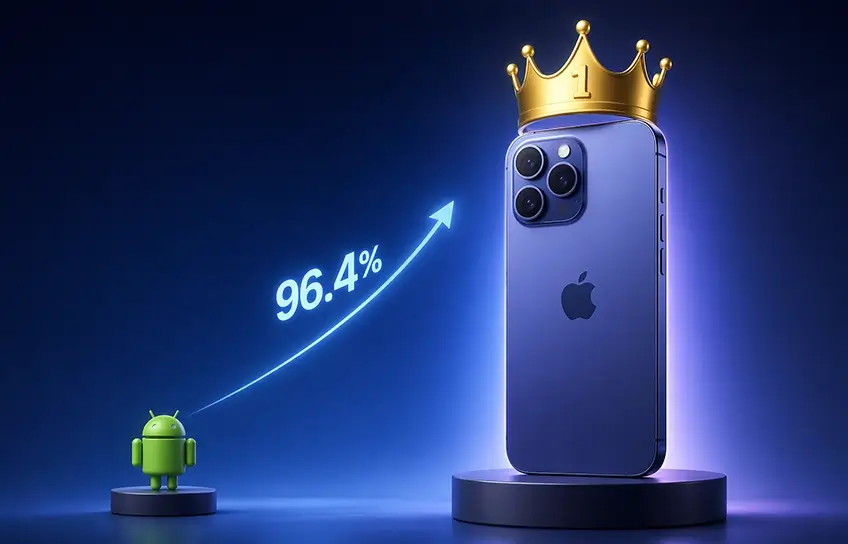
Apple has always had loyal customers. But the latest numbers from a large-scale 2026 survey show something even the company likely did not expect: iPhone loyalty has never been this strong, Android users are now nearly four times more likely to switch platforms, and the gap between the two has reached its widest point in the last seven years.
The survey, conducted by phone trade-in platform SellCell, polled more than 5,000 U.S. smartphone users, with roughly equal representation between iPhone and Android owners using two separate surveys with matching question structures. The results are hard to ignore.
The 96.4% Number Is Not the Real Story
Yes, 96.4% of iPhone users said they plan to buy another iPhone for their next upgrade. That is up from 91.9% in 2021 and 90.5% in 2019. A steady climb, year after year.
But here is the stat most outlets skipped: 83.8% of iPhone users have stayed with Apple for more than five years. Compare that to Android, where only 33.8% of users have stayed with the same brand for that long.
That is not just loyalty. That is a user base that has fully settled in and has no reason to look elsewhere. Apple is not just winning new customers. It is holding onto the ones it already has at a rate no Android brand comes close to matching.
Android Users Are 4x More Likely to Switch
On the Android side, overall brand loyalty sits at 86.4%. That sounds solid until you look at what it actually means: 13.6% of Android users are planning to leave their current platform.
That is nearly 1 in 7.
By comparison, only 3.6% of iPhone users said they would switch to Android. That makes Android users almost four times more likely to jump ship than iPhone users, and the 10-percentage-point switching gap is the largest SellCell has recorded since it began tracking in 2019.
The traffic between platforms is also heavily one-sided. Of the small group of iPhone users open to switching, 69.7% said they would choose a Samsung device and 20.2% said they would pick a Google smartphone. Going the other way, 26.8% of Android users considered a switch named the iPhone as their next device. That one-way pull toward Apple has been consistent across every survey SellCell has run.
Why iPhone Users Stay: It Is Not Just the Hardware
When SellCell asked iPhone users why they planned to stick with Apple, the most common answer was not camera quality or chip performance. It was simply that they prefer iOS. 60.8% of loyal iPhone users said that was their main reason.
Another 17.4% pointed to the Apple ecosystem. Once you are using an iPhone alongside an Apple Watch, AirPods, a Mac, or an iPad, switching is not just about changing a phone. Features like Handoff, AirDrop, Universal Clipboard, iCloud sync, iMessage, and FaceTime turn separate devices into a single connected setup. You start a task on one device and pick it up on another without thinking about it. Walking away from that means rebuilding years of workflow on a new platform.
Product reliability, ease of use, and trust in Apple’s privacy and security practices made up the rest of the reasons cited. Price was hardly mentioned as a reason to stay.
For the small group of iPhone users considering a switch, price was the top reason. Around 22.5% also said other brands offer better technology, which is worth noting. It tells us that perceived tech advantage still has the power to move even the most loyal Apple users.
What This Means for Samsung and Google
Both Samsung and Google have actually improved their loyalty numbers. Samsung jumped from 74% in 2021 to 90.1% in 2026, though its switching rate still sits at 9.9%. Google rebounded from 65.2% to 86.8% over the same period. Those are real gains.
But here is the problem those numbers hide: Android users overall still switch at nearly four times the rate of iPhone users. Even with better retention across individual brands, the Android ecosystem as a whole is losing ground on the loyalty front.
For Samsung and Google, the challenge is twofold. They need to keep their own users happy while also making a strong enough case to pull iPhone users across. The data suggests neither is happening at scale.
The AI Factor Nobody Is Talking About
Technology is quietly emerging as the next loyalty battleground. The SellCell survey found that 22.5% of iPhone users said they would consider switching if a competing platform offered better technology. That number is even higher on the Android side at 27.1%.
With AI features now a major selling point across all flagship phones, this is where the next loyalty war will be fought. If any Android brand manages to deliver a noticeably superior AI experience, it has a real lever to pull. For Apple, keeping its AI features ahead of the curve is not just about attracting new buyers. It is about protecting a base that, for the first time, has admitted technology could be enough to make them leave.
By the Numbers
| Metric | iPhone | Android |
| Brand Loyalty (2026) | 96.4% | 86.4% |
| Switching Rate (2026) | 3.6% | 13.6% |
| Loyalty (2021) | 91.9% | N/A |
| Loyalty (2019) | 90.5% | N/A |
| Users Loyal 5+ Years | 83.8% | 33.8% |
Where switchers go: 69.7% of iPhone switchers pick Samsung, 20.2% pick Google. 26.8% of Android switchers pick iPhone.
Bottom Line
The smartphone market is hardening along platform lines, and Apple is the clear winner of the loyalty game right now. A 96.4% retention rate is remarkable on its own. But when you combine it with 83.8% of users staying for five or more years, you start to understand just how deeply rooted iPhone loyalty has become.
For Android brands, the path forward is not just about building a better phone. It is about building a better reason to stay. And right now, that reason is not strong enough for 1 in every 7 of their users.
Note: SellCell’s survey was limited to 5,000 U.S. respondents, so global trends may differ.
