


Britain joins a growing global push to pull young people off platforms that many parents say are doing real damage.
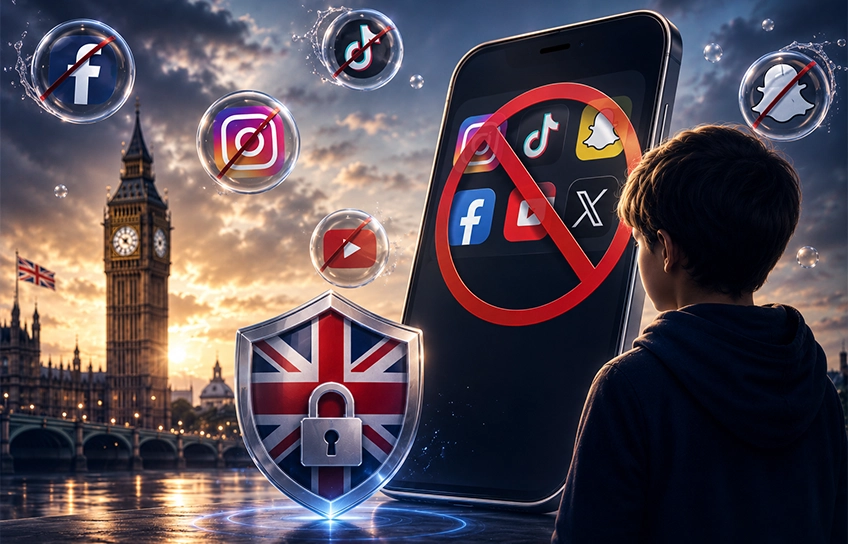
The United Kingdom officially became the latest nation to restrict social media for children on Monday, June 15, 2026, when Prime Minister Keir Starmer announced that children under 16 will be banned from accessing major platforms including TikTok, Instagram, YouTube, Snapchat, Facebook, and X.
The move places Britain inside a rapidly expanding group of countries that have decided the risks of unrestricted social media for children outweigh the benefits, and signals that governments around the world are losing patience with the tech industry’s self-regulation.
A Decision Years in the Making
This did not happen overnight. The push gained momentum after Australia became the first country to pass a law barring children under 16 from accessing major social media platforms, an effort aimed at addressing concerns about the physical and mental health effects of excessive online use. Britain watched closely and, after months of deliberation, decided to follow a similar path and go further.
The announcement followed a national consultation survey that received more than 116,000 responses between March 2 and May 26, which solicited public opinions on children’s use of technology. More than 83% of parents who responded said the risks of social media use outweigh the benefits, and 90% expressed support for a minimum age of 16 before children can access social media platforms.
Starmer did not soften the message. “Every parent can see it with their own eyes. Social media is making children unhappy,” said Starmer, who has two teenage children.
What the Ban Actually Covers
The ban will apply to platforms including Snapchat, TikTok, YouTube, Instagram, Facebook and X, but not YouTube Kids or messaging services like WhatsApp and Signal. Starmer stressed that enforcement action will target tech companies, not children.
But the government made clear this goes beyond a simple platform block. He said the government will act to prevent strangers from contacting children on gaming and livestreaming platforms. Authorities are also considering additional measures including overnight curfews and breaks in infinite scrolling for those under 18. Romantic AI chatbots designed to simulate relationships with users will be restricted to adults only.
Enforcement will fall to Ofcom, the UK’s communications regulator. Ofcom will conduct a rapid study on what is effective age assurance for verifying whether someone is over 16, with the ban likely relying on technologies like digital ID and face scans. Legislation is expected to reach Parliament before the end of 2026, with protections coming into force in Spring 2027.
Not Everyone Is Convinced
The announcement drew praise from parents and child safety campaigners, but it also met a wall of skepticism from critics, legal experts, and the tech companies themselves.
Critics of social media bans argue that blanket bans are ineffective and will simply stifle access to age-appropriate experiences with parental controls, and that young people will find a way around the ban. A BBC report found that downloads of VPNs in Australia, which hide users’ locations to avoid country-specific restrictions, increased before the ban took effect.
Technology lawyer Diane Mullenex at Pinsent Masons raised a pointed concern: “Once ministers move beyond social media into livestreaming and chatbots more widely, the law becomes far more complex to police, especially where services are based overseas or can be accessed through VPNs.”
YouTube and Meta both pushed back publicly. YouTube warned that a blanket social media restriction could push kids out of curated, supervised, beneficial experiences and towards anonymous, less-safe services. Meta said a ban could drive teens to online alternatives without any parental controls.
Starmer acknowledged the challenge head-on. He told a news conference he would fight back if technology companies resist the move, and acknowledged some teens would try to find their way around a ban. He compared it to alcohol restrictions, arguing that the difficulty of enforcement is no reason to abandon the principle entirely.
Where the World Stands
Britain is not acting alone. Australia, Canada, Brazil and Indonesia have introduced legislation or announced age-based restrictions or requirements for children’s access to social media, while France, Spain, Denmark, Thailand and South Korea are among others studying or developing similar approaches.
What sets the UK apart is the stated ambition to go further than any of them, combining a platform ban with broader restrictions on harmful online features, tougher age verification requirements, and a commitment to hold tech companies financially accountable if they fail to comply.
Whether it works in practice is the question that no government has fully answered yet. The tools are in place. The political will is there. What remains to be seen is whether the law can keep up with the technology, and whether the children it is designed to protect will actually be safer once it does.
