


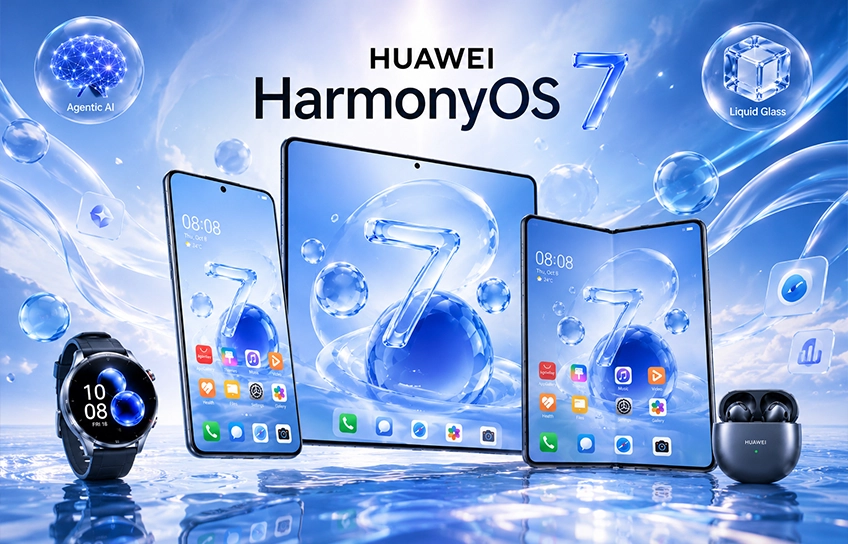
Huawei just made its biggest software move of the year. At its annual developer conference on June 12, 2026, the company pulled back the curtain on huawei’s harmonyos 7, a major update that brings a glass-inspired visual overhaul, a fundamentally smarter AI assistant, and a meaningful performance jump to smartphones, tablets, PCs, wearables, and IoT devices all at once.
Glass Is Now the Design Language of 2026
The first thing you notice about HarmonyOS 7 is how it looks. Huawei has introduced what it calls a spatial design language, which uses software-based rendering to add depth, translucency, and three-dimensional effects across the entire interface. Buttons, sliders, system controls, and lock screen elements all carry this new glass-like quality, with dynamic lighting that shifts and responds as you interact with the screen.
The lock screen is where it becomes most visible. HarmonyOS 7 takes a standard flat photo and renders it with perceived depth, turning your wallpaper into a layered, interactive scene every time you wake your device. It is a subtle effect, but it changes how the phone feels to pick up.
How Does It Compare to Apple and Samsung?
It is worth being straightforward here. This visual direction is not something Huawei invented in isolation. Apple debuted its Liquid Glass aesthetic at WWDC on June 9, just three days before HarmonyOS 7 was announced. Samsung is heading the same way with One UI 9. Three of the world’s biggest operating systems are all converging on translucency, depth, and frosted-glass surfaces as the defining look of 2026.
Huawei’s version is arguably more interactive than Apple’s implementation, with touch-responsive lighting effects that give the interface a slightly more playful, tactile feel. But the broader design shift is an industry-wide move, not a solo one.
The AI Assistant Has Become Something Bigger
Beyond the visual refresh, the more significant change in HarmonyOS 7 is what happened to the AI assistant. Huawei is calling this phase Agentic AI, and the difference from a typical assistant is meaningful.
Previously, AI assistants largely answered questions or fetched information. The upgraded Xiaoyi assistant in HarmonyOS 7 is now built into the system at a deeper level, with access to over 2,100 system-level capabilities and the ability to coordinate more than 2,000 third-party AI agents. What this means practically is that the assistant can carry out complex, multi-step tasks inside your apps without you having to navigate through menus yourself. You give it an intent, and it figures out the path.
The Framework Powering It All
Under the hood, Huawei has introduced the HarmonyOS Intelligent Agent Framework 2.0, which operates on what the company calls an “intent as a service” model. Rather than the user selecting an app, opening it, finding the right function, and completing the action manually, the system compresses that entire sequence into a single natural language command.
Huawei claims a task execution success rate of over 90 percent with this framework, which is honest enough to note means roughly one in ten complex requests still does not complete as expected. That is a reasonable benchmark for where AI task automation currently stands, and Huawei deserves credit for stating the number rather than just calling it “near perfect.”
The system also supports new photo editing tools powered by AI and brings what Huawei describes as an “Agentic Self-Evolving Architecture,” allowing the assistant to learn user habits over time and apply that knowledge to future tasks.
A 15% Performance Gain and a Security Layer Worth Noting
HarmonyOS 7 delivers up to 15 percent better overall performance compared to HarmonyOS 6.1. Users should notice faster app launches, smoother animations, and more responsive gaming. Huawei has not published detailed benchmark methodology yet, so real-world testing will tell the fuller story once the stable build arrives.
One area that most coverage has underplayed is security. HarmonyOS 7 introduces a dedicated anti-fraud platform that can detect suspicious QR codes, identify app impersonation attempts, flag fraudulent web pages, and recognize overseas spoofed phone numbers. It also adds AI-driven voice scam detection, which filters potentially malicious calls in real time. For users in markets where phone scams are common, this is a genuinely useful addition.
Who Gets It First and When
The developer beta for HarmonyOS 7 launched on June 12, with 15,000 openings available for eligible devices. The first batch includes the Huawei Mate 80 Pro, Mate X7, Mate XT Master, Pura 90 Pro Max, Pura X, Pura X Collector’s Edition, and the nova 15 Pro. A public beta is expected to follow once developers confirm stability.
The stable consumer release is planned for fall 2026, and the Huawei Mate 90 series is expected to be the first lineup to ship with HarmonyOS 7 preloaded out of the box.
What This Update Actually Means
HarmonyOS 7 is a significant step forward, but it is most interesting when you consider the bigger picture. Huawei has been building its own software ecosystem independently for years now, and each version of HarmonyOS moves further from any Android dependency while closing the gap with what iOS and other major platforms offer.
This update does not just add features. It signals that Huawei is treating software experience as a long-term competitive priority, not just a checkbox. Whether the Agentic AI delivers consistently in daily use, and whether the Liquid Glass design feels as refined in its final form as it does in developer previews, are questions the fall release will answer.
For now, HarmonyOS 7 is one of the more ambitious software updates of the year, and it arrives at exactly the moment the entire industry is rethinking what a phone’s interface should feel and behave like.
