


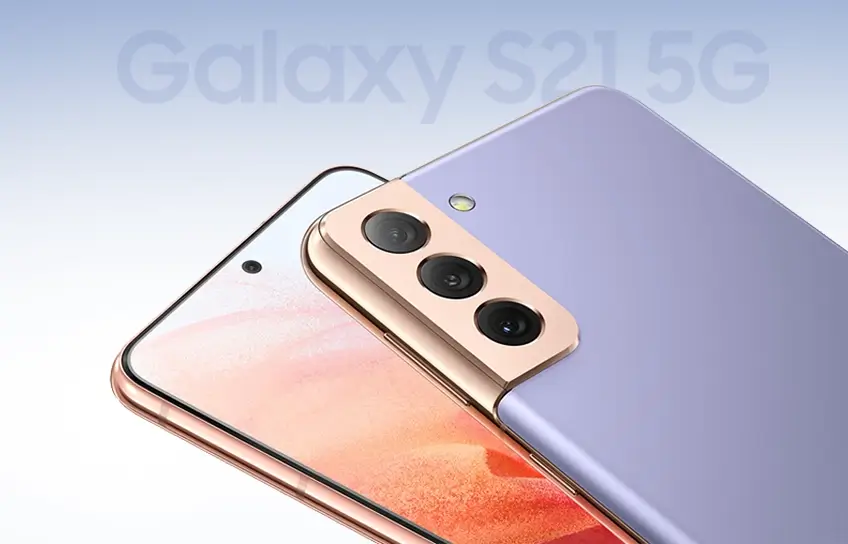
Five years after its launch, the Samsung Galaxy S21 still holds a unique position in the Android market. When Samsung introduced it in January 2021 at $799, it represented a $200 price cut over the Galaxy S20, making it the most accessible flagship Samsung had offered in years. Today in 2026, that value proposition has only grown stronger, with clean used and refurbished units now available for as low as $150 on the open market.
The Galaxy S21 sits at the base of what was Samsung’s most aggressively priced flagship lineup, below the S21 Plus and S21 Ultra, but it carries the same Snapdragon 888 processor, the same 120Hz Dynamic AMOLED display technology, and full Sub-6GHz and mmWave 5G support that defined flagship connectivity in 2021. The question worth asking in 2026 is not whether this phone was good at launch. It clearly was. The real question is whether it still delivers enough value to justify a purchase today and that is exactly what this review will answer.
Samsung Galaxy S21 5G Specifications
| Feature | Details |
| Launch Date | January 29, 2021 |
| Display | 6.2-inch Dynamic AMOLED 2X, 120Hz, HDR10+ |
| Resolution | 1080 x 2400 pixels (421 ppi) |
| Screen Protection | Corning Gorilla Glass Victus |
| Chipset (USA) | Qualcomm Snapdragon 888 5G (5nm) |
| Chipset (International) | Samsung Exynos 2100 (5nm) |
| RAM | 6GB / 8GB |
| Storage | 128GB / 256GB (no microSD slot) |
| Rear Cameras | 12MP (wide) + 12MP (ultra-wide) + 64MP (telephoto, 3x optical zoom) |
| Front Camera | 10MP |
| Video | 8K@24fps, 4K@30/60fps, 1080p up to 240fps |
| Battery | 4,000mAh |
| Wired Charging | 25W (USB-C, PD3.0) |
| Wireless Charging | 15W Qi / 4.5W reverse wireless |
| OS at Launch | Android 11, One UI 3.1 |
| Final OS Update | Android 15, One UI 7 |
| SIM | Nano-SIM + eSIM |
| 5G Support | Sub-6GHz + mmWave (USA model) |
| Wi-Fi | Wi-Fi 6 (802.11ax) |
| Bluetooth | 5.0 |
| NFC | Yes |
| Water Resistance | IP68 (1.5m for 30 min) |
| Build | Gorilla Glass Victus front, polycarbonate back, aluminum frame |
| Dimensions | 151.7 x 71.2 x 7.9 mm |
| Weight | 169g (Sub-6) / 171g (mmWave) |
| Colors | Phantom Gray, Phantom White, Phantom Violet, Phantom Pink |
Performance and Hardware
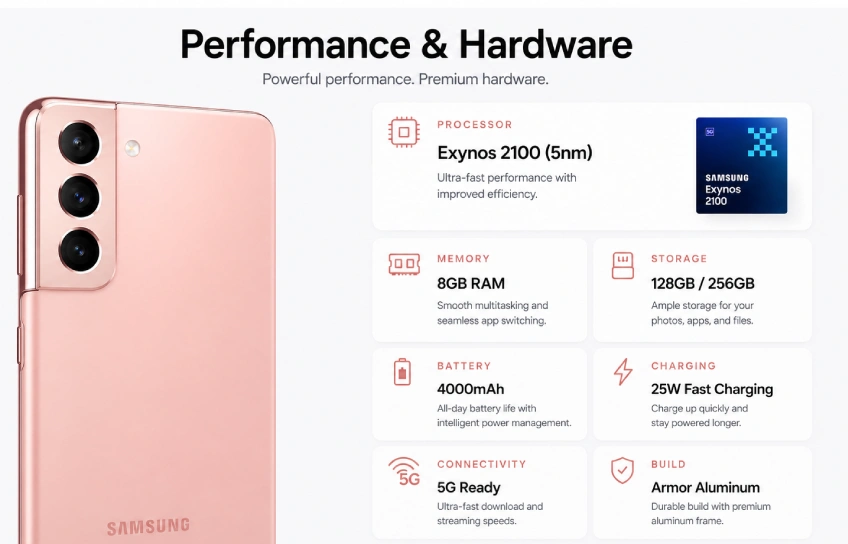
When Samsung introduced the S21 lineup, it made a deliberate choice to focus on what most people actually need rather than chasing specs for the sake of marketing. The samsung galaxy s21 5g release date was January 29, 2021, arriving at a time when the market was hungry for a device that balanced quality and affordability. Samsung trimmed a few premium features from its predecessor to bring the price down to $799 at launch, and the core hardware it kept has proven to be the right call.
The Snapdragon 888 processor inside the US model was the most powerful chip available at the time. Paired with 8GB of RAM, it handled multitasking, gaming, and demanding apps effortlessly. Five years on, average users’ processing demands have simply not outpaced what the 888 can deliver, and that speaks volumes about the hardware Samsung chose.
When you look at the samsung galaxy s21 5g specs, you quickly understand why this phone has held up so well. The 6.2-inch Dynamic AMOLED display with a 120Hz adaptive refresh rate was ahead of its time for a phone in this price bracket. Colors remained rich and vibrant, brightness was more than adequate for outdoor use, and the smooth scrolling experience still feels premium compared to budget phones released far more recently.
Software Updates
One of the biggest reasons this phone has stayed relevant is Samsung’s commitment to software updates. The S21 received four years of Android OS updates and five years of security patches, which is genuinely impressive for a phone in its category. That means users were protected and supported well into the mid-2020s, and the phone continued to gain new features through Samsung’s One UI updates long after launch.
By the time Android 14 arrived on the S21, the phone was handling each update without slowdown or instability. For a device that launched when many Android phones were lucky to see a single major update, receiving four full Android OS upgrades and five years of security patches is a concrete reason why so many owners never felt the need to replace it.
What Still Works in 2026
Camera
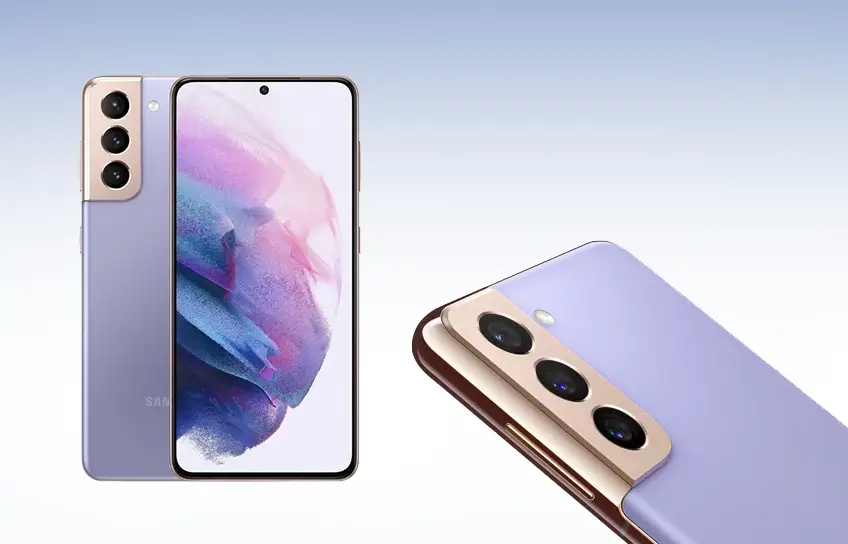
The S21 launched with a triple camera system that impressed reviewers across the board, and five years later the hardware itself has not changed. Every samsung galaxy s21 5g review from the time of launch highlighted the 12MP main sensor, 12MP ultra-wide, and 64MP telephoto with 3x optical zoom as a strong, versatile setup, and those strengths still hold up in real-world use today.
Daylight shots are sharp, well-exposed, and naturally colored. The ultra-wide lens gives you creative flexibility that you simply would not get on a budget phone even today. And while Night Mode has been surpassed by newer generations of processing, it still handles low-light scenes in a way that produces usable, clean images rather than noisy, blurred messes.
The selfie camera, which was greatly improved over its predecessor, remains genuinely good for video calls, social media posts, and casual portraits. For most users who are not professional content creators, the S21’s camera system in 2026 is more than sufficient.
Battery Life
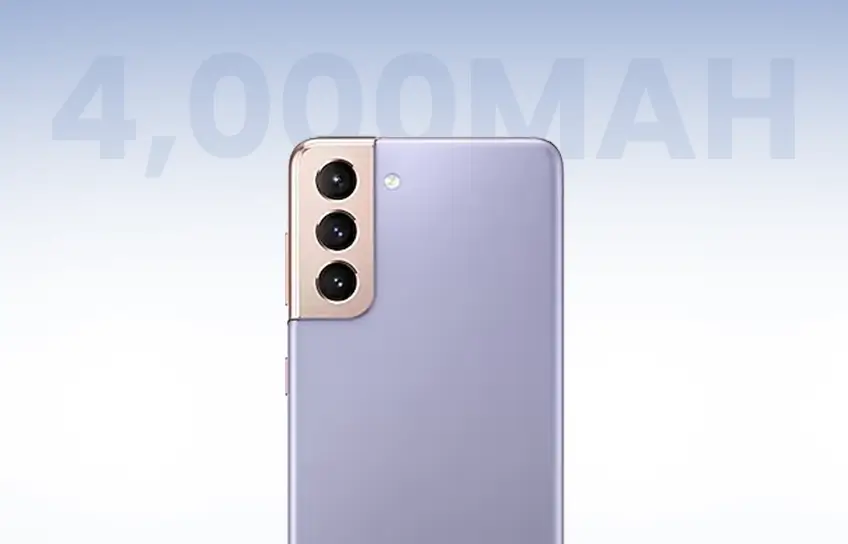
The 4,000mAh battery was considered modest at launch, but with software becoming increasingly optimized and the Snapdragon 888 benefiting from One UI efficiency improvements, real-world battery life on a well-maintained S21 holds up for a full day of moderate use. Charging via 25W wired connection is not the fastest by today’s standards, but a full charge in around 70 minutes is practical enough, and 15W wireless charging adds further flexibility.
Build Quality
The polycarbonate back, which Samsung branded as “Glasstic,” was debated at launch, but it turned out to be a practical long-term choice. Unlike glass, it resists shattering on impact, picks up fewer visible scratches over time, and does not become a fingerprint magnet the way glossy backs typically do.
If you do want to protect the display, finding a samsung galaxy s21 5g screen protector is still easy in 2026, with tempered glass options available from multiple brands at very reasonable prices. The IP68 water resistance rating also means the phone can survive rain, accidental splashes, and even brief submersion, which is genuinely reassuring for a five-year-old device.
Who Should Buy Samsung Galaxy S21
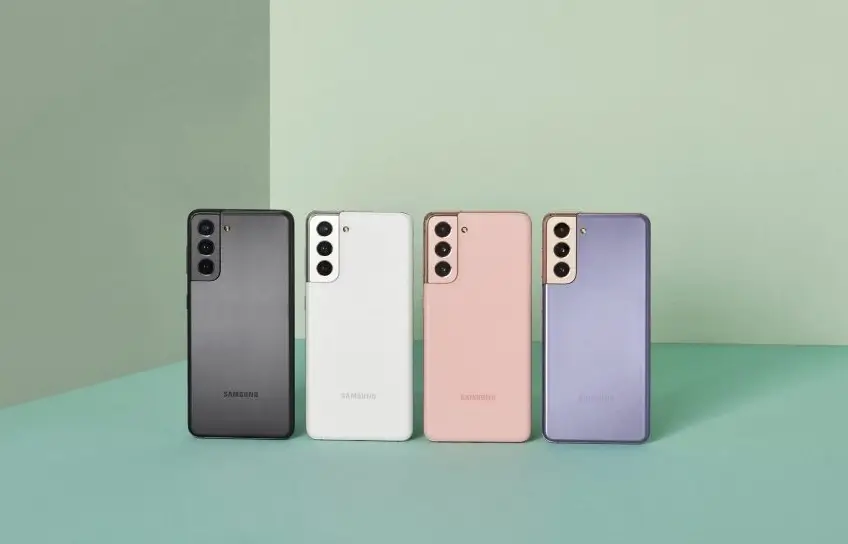
Budget Buyers
The used and refurbished market has brought the samsung galaxy s21 5g price down dramatically from its original launch figure. You can now find a clean, well-maintained unit for a fraction of what it once cost, getting flagship-era internals, an excellent display, a capable triple camera system, and 5G connectivity. For someone upgrading from an older device or looking for a reliable daily driver without spending on a brand-new flagship, the S21 makes a compelling argument in a world where smartphones have become extraordinarily expensive.
Connectivity and 5G
One area where the S21 still impresses is its network flexibility. The phone supports both sub-6GHz and mmWave 5G bands, and samsung galaxy s21 5g esim support is built in, which is a genuinely useful feature for frequent travelers or anyone who wants to switch carriers digitally without a physical SIM swap.
For storage, the samsung galaxy s21 5g 128gb variant is the most commonly available on the used market and suits most users who rely on streaming rather than storing large local media libraries.
Compact Size
As phones have trended toward larger displays, the S21’s 6.2-inch screen feels refreshingly manageable. It fits comfortably in one hand, slides into a pocket, and does not demand the two-handed juggling act that today’s flagships often require. For people who find modern phones simply too big, the S21 fills a niche that few current devices address.
A closer look at the samsung galaxy s21 5g specifications also confirms a surprisingly complete feature set: IP68 water resistance, an in-display fingerprint scanner, Bluetooth 5.0, Wi-Fi 6, and wireless charging all come standard at a fraction of the original price.
Limitations
No recommendation is complete without honesty. Official software support has ended, meaning the phone no longer receives Samsung security patches, which is a real concern for anyone storing sensitive data on their device. The lack of a microSD card slot limits you to whatever internal storage the unit came with, and the 25W charging speed is noticeably slower than what current mid-range phones offer. These are genuine trade-offs worth weighing before buying.
Pros
- Snapdragon 888 still handles everyday tasks smoothly in 2026
- Stunning 6.2-inch Dynamic AMOLED display with 120Hz refresh rate
- Versatile triple camera system with 3x optical zoom
- IP68 water resistance built in
- eSIM support for carrier flexibility
- Compact, one-hand-friendly design
- Significant price drop on the used and refurbished market
Cons
- Official software support ended in February 2026
- No microSD card slot for storage expansion
- No headphone jack
- 25W charging is slow compared to current mid-range phones
- Charger not included in the box
- Battery life can disappoint heavy users
Final Verdict
The Galaxy S21 was never trying to be the most impressive phone on paper. It was built to be useful, durable, and worth the money, and five years later it is still delivering on all three. For buyers who can find a clean unit at today’s used market prices, it remains one of the most sensible value purchases in the Android space. That is not a small thing in a market where most phones are forgotten within two years of launch.
