


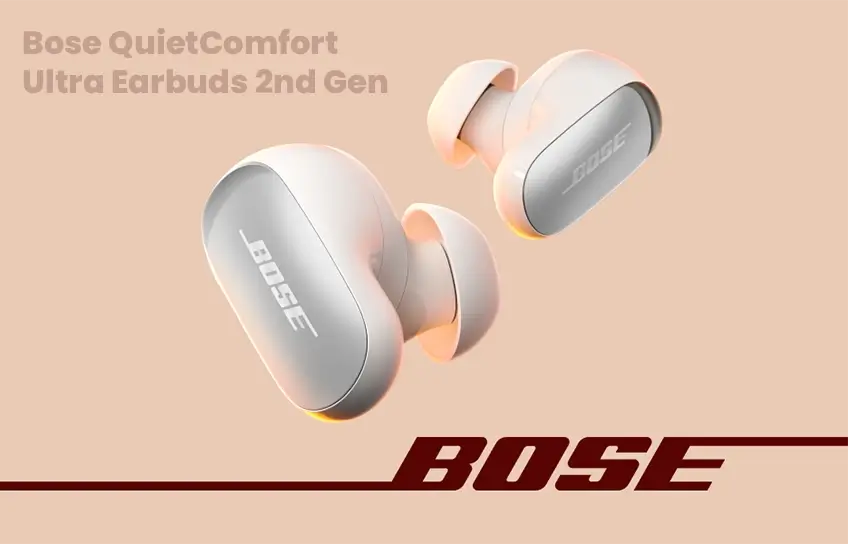
I have been commuting with the Bose QuietComfort Ultra Earbuds (2nd Gen) every morning for the past three weeks. Train rides, packed coffee shops, back-to-back video calls from a noisy co-working space, and one particularly painful open-plan office day where someone three desks over would not stop grinding coffee beans at 9 a.m. Through all of it, these earbuds did exactly what Bose promised: they shut the world out better than anything else I have tried at this price.
But whether that is enough to justify $299 in 2026 is a more complicated answer than it used to be. The Sony WF-1000XM5 has quietly dropped to around $200 on the street. The Technics EAH-AZ100 pushes 10 hours of battery life. If you’re researching the full premium earbud landscape, our wireless headphones and earbuds guide maps the entire category. For everyone here specifically for the Bose verdict, let’s get into it.
Bose QuietComfort Ultra Earbuds (2nd Gen) Specification
| What | Details |
| Price | $299 |
| Released | September 2025 |
| Bluetooth | 5.3 with multipoint |
| Codecs | SBC, AAC, aptX Adaptive |
| Microphones | 10 |
| Battery (earbuds) | 6 hrs ANC on / 4 hrs Immersive Audio on |
| Battery (total) | 24 hrs with case |
| Fast charge | 20 min = approx. 2 hrs |
| Water resistance | IPX4 |
| Weight | 7.7g per earbud |
| Wireless charging | Yes, Qi standard |
| Colors | Black, White Smoke, Deep Plum |
Three Weeks In, Here’s What Actually Stood Out
The design hasn’t changed from the 2023 original. Same chunky oval body, same stubby stem, same stability bands that hook into the upper curve of your ear. Bose didn’t touch any of it, and honestly that’s the right call. The original fit was one of the best in the category. I’ve tried a lot of earbuds that feel great for 20 minutes and start to ache after an hour. These don’t. I wore them through a four-hour work session last Tuesday without once reaching up to adjust them.
That stability band system is worth understanding if you haven’t used Bose earbuds before. It’s a small rubber ridge that presses gently against the inner wall of your outer ear. It doesn’t sit in the ear canal. It just anchors the bud from the outside, which means the pressure point is different from most earbuds, and most people find it significantly more comfortable for long sessions.
There is a catch with fit, and it’s one Bose should probably be more upfront about. If you have small ears or shallow outer ear structure, this design fights you. The stability band needs something to push against. Without it, the earbuds sit loosely and the seal breaks, which tanks both the passive isolation and the ANC effectiveness. I have a colleague with smaller ears who tried mine for an afternoon and got a completely different experience from what I described above. She returned them and went with AirPods Pro 3. If you can, try them in a store before buying.
What Bose did change in this generation: wireless charging on the case (finally), a nozzle wax guard on each bud, the ability to disable touch controls via the app, and all the internal upgrades covered below. The case is still bigger than I’d like. It feels chunky in a jacket pocket compared to Sony’s case or Apple’s. It’s not a dealbreaker, but it’s the one physical thing that doesn’t match the $299 price tag.
The ANC Is Still the Main Event

I want to describe what happened on my commute last Thursday because it explains the Bose ANC better than any spec can.
The scene: a crowded rush-hour train, standing, no seat, the kind of ride where everyone is pressed together and the wheel screech on the tracks is genuinely unpleasant. On went the earbuds, Quiet Mode switched on, play pressed. Within about two seconds the entire carriage noise collapsed down to almost nothing. Not reduced. Not softened. Gone, for the most part. There I was, standing in the middle of a packed train listening to John Coltrane’s “A Love Supreme” like I was in my living room.
I’ve used a lot of earbuds that do good ANC. The Bose QC Ultra 2nd Gen is in a different category from good. It is, in my experience across everything I’ve tested, the most effective noise cancellation in true wireless earbuds right now.
The upgrade over Gen 1 specifically sits in the mid frequencies. The original was already exceptional at blocking low-frequency rumble. The 2nd Gen handles the 200 to 2,000 Hz range more aggressively, which is where airplane cabin drone, HVAC hum, and open-office noise live. That coffee grinder scenario I mentioned at the top of this review? Quiet Mode killed it completely. I genuinely couldn’t tell someone was grinding coffee three meters away.
The improved ActiveSense feature is more nuanced than it sounds on paper. In Aware Mode, it doesn’t just pipe ambient sound through and leave you to deal with it. It listens for sudden loud spikes and briefly suppresses them before they reach you, then lets the ambient sound return. Practically, this means you can walk down a busy street in Aware Mode, hear conversations around you clearly, and still have a horn blast or a bus engine automatically muffled before it hits you.
It’s a more natural-feeling transparency experience than the first generation. I actually started using Aware Mode more than I expected to, specifically on outdoor runs where I wanted situational awareness without pulling the earbuds out.
How They Actually Sound on Music

These are not audiophile earbuds. I want to be clear about that before anything else. If you are coming from the Technics EAH-AZ100 or the Sennheiser Momentum True Wireless 4 and expecting the same level of sonic detail, you’ll find the Bose a step behind on resolution and midrange transparency.
What they are is genuinely enjoyable to listen to for extended sessions, across a wide range of music, without fatigue.
I spent a morning last week using these specifically to test sound quality with a range of tracks. For bass, I used Kendrick Lamar’s “HUMBLE.” The kick drum and bass line on that track are a good litmus test for weight and timing. The Bose handled it with real punch. Not bloated, not exaggerated. The bass hits with authority and then gets out of the way of the midrange. That wasn’t true of the first generation, which had a tendency to let bass bleed upward and muddy everything else. The 2nd Gen cleaned that up noticeably.
For vocal clarity, I went to D’Angelo’s “Untitled (How Does It Feel).” If any earbuds are going to smear the intimacy of that recording, you’ll know. The Bose kept it intact. Vocals sit forward and present, which is different from how the first generation treated them. There’s more air around the voice now.
Where I noticed the limitations was in complex, layered arrangements. I put on a live recording of a jazz quartet and the individual instruments were harder to separate than I’d like. The Technics EAH-AZ100 does that separation better. The Bose version has a slightly warmer, more blended quality that most listeners will find pleasing, but it doesn’t quite resolve fine musical detail the way a more audiophile-focused pair would.
The three-band EQ in the Bose Music app (Bass, Mid, Treble) gives you some tuning room but not much. If you like to fine-tune your sound, it will frustrate you. Sony’s app offers a six-band EQ on the WF-1000XM5 and gives you considerably more control. For most listeners, the stock tuning will be fine. For anyone who EQs everything, it’s a genuine limitation.
CustomTune Is More Useful Than Bose Lets On

Every time you insert the QC Ultra 2nd Gen earbuds, they play a short test tone and use the onboard microphones to analyze how it reflects inside your specific ear canal. Then they calibrate both the sound profile and the ANC response to your anatomy. Bose calls this CustomTune.
Most reviews mention it in a single sentence and move on. It deserves more attention than that.
No two ear canals are the same shape or size. A factory-flat EQ tuned to an average ear sounds slightly off on most individual listeners. CustomTune corrects for your specific anatomy automatically, every single time you put the earbuds in. In my testing, switching between two different ear tip sizes produced a noticeably different sound before the calibration tone ran, and a more consistent result afterward.
A few things I learned about getting the most from it:
- Run the calibration in a quiet space. Background noise interferes with the test tone analysis and produces a less accurate result.
- Re-run it manually whenever you change ear tip sizes. The calibration from a medium tip is not accurate for a large tip. You can trigger it from Settings in the Bose Music app.
- If more than one person uses these earbuds, each person should run their own calibration. The setting does not save multiple profiles, so whoever used them last has set the calibration for the next person too.
- The whole process takes about eight seconds.
I Made Calls From a Busy Intersection

The Gen 1 QC Ultra Earbuds had a microphone problem. Calls sounded intelligible but background noise bled through enough that people on the other end consistently asked me to repeat myself when I was outdoors. I stopped using them for important calls while walking.
The 2nd Gen introduced AI SpeechClarity, which uses the 10-microphone array and a dedicated processing layer to isolate the human voice specifically. I wanted to test this properly rather than just in ideal conditions, so I made several calls from a busy street with traffic moving in both directions.
The people I called said they could hear me clearly. One specifically said it sounded like I was indoors. This was far from the case, standing on a pavement with buses passing. Testing it again in a coffee shop during the lunch rush produced the same result. The SpeechClarity system does not eliminate all background noise on calls, and if you are standing next to a construction site it will not perform miracles. But it is a measurable and meaningful improvement over what the Gen 1 could do.
One honest note: in quiet indoor environments, the microphone quality is still average. This is not a professional headset. The improvement shows up specifically in the noisy outdoor situations where the Gen 1 failed most noticeably. Indoors, the difference is minimal.
Immersive Audio, Cinema Mode, and the Battery Trade-Off

These two modes confuse a lot of buyers and no one explains the difference clearly, so here it is.
Immersive Audio:
Is Bose’s spatial audio system for music. It uses head tracking to place the virtual soundstage in front of you in fixed space, so when you turn your head left, the music sounds like it’s coming from your right. Two sub-modes exist: Still (for stationary listening, the stage stays fixed) and Motion (the stage moves with your head, always staying in front of you).
I use Still mode when working at a desk. It genuinely pulls the music further out of my head than standard mode, and for certain recordings, particularly anything with a wide natural soundstage, it makes a real difference to the listening experience.
Cinema Mode:
Is a preset version of Immersive Audio specifically tuned for video content. Instead of optimizing for music, it balances dialogue clarity, sound effects, and background music the way a film mix is intended to be heard. The key difference from standard Immersive Audio is that Cinema Mode locks its settings. You cannot adjust anything while it’s active.
Bose has hard-coded the processing chain for video because the balance it chose works well for most content, and they did not want users accidentally degrading it.
Now the battery reality, which neither mode escapes:
| Listening Mode | Single Charge | Total With Case |
| ANC on, Immersive Audio off | 6 hours | 24 hours |
| ANC on, Immersive Audio on | 4 hours | ~16 hours |
| ANC on, Cinema Mode on | 4 hours | ~16 hours |
| Fast charge (20 min) | +2 hours | N/A |
I prefer Immersive Audio in Still mode, which means I personally live in the 4-hour world. For my commute and a morning work session that’s fine, because the case charges the earbuds between uses. On a long-haul flight it would be a problem. The case holds three full earbud charges, but if you’re running Immersive Audio the whole way, you’ll burn through all of that before a 12-hour flight is done.
If battery endurance is a priority, turn Immersive Audio off and you get your 6 hours back. Or look at the Technics EAH-AZ100, which reaches 10 hours per charge. The Bose battery is not broken. It is just shorter than the competition and shorter than you want it to be on a $299 flagship.
Who These Earbuds Are Actually For
After three weeks of daily use, here is my honest read on who gets the most from these.
Buy them if you travel frequently or commute on public transport. The ANC performance at this level is genuinely worth paying for over a cheaper alternative, and nothing I’ve tested beats it for blocking out the specific frequencies that make transport noise so exhausting.
Buy them if you take a lot of calls in mixed environments. SpeechClarity fixed the one thing that made me distrust the Gen 1 for outdoor calls. It works.
Buy them if you’re on Android and want a high-quality codec. aptX Adaptive gives Android users access to significantly better wireless audio quality than AAC can deliver. AirPods Pro 3 locks Android users to AAC. For Android-first users, the Bose is the more capable choice.
Consider something else if you have small ears. The stability band system needs space to anchor. Without the right ear geometry, you’ll fight the fit constantly, and a poor seal means poor ANC, which defeats the entire purpose.
Consider something else if you are deep in the Apple ecosystem. The AirPods Pro 3 pairs faster, switches between devices instantly, and integrates with iOS in ways the Bose simply doesn’t. It also costs $50 less. The Bose sounds better on Android. On iPhone the gap narrows considerably.
Consider something else if pure sound quality is the priority. For $200 right now, the Sony WF-1000XM5 gives you a more detailed, better-separated sound with a six-band EQ. If you are buying these primarily as a music-quality device and ANC is secondary, the Sony at its current price is genuinely the more rational buy.
Verdict
The Bose QuietComfort Ultra Earbuds 2nd Gen are not a dramatic reinvention. Bose took the original, fixed its two genuine weaknesses (mediocre call quality, no wireless charging), refined the ANC, and kept everything else that was already working.
For what they’re designed to do, which is block out the world more completely than anything else in the true wireless category, they remain the best you can buy right now. The SpeechClarity upgrade is real and earned. The comfort is genuinely excellent for long sessions. The sound quality is enjoyable without being exceptional.
The battery limitation is the only thing that stings at $299 in 2026. Four hours with Immersive Audio on, in a year when competitors are pushing 8 to 10 hours, is a number Bose needs to fix in Gen 3.
If you are a frequent traveler, a commuter, or someone whose daily life involves trying to find quiet in noisy environments, $299 buys you the best tool available for that specific job. If that’s not your primary need, the money goes further elsewhere.
