


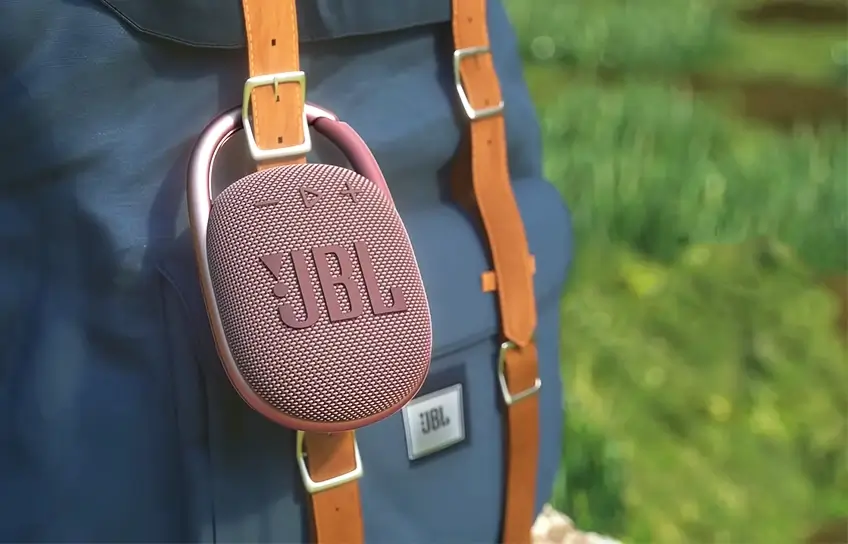
Most people underestimate a speaker this small, and that is exactly what the jbl clip 4 counts on. It weighs just over half a pound, clips onto a backpack strap in seconds, and holds up in rain, mud, and shower steam without complaint. For something that fits in a jacket pocket, it gets surprisingly loud, lasts well through a full day, and has built a large following among hikers, commuters, and students for good reason.
This jbl clip 4 review walks through the design, sound quality, battery life, waterproofing, and real-world performance so you can decide whether it is the right speaker for what you actually need.
JBL Clip 4 Full Specifications
Here is a full breakdown of the technical specs so you know exactly what this speaker offers.
| Specification | Details |
| Dimensions | 5.3 x 3.4 x 1.8 inches |
| Weight | 240g (0.53 lbs) |
| Driver | 40mm, 5W dynamic driver |
| Bluetooth | 5.1 (SBC, AAC codecs) |
| Range | Up to 10m (15m open space) |
| Battery Life | Up to 10 hours |
| Charge Time | Approx. 3 hours |
| Charging Port | USB-C |
| Waterproofing | IP67 (dustproof + waterproof) |
| Colors | Black, Blue, Pink, Red, Gray, Camo |
| Speakerphone | No |
| App Support | No (JBL Portable app not supported) |
| PartyBoost | Not supported |
| MSRP | ~$70 (frequently on sale ~$50) |
Design and Build Quality

The build on this speaker is noticeably different from the older round Clip models. Looking at the jbl clip 4 specifications, the dimensions come in at roughly 5.3 by 3.4 by 1.8 inches with a weight of around 240 grams. JBL switched from a circular shape to a more oval, rounded-rectangle form in this generation. It sits flatter in your hand, lays steadier on a surface, and the new shape makes it easier to clip onto narrow straps and rails.
The integrated carabiner is one of the standout features. In previous generations, the clip was a known weak point that could bend or crack with regular use. JBL addressed this by embedding the most vulnerable parts of the hinge into the body of the speaker itself. The result is a clip that feels solid and operates smoothly with one hand. You can hook it onto a backpack, a bike handlebar, a gym bag, or a shower curtain rail without worrying about it snapping off.
The front and back are wrapped in a fabric grille that grips well even with wet hands. The back panel has rubberized ridges that stop the speaker from sliding when you lay it flat on a desk or table. It is a small but practical touch that makes a difference when you are using it hands-free on a hard surface.
Controls and Ports

The button layout is simple and easy to use. Three buttons on the front panel handle play, pause, and volume, while power and a dedicated Bluetooth button sit on the side. The jbl clip 4 pairing process is simple: hold the Bluetooth button, find the speaker in your device’s Bluetooth menu, and you are connected within seconds. Skipping forward a track is possible with a double press of the play button, though there is no option to go back.
The USB-C charging port sits uncovered at the bottom of the speaker, which is a welcome upgrade from older micro-USB designs. There is no headphone jack and no support for multi-speaker pairing through JBL’s PartyBoost feature. For most people who just want music on the go, neither of those things will be a problem.
Water and Dust Resistance

Anyone curious about whether the jbl clip 4 waterproof rating is as good as advertised will not be disappointed. The IP67 certification means the speaker is fully dustproof and can handle submersion in up to one meter of water for up to 30 minutes without damage. That covers everything from rain on a trail to a full drop in a sink, which is a lot of peace of mind for a speaker you plan to carry everywhere.
What makes this especially notable is that the USB-C port sits completely uncovered and the speaker still holds its IP67 rating. You do not need to pull back any rubber flaps before charging, which was a constant minor annoyance in older Clip models. The speaker handles rain on a trail, splashes at the beach, steam in a shower, and sandy outdoor conditions without any issues.
How Does It Actually Sound?
Sound quality is where small speakers often disappoint, and it is also where expectations need to stay realistic. The Clip 4 houses a single 40mm, 5-watt driver. That is a significant bump in power over the previous model, and you can hear the difference. At moderate volumes, the sound is clear, well-defined, and noticeably louder than you might expect from something this compact.
The midrange and treble are the speaker’s strengths. Voices come through with good clarity, whether you are listening to a podcast, a talk radio stream, or acoustic music. It is also worth noting that there is no jbl clip 4 app support, so you cannot adjust EQ settings the way you can with newer JBL models like the Clip 3. The sound is what it is out of the box, and for most everyday listeners, that is perfectly fine.
What About the Bass?
Bass is the honest limitation here. The low end is present and slightly improved over earlier versions, but it is not going to satisfy anyone who loves heavy electronic music, bass-heavy hip-hop, or anything that relies on a deep, rumbling low frequency. The speaker physically cannot produce significant low-end output given its size, and pushing it to maximum volume can introduce some distortion on bass-heavy tracks.
The sweet spot sits between 50 and 75 percent volume. At those levels you get the best balance of clarity and warmth without the sound thinning out or getting harsh. If you regularly push it to full blast, the quality drops noticeably. At moderate levels though, it sounds considerably better than most speakers at this price and size.
Battery Life

The jbl clip 4 battery life is rated at 10 hours of playback by JBL, which turns out to be a fairly conservative estimate. Real-world tests have shown that at moderate volume levels, the battery can far exceed that figure, with some users reporting well over 20 hours of use in controlled conditions. For a weekend camping trip or a full day out, you are unlikely to run out of power before you run out of things to do.
Charging takes around three hours via the USB-C cable included in the box. There is no fast charging, which might frustrate people used to quick top-ups on other devices. That said, the long battery life means you are not plugging this in very often. For most users, charging it overnight once a week is all it takes. Bluetooth 5.1 also contributes to power efficiency, helping squeeze more playtime out of each charge compared to older Bluetooth standards.
Who Should Buy This Speaker?
This speaker works well for hikers, cyclists, students, travelers, and anyone who wants music on the go without carrying something bulky. The carabiner makes it easy to clip onto a bag and forget about it until you need it, and the waterproofing means you do not have to think twice about weather or wet environments. It also does a solid job as a shower speaker.
It is less ideal for people who want serious bass, multi-speaker setups, or a device that can fill a large outdoor space with sound. If you need something with more power for a gathering of more than a handful of people, stepping up to the JBL Flip or Charge series would be a smarter investment.
How It Compares to the Competition
The most relevant alternatives include the JBL Go 3, the Bose SoundLink Micro, and the Tribit Stormbox Micro. The Go 3 is smaller and cheaper, making it a good pick for those on a tighter budget, but its battery tops out around five hours and it lacks the carabiner. The Bose SoundLink Micro has better bass and a unique elastic strap mount, but costs significantly more.
The Tribit Stormbox Micro is more affordable and lets you pair two units for stereo sound, though its design is generally considered less refined. When you consider the jbl clip 4 price against what you get, it sits comfortably in the mid-range of the compact speaker market, typically retailing around $70 and frequently going on sale for closer to $50.
At that range, it offers a better balance of durability, design, and sound than most direct competitors. If you are comparing it to the newer Clip 5, that model brings a 7-watt driver, 12-hour battery, and app-based EQ, which are worthwhile upgrades if budget allows. For most buyers though, the Clip 4 at a discounted price remains an excellent deal.
Pros
- Rugged, redesigned carabiner clips to almost anything
- IP67 rated, fully dustproof and waterproof
- Up to 10 hours of battery life (often exceeds it)
- USB-C charging with no port cover to fumble with
- Loud and clear sound for its compact size
- Available in multiple color options
- Compact and light at 240g, easy to carry anywhere
Cons
- Bass is thin, not ideal for hip-hop or EDM
- No app support or EQ adjustments
- No speakerphone or voice assistant access
- Cannot pair with other JBL speakers (no PartyBoost)
- No fast charging; takes around 3 hours to charge
- Only one device can be connected at a time
Final Verdict
The JBL Clip 4 does its job without overcomplicating things. It is compact, waterproof, clips onto almost anything, and lasts all day on a charge. It will not replace a proper bookshelf speaker or fill a backyard with sound, but it was never meant to. What it does well is give you reliable, decent-quality audio in a form factor small enough to take anywhere without thinking about it.
For a compact portable speaker, it covers the bases that matter most: durability, battery life, waterproofing, and a clip that actually holds. It is easy to recommend to campers, commuters, and students. If it fits what you need, you can check the latest pricing on Amazon or at major electronics retailers, where it regularly drops below its standard retail price.
