


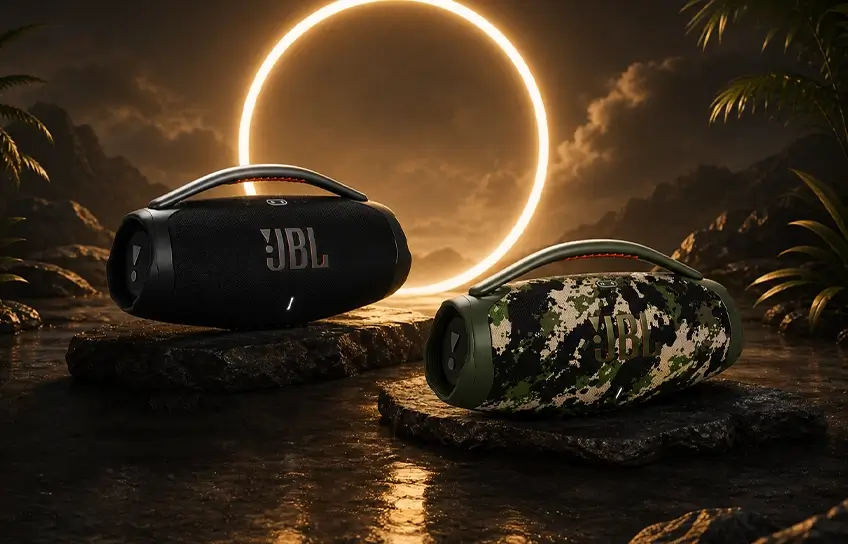
Most portable Bluetooth speakers are built for convenience. The jbl boombox 3 is built for impact. It weighs nearly 15 pounds, pumps out 180 watts of sustained power, and produces bass deep enough to feel in your chest. It is the kind of speaker people turn around to look at when you set it up at a park or a backyard.
If you are shopping for a speaker that genuinely delivers a concert-level experience wherever you take it, and you want to know exactly what you are getting before spending $500, this review covers everything you need to make a confident decision.
JBL Boombox 3 Specifications
| Specification | Details |
| Price | $499.95 USD / $599.98 CAD |
| Dimensions | 482 x 257 x 200 mm (19 x 10 x 8 in) |
| Weight | 6.7 kg / 14.7 lbs |
| Total Power Output | 180W RMS (AC) / 136W RMS (Battery) |
| Subwoofer Power | 80W (AC) / 60W (Battery) |
| Midrange Power | 2 x 40W (AC) / 2 x 30W (Battery) |
| Tweeter Power | 2 x 10W (AC) / 2 x 8W (Battery) |
| Driver Configuration | 1 Subwoofer + 2 Midrange + 2 Tweeters + 2 Passive Radiators |
| Frequency Response | 40Hz – 20kHz |
| Bluetooth Version | 5.3 |
| Audio Codec | SBC only |
| Battery Life | Up to 24 hours (at 50% volume) |
| Charge Time | Approx. 6.5 hours |
| Battery Capacity | 72.6 Wh |
| Water/Dust Rating | IP67 |
| Connections | Bluetooth 5.3, 3.5mm Aux Input, USB-A Out (charging) |
| App | JBL Portable App (iOS & Android) |
| Speaker Pairing | JBL PartyBoost |
| Colors Available | Black, Camouflage |
| Power Supply | Built-in AC power cord (no external brick) |
Build and Design

The Boombox 3 measures 19 inches wide, 10 inches tall, and 8 inches deep. It weighs 14.7 pounds, noticeably heavier than its predecessor the Boombox 2 at 13 pounds. That extra weight comes directly from the added subwoofer and the larger internal components that power its upgraded sound. The metal carrying handle, wrapped in orange silicone on the grip area, makes it manageable to carry at your side from room to room or from the car to the campsite, but this is not a speaker you will sling over your shoulder for a long walk.
The cylindrical body is wrapped in a durable fabric grille that resists scuffs and scrapes well. The speaker sits on a flat base when placed upright, but its round shape means it will roll if you lay it on its side in a car trunk without securing it. It comes in black or a camouflage colorway. On each end, two large passive radiators are visible and move noticeably with heavy bass content, giving you a real-time visual confirmation that the drivers are working at full effort.
IP67 Rating: Waterproof and Dustproof
IP67 means the speaker is fully dustproof and can survive submersion in one meter of water for up to 30 minutes. In practical terms, it handles poolside splashes, rain during an outdoor event, sandy beach conditions, and being rinsed off with a garden hose after a muddy day outside.
The ports on the back are protected by a rubber flap that must be kept closed for the rating to apply. This is one step above the IPX7 rating on the older Boombox 2, which was water-resistant but not dustproof. That extra dust protection matters more than most people realize when using a speaker near sand, soil, or gravel.
Sound Quality

The Boombox 3 delivers 180 watts RMS, which measures continuous sustained power during actual playback rather than a brief peak spike. This is why it sounds louder and fuller than competitors that advertise higher wattage using inflated peak figures. The driver setup uses a 2.1 configuration: one subwoofer, two midrange drivers, and two tweeters facing forward, with two passive radiators on either side extending bass depth.
This is the biggest change from the Boombox 2. The added subwoofer pushes low-frequency response down to 40Hz from 50Hz, a difference that is audible and physically felt on bass-heavy tracks. On Radiohead’s Creep, vocals sit forward with clear texture and the guitar shifts from quiet to distorted without losing definition. The dynamic range on a track like this is stronger than you would expect from a portable speaker.
On Kendrick Lamar’s HUMBLE., the kick drum hits with genuine thump and the 808 sub-bass sits full and low without disappearing under the midrange. This is where the dedicated subwoofer earns its place most clearly. On Al Green’s Let’s Stay Together, the horns and vocals come through cleanly without muddiness. For acoustic or classical tracks, dropping the bass one notch in the app makes the speaker more balanced and usable across genres.
Volume and Distortion
Many large portable speakers thin out or distort past 70 to 80 percent volume. The Boombox 3 does not. The subwoofer gets punchier as volume increases, and there is no noticeable distortion even at near-maximum levels.
The 180-watt RMS amplifier provides more sustained headroom than similarly sized competitors. Even in battery mode at 136 watts, there is no audible compression when pushed hard.
Battery Life and Charging

JBL advertises 24 hours of battery life, but that figure is measured at 50 percent volume. At 80 percent volume, which is a realistic level for outdoor use, real-world playback lands around 8 hours. That is enough for a full afternoon party or a day at the beach without needing to recharge mid-event. The 72.6-watt-hour battery takes approximately 6.5 hours to fully recharge from empty. Unlike the Boombox 2, which required an external power brick, the charging cable plugs directly into the speaker via a built-in AC port, making it straightforward to replace if the cable gets damaged.
When plugged into AC power, the speaker runs at its full 180-watt output rather than the 136-watt battery mode. The difference in bass punch and overall loudness ceiling is noticeable, so for a backyard setup with an outlet nearby, plugging in is worth doing. The USB-A port on the back also lets you charge a phone or tablet directly from the speaker’s battery, a practical feature during long outdoor sessions away from power sources.
The JBL Portable App
The JBL Portable app connects via Bluetooth and provides a three-band equalizer with five positions per band covering bass, midrange, and treble. It does not specify frequencies or include presets, so adjustments are made entirely by ear. The speaker’s default tuning is brighter than the Boombox 2, meaning the highs are more prominent straight out of the box.
A practical starting point for most music is raising the bass two clicks and lowering the treble one click, which produces a more balanced result across rock, pop, and acoustic tracks without over-emphasizing the low end in indoor spaces. The app also delivers firmware updates wirelessly.
JBL has pushed meaningful performance improvements since the speaker launched, so installing updates before your first serious listening session is a good habit. Beyond the EQ and updates, the app includes a user guide and the PartyBoost connection panel. It does not offer advanced features like room calibration or preset sound profiles, which some competitors include at this price, but what it does offer works reliably without unnecessary complexity.
PartyBoost and Connectivity

PartyBoost is JBL’s wireless speaker-linking system that lets you connect multiple compatible speakers to play the same audio in sync. It works directly through the button on the speaker without needing the app open. Compatible models include the Charge 5, Flip 5, Flip 6, Pulse 4, and Xtreme 3, among others.
When you pair two Boombox 3 units specifically, you can enable true stereo mode where each speaker handles a separate audio channel. Any other combination of compatible speakers plays in synchronized mono. One important limitation is that the Boombox 3 cannot connect with older JBL speakers using the Connect Plus system, so if you own a Boombox 1 or Xtreme 2, they will not pair with this model.
Bluetooth and Wired Connection
The Boombox 3 uses Bluetooth 5.3 and is designed to support two simultaneous device connections, letting two people queue music from separate phones. In practice, this feature has been inconsistent for some users, with the second device occasionally dropping its connection.
The speaker uses the SBC codec only, with no support for AAC or aptX. SBC compresses audio more than those higher-quality codecs, which can reduce fine detail in complex music. For outdoor listening at high volumes the real-world difference is minimal and most listeners will not notice, but it is a fair criticism at this price point. A 3.5mm aux input on the back provides a wired alternative that bypasses Bluetooth compression entirely if audio quality is a priority.
Price and Who It Is For
The Boombox 3 retails at $499.95 in the US and $599.98 in Canada. It regularly goes on sale for $100 to $150 off at Amazon and Best Buy, making those sale windows the better time to buy if you can wait. The Tribit Stormbox Blast is a cheaper alternative that sounds competitive at moderate volumes but loses bass precision and clarity when pushed hard.
The Sony SRS-XG500 sits in a similar price range and is a capable speaker, but it also trails the Boombox 3 in raw output and low-end depth at high volume. For buyers who want PartyBoost and IP67 protection in a lighter package, the JBL Xtreme 3 at around $279 weighs only 5.9 pounds, includes a shoulder strap, and covers most of the same core features.
The Boombox 3 makes the most sense for people who host outdoor events regularly, have a fixed spot to set the speaker up, and prioritize volume and sound quality over lightweight portability. It is not suited for long hikes or daily commutes. But for tailgates, pool days, large backyard gatherings, or any situation where music needs to genuinely fill a real space, very few portable speakers at this price deliver as consistently. You can check current pricing and availability through Amazon or directly on JBL’s website.
Pros
- 180W RMS sustained power, noticeably louder and fuller than peak-rated competitors
- Dedicated subwoofer extends bass down to 40Hz for real, felt low-end impact
- No distortion even at near-maximum volume
- IP67 rated: fully dustproof and waterproof up to 1 meter for 30 minutes
- USB-A port lets you charge your phone directly from the speaker
- PartyBoost links multiple compatible JBL speakers wirelessly with one button press
Cons
- Heavy at 14.7 lbs, not practical for long-distance carrying
- SBC-only Bluetooth codec, no AAC or aptX support
- Multipoint two-device connection is inconsistent in practice
- No shoulder strap included, unlike the JBL Xtreme 3
- Default EQ tuning is too bright and needs manual adjustment out of the box
- 6.5-hour recharge time is long for a speaker at this price
Final Verdict
The Boombox 3 earns its reputation through measurable upgrades: a dedicated subwoofer reaching down to 40Hz, 180 watts of sustained RMS power rather than inflated peak figures, a full IP67 rating that adds dust protection its predecessor lacked, and a built-in EQ that was entirely absent from earlier versions. Its weaknesses are equally real.
The SBC-only codec, the inconsistent multipoint connectivity, the absence of a shoulder strap, and the 6.5-hour recharge time are all trade-offs worth factoring in before buying. But if loud, clear, distortion-free sound in outdoor environments is the priority, the Boombox 3 does that better than anything else in its size class. Catch it on sale and it becomes one of the most capable outdoor speakers available at any price.
