


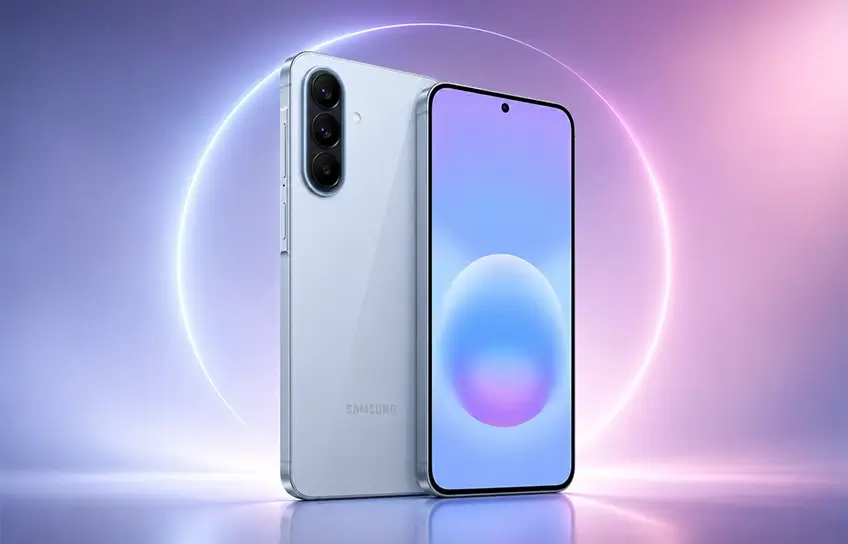
The Samsung Galaxy A57 5G is the most refined mid-range smartphone Samsung has ever built. Launched on April 9, 2026 in the US at $549, it packs a 6.7-inch Super AMOLED+ display, a new Exynos 1680 chip, IP68 water resistance, and six years of guaranteed software updates into a chassis that weighs just 179g. It is not a dramatic leap over the A56, but it is the most complete Galaxy A package to date.
Here is the angle most reviews miss: $549 spread across six years of supported ownership works out to roughly $91.50 per year. That single number reframes the entire value debate. No other Android phone in this price range offers the same combination of build quality, software longevity, and daily usability.
This review covers every angle competitors skip, from the AI chip upgrade to the microSD removal fallout, so you can decide whether this is the right phone for you. If you are still building your shortlist, start with our guide to the best mid-range 5G phones under $600 before committing.
Design and Build Quality

The Galaxy A57 5G does not look or feel like a $549 phone. That is the first thing you notice picking it up. At 6.9mm thin and 179g, Samsung shaved nearly 20g off the A56, making this the lightest Galaxy A model since the A52.
The difference between 179g and 198g is not a rounding error on a spec sheet. It is the difference between a phone you forget is in your pocket and one that drags at your side all day. Both the front and back panels use Gorilla Glass Victus+, and the aluminum frame delivers a rigidity that plastic-backed rivals like the Google Pixel 10a simply cannot replicate.
The IP68 rating is a legitimate headline upgrade. Every previous Galaxy A phone topped out at IP67. IP68 means full submersion up to 1.5 meters for 30 minutes, not just splash resistance. For real-world users, that translates to genuine confidence in the rain, around sinks, and in the hands of children.
One design flaw worth flagging: the glossy back on the darker finishes (Navy and Gray) is a serious fingerprint magnet. One touch leaves visible smears. The lighter Icyblue and Lilac options hide oils significantly better. If you plan to use the phone without a case, your color choice will affect daily satisfaction more than you might expect.
Galaxy A57 5G Design Specifications:
| Feature | Specification |
| Dimensions | 161.5 x 76.8 x 6.9mm |
| Weight | 179g |
| Frame Material | Aluminum |
| Front and Back Glass | Gorilla Glass Victus+ |
| Water Resistance | IP68 (1.5m for 30 minutes) |
| Screen-to-Body Ratio | 88.8% |
| Available Colors | Navy, Gray, Icyblue, Lilac |
| Connectivity | Wi-Fi 6E, Bluetooth 6.0, NFC, eSIM |
Samsung Galaxy A57 5G Display
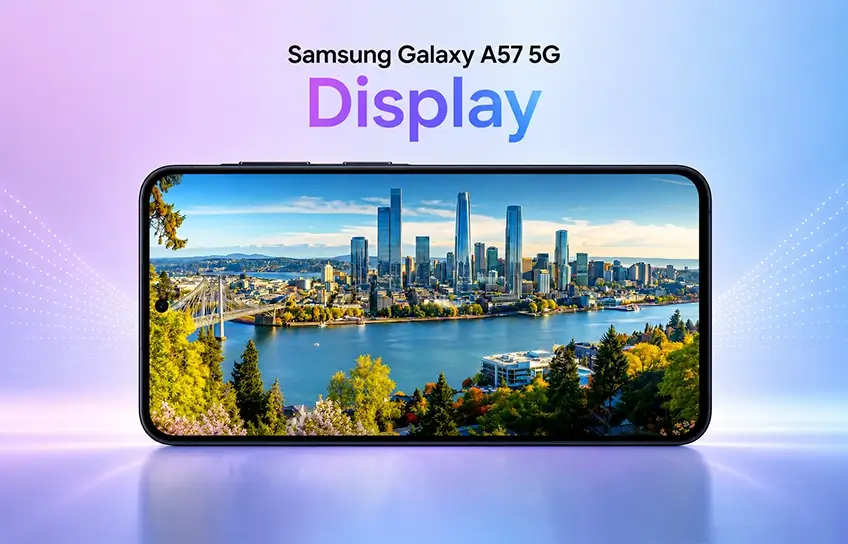
The display is one of the strongest reasons to buy this phone, and it is a more significant upgrade than it appears on paper. Samsung moved from the standard Super AMOLED panel used in the A56 to a Super AMOLED Plus panel. The difference is structural. Super AMOLED Plus uses a full RGB subpixel arrangement rather than the Diamond Pentile matrix common on mid-range AMOLED screens.
That means more subpixels per inch, sharper text, tighter icon rendering, and more accurate color output at 1080p resolution. It is also a thinner panel construction, which contributed directly to the A57’s slim 6.9mm chassis. Samsung had not used this panel technology in the A-series since the Galaxy A73.
Peak brightness reaches 1,900 nits with Vision Booster engaged, ensuring outdoor legibility in direct sunlight. In testing, recorded automatic maximum brightness hits 1,259 nits — a solid real-world number at this price point. The 120Hz adaptive refresh rate scales down automatically to 60Hz during video playback and idle states, balancing smoothness and battery efficiency without requiring manual adjustment.
For media consumption, very few phones under $600 match this screen. The 6.7-inch canvas, deep OLED blacks, and vibrant color output make it excellent for YouTube, Netflix, and social video. The Google Pixel 10a’s panel does reach 2,000 nits peak, making it marginally brighter for outdoor viewing. But at 6.3 inches, the Pixel screen is simply a smaller watching experience.
Display Comparison: Galaxy A57 5G vs. Direct Competitors:
| Feature | Galaxy A57 5G | Google Pixel 10a | Nothing Phone (4a) Pro |
| Screen Size | 6.7 inches | 6.3 inches | 6.7 inches |
| Panel Type | Super AMOLED+ | P-OLED | AMOLED |
| Refresh Rate | 120Hz adaptive | 120Hz | 120Hz |
| Peak Brightness | 1,900 nits | 2,000 nits | ~1,300 nits |
| Resolution | FHD+ (2340 x 1080) | FHD+ | FHD+ |
| HDR Support | HDR10+ | HDR | HDR10+ |
| Vision Booster | Yes | No | No |
Performance and AI
This is where the A57 gets genuinely interesting, and where most published reviews stay frustratingly shallow.
The Exynos 1680 is a 4nm chip with a tri-cluster CPU: one core at 2.9GHz, three at 2.6GHz, and four efficiency cores at 1.95GHz. Daily performance is smooth and consistent across social media, navigation, streaming, messaging, and photography. One UI 8.5 animations are fluid. App launches are fast. The 8GB RAM US model handles 10 to 15 open apps in multitasking without stutter.
For gaming, results are more context-dependent. Casual titles including Mobile Legends, Subway Surfers, and Pokémon GO run at high settings without thermal throttling. More demanding titles like Genshin Impact and Call of Duty: Mobile perform better at medium graphics settings to maintain consistent frame rates. The Exynos 1680 GPU does not match the Tensor G4 inside the Google Pixel 10a for raw graphics throughput, but for most mobile gamers, the A57 delivers a fully satisfying experience.
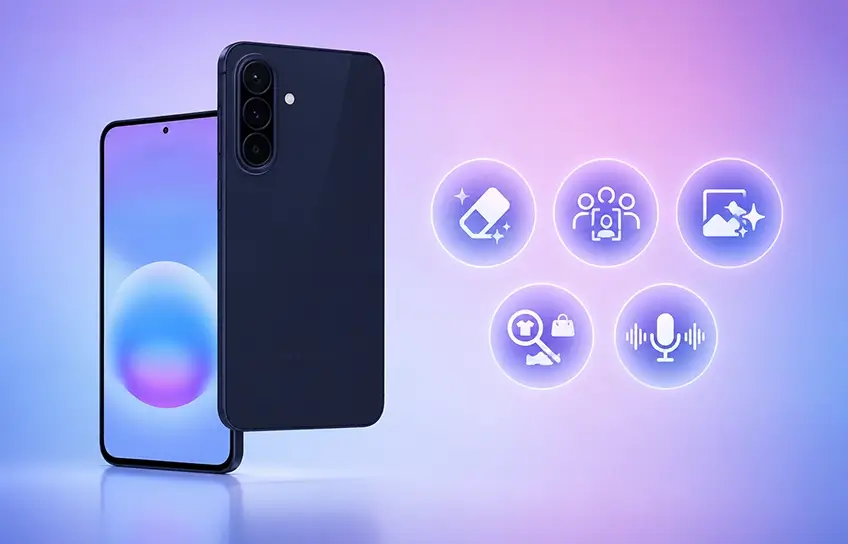
The upgrade that matters most in 2026 is the NPU (Neural Processing Unit). The Exynos 1680 scores 19.6 TOPS (Tera Operations Per Second), up 33% from the 14.7 TOPS on the A56’s Exynos 1580. That jump is what makes Samsung’s Awesome Intelligence AI features run on-device without any cloud routing:
- Object Eraser: removes people or objects from photos entirely on-device
- Best Face: selects the sharpest expression per person from a burst of group shots
- Edit Suggestions: AI-generated photo edit prompts inside the Gallery app
- Circle to Search (multi-object): search for an outfit and its accessories simultaneously from one image capture
- Live Transcription: real-time audio-to-text conversion, previously a Galaxy S-series exclusive feature
Real-World Performance by Task:
| Task | Performance Result |
| Social media and video streaming | Smooth, consistent, no dropped frames |
| Photography and AI editing tools | Fast, fully on-device processing |
| Casual gaming (Mobile Legends, Pokémon GO) | High settings, stable frame rate |
| Demanding gaming (Genshin Impact) | Medium settings recommended |
| Multitasking with 8GB RAM | 10 to 15 apps without stutter |
| AI features (Object Eraser, Circle to Search) | On-device, no internet required |
Samsung Galaxy A57 5G Camera
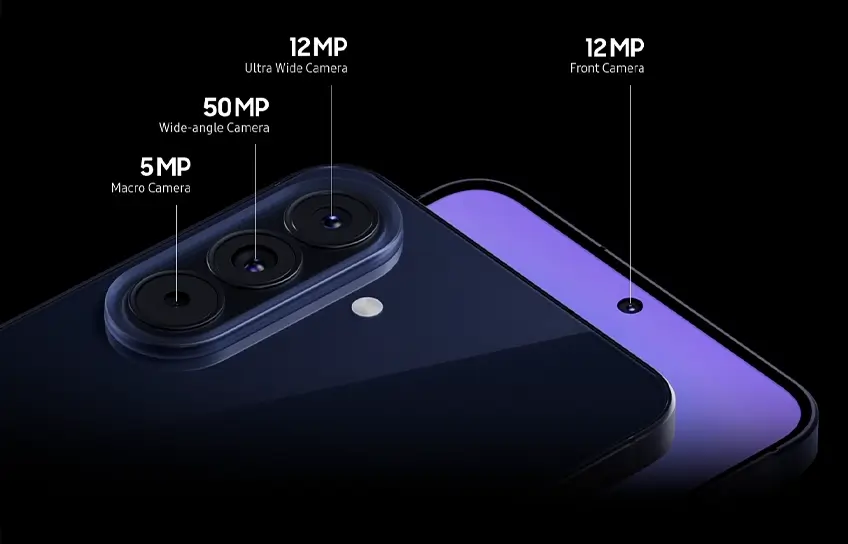
Truth is, the camera is the A57’s most polarizing feature, and the area where Samsung made the least visible change. The hardware is identical to the A56. The rear system has a 50MP primary camera with OIS, a 12MP ultrawide, and a 5MP macro lens.
The front carries a 12MP selfie camera. Samsung did not upgrade the sensors. What changed is the image signal processor (ISP) inside the Exynos 1680, which extracts meaningfully better output from the same hardware through improved computational photography.
In daylight, results are strong. Images are sharp, color-accurate, and clean at 100% crop. The OIS on the primary sensor controls handheld movement well and delivers stable 4K/30fps video. The ultrawide handles wide compositions with acceptable distortion at the edges. Selfie quality at 12MP with 10-bit HDR video support is competitive for the price tier.
Low-light performance is where the A57 shows its limits clearly. Night shots can produce visible noise, softer fine detail, and lens flares around bright light sources like neon signs or streetlamps. The OIS helps with motion, but it cannot compensate for a smaller sensor in genuinely dark environments. The Google Pixel 10a, which uses Tensor G4-powered computational photography tuned specifically for night scenes, outperforms the A57 after dark at the same price range.
Camera Strengths:
- Consistent, accurate color science in daylight conditions
- OIS delivers stable handheld stills and smooth 4K/30fps video
- Circle to Search integration turns the camera into a practical shopping and research tool
- 10-bit HDR front camera video for richer selfie content
- Best Face AI selects the sharpest expression from burst group shots automatically
Camera Weaknesses:
- Low-light noise and detail loss after dark
- Lens flares around neon signs and high-contrast bright sources at night
- 5MP macro lens is underwhelming even for this price bracket
- No telephoto lens across the entire system (same as A56 and A55)
- No charger in the box, which limits extended 4K video testing sessions
Battery Life and Charging
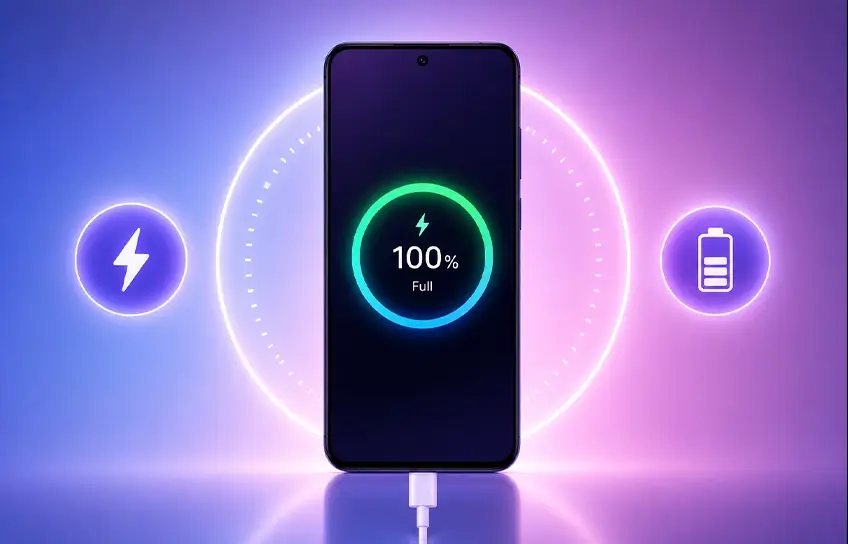
The 5,000mAh battery is the same capacity as the A56. On paper, that sounds like a missed opportunity. In practice, the Exynos 1680’s improved efficiency and the 120Hz adaptive refresh rate’s intelligent scaling deliver better real-world results than the unchanged capacity suggests.
Real-world screen-on time lands at approximately 6.5 to 7 hours with mixed daily usage including social media, browsing, camera use, and streaming. That covers a full working day for most users and stretches into the next morning under lighter loads. Heavy gaming sessions will push the figure closer to 5 to 6 hours.
45W Super Fast Charging reaches approximately 65 to 70% from flat in 30 minutes. At the $450 to $550 price range, many competitors still ship with 25W or slower charging. The A57’s 45W spec is a genuine practical advantage for users who charge in short bursts throughout the day.
Two important limitations to flag before purchasing:
- No charger is included in the box. The package contains a USB-C cable and a SIM ejector only. Budget an additional $15 to $30 for a compatible 45W USB-C charger if you do not already own one.
- No wireless charging. The Google Pixel 10a supports wireless charging at $499. The A57 does not. In 2026, its absence on a $549 phone is increasingly difficult to justify, regardless of how common the omission remains at this price tier.
Battery and Charging Specifications:
| Spec | Samsung Galaxy A57 5G |
| Battery Capacity | 5,000mAh (4,905mAh rated minimum) |
| Wired Charging Speed | 45W Super Fast Charging |
| Estimated 0 to 65% Time | Approximately 30 minutes |
| Wireless Charging | Not supported |
| Charger Included in Box | No (USB-C cable only) |
| Real-World Screen-On Time | 6.5 to 7 hours (mixed use) |
Software and Long-Term Updates

Six years of support. And that number genuinely changes the ownership calculus. The Galaxy A57 5G ships with Android 16 and One UI 8.5, the same software release that launched on the flagship Galaxy S26 series. Samsung has committed to six major Android OS upgrades and six years of monthly security patches from the March 2026 launch date, meaning guaranteed support through at least 2032.
In cost terms, $549 divided by six years equals roughly $91.50 per year of fully supported device life. No other Android phone in this price range currently matches that support duration. Google offers seven years on the Pixel 10a, starting at $499, which works out to approximately $71.30 per year. That comparison is close, and the Pixel wins on pure cost-per-supported-year. What the A57 provides that the Pixel does not is a larger display, faster 45W wired charging, and a more premium physical build.
One UI 8.5 is a polished, well-optimized software experience. Animations are smooth, the notification panel is highly customizable, and core productivity features including split-screen multitasking and Samsung’s integration with Windows via Link to Windows all work reliably. The AI assistant situation runs both Google Gemini and Samsung Bixby simultaneously, which creates some redundancy that new users may find confusing until they settle on a preference.
The bloatware is present and worth addressing directly before purchase. Pre-installed apps include Samsung Shop, Samsung TV, Samsung News, My Galaxy, M365 Copilot, Outlook, LinkedIn, and Facebook. Most can be removed during initial setup or uninstalled afterward through Settings. One persistent exception is Glance, a lock screen AI feature that can override your wallpaper even after you decline it during setup. Disabling it manually inside Settings takes about 60 seconds, but it should not require manual intervention at all.
Software and Long-Term Support Comparison:
| Phone | Launch Price | OS Updates | Security Updates | Approx. Cost Per Year |
| Samsung Galaxy A57 5G | $549 | 6 years | 6 years | ~$91.50 |
| Google Pixel 10a | $499 | 7 years | 7 years | ~$71.30 |
| Nothing Phone (4a) Pro | ~$399 | 3 years | 4 years | ~$133.00 |
| Samsung Galaxy S25 FE | $500 | 4 years | 4 years | ~$125.00 |
MicroSD Slot Removal: What It Means and What to Do About It
The microSD slot is gone from the Galaxy A57 5G. Samsung removed it permanently, continuing a trend that began with the A56.
This is not a footnote. For a large share of mid-range buyers who relied on inexpensive expandable storage, it represents a genuine loss of flexibility. Samsung’s official response is the new 512GB internal storage option, a first for the Galaxy A-series. But purchasing additional internal storage to compensate for a removed feature is a fundamentally different proposition from choosing your own storage terms on your own timeline.
Practical alternatives if you buy the A57 5G:
- Buy the 256GB model as your baseline. The 128GB tier is too constrained within 12 to 18 months of active camera use, especially with 4K video.
- Enable automatic cloud backup on day one through both Google Photos and Samsung Cloud. This is the most friction-free way to prevent storage anxiety without active management.
- Keep a USB-C OTG adapter and a small thumb drive for bulk file transfers and emergency overflow. A quality adapter costs under $10 and handles the task without requiring an internet connection.
- Avoid the 512GB storage tier at any price near $700. At that level, the Samsung Galaxy S25 FE becomes the smarter buy with a more powerful chipset at a lower total cost.
If expandable storage is genuinely non-negotiable for your workflow, the Samsung Galaxy A37 5G retains a microSD slot at a lower price point and is worth comparing directly before committing to the A57.
Should You Buy the Samsung Galaxy A57 5G?
Not every phone fits every buyer. Here is a clear breakdown by purchase profile.
Buy the Galaxy A57 5G if you are:
- A long-term keeper who wants one solid phone for five to six years without upgrade pressure. The six-year support window, IP68 body, and Gorilla Glass Victus+ durability make this a defensible multi-year buy.
- A content consumer who watches a lot of video. The 6.7-inch Super AMOLED+ display is among the best screens available in mid-range Android in 2026.
- Someone who values build quality over raw benchmark scores. Aluminum frame, Gorilla Glass front and back, and IP68 represent a hardware package that beats most competitors at this price tier.
- A first-time Galaxy A buyer upgrading from a budget Android phone. One UI 8.5 is approachable, well-animated, and noticeably more polished than stock Android alternatives.
Look at alternatives if you:
- Prioritize low-light camera performance. The Google Pixel 10a’s computational photography, particularly its night mode, outclasses the A57 after dark at $499.
- Want wireless charging. The Pixel 10a supports wireless charging. The A57 does not. At $549 in 2026, that omission carries real weight.
- Need expandable storage. The Samsung Galaxy A37 5G keeps the microSD slot and sits at a lower entry price for storage-flexible buyers.
- Prefer a compact phone. At 6.7 inches, the A57 is a large device. The Pixel 10a at 6.3 inches is a meaningfully more manageable one-handed experience.
- Are considering flagship performance. The Samsung Galaxy S25 Ultra operates in a completely different tier, with the Snapdragon 8 Elite chip, a 200MP primary camera, and the S Pen ecosystem. It targets power users who need the absolute best, not buyers optimizing for mid-range value.
The comparison that matters most is the Galaxy S25 FE at $500. It is $49 cheaper at launch, includes a more powerful chip in select configurations, and carries Samsung’s flagship design aesthetic. At full price, the S25 FE represents stronger immediate value.
The A57 counters with a six-year support window (versus four years on the S25 FE), a lighter 179g build, and IP68 certification. If the S25 FE drops to $430 to $450 on sale, it becomes the clear winner. At launch prices, both phones make a reasonable case depending on whether you optimize for today’s specs or long-term ownership.
For buyers who want a distinctive aesthetic and can accept a shorter update commitment, the Nothing Phone (4a) Pro is a credible option. Its Glyph Interface is practically useful for notifications, its hardware has improved substantially over previous generations, and it launches at a lower starting price than the A57.
Conclusion
The Samsung Galaxy A57 5G is the most complete Galaxy A smartphone Samsung has shipped to date. It is not a specification revolution over its predecessor, but it is a purposeful refinement that gets the fundamentals right: a class-leading 6.7-inch Super AMOLED+ display, a slim 179g premium chassis, first-ever IP68 water resistance in the A-series, capable on-device AI through the Exynos 1680 NPU, and a six-year software commitment that no comparable phone at this price fully matches.
The trade-offs are genuine. There is no microSD slot, no wireless charging, no charger in the box, and the low-light camera has clear limits relative to the Google Pixel 10a. Buyers who prioritize any of those features should look at alternatives before committing.
