


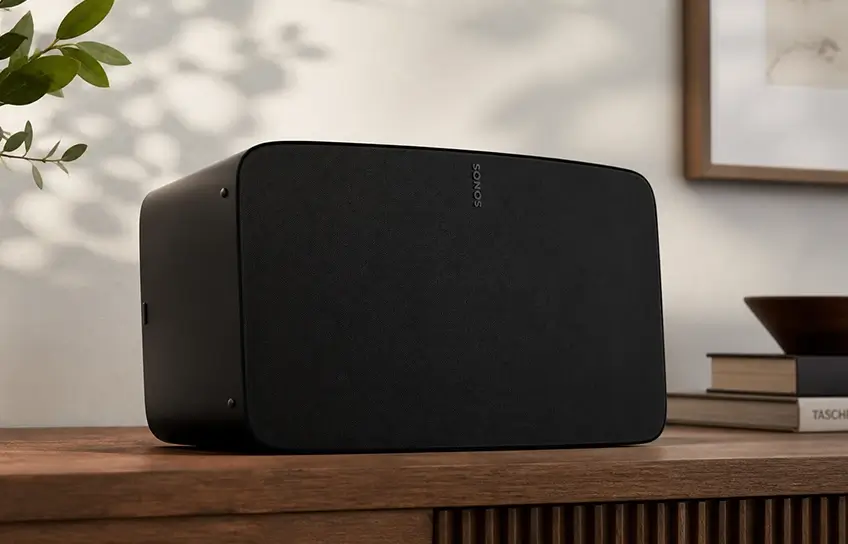
Shopping for a premium home speaker is rarely straightforward. Walk into any audio store or scroll through any tech site and you will find yourself comparing dozens of options at wildly different price points. Compact, budget-friendly options like the jbl clip 4 serve a completely different purpose than what we are talking about here. The Sonos Five sits in an entirely different category: a serious, stay-at-home speaker built for people who want real, room-filling audio without compromise.
But in 2026, with newer Sonos models on the market and competition fiercer than ever, does it still make sense to buy one? That is exactly what this review sets out to answer. Released in June 2020 as the successor to the widely respected Play:5 Gen 2, the Sonos Five kept the same six-driver architecture, added a faster quad-core processor, improved Wi-Fi stability, and introduced Apple AirPlay 2 support. It was a focused upgrade rather than a reinvention.
Six years on, that decision looks smart. The core hardware still outperforms many newer competitors, and the Sonos app remains one of the most reliable multi-room platforms available.
Sonos Five Specifications
Before diving into the details, here is a complete look at the key specs at a glance.
| Specification | Details |
| Drivers | 3 mid/bass woofers + 3 tweeters (6 total) |
| Amplification | 6 x Class D amplifiers |
| Dimensions (HxWxD) | 20.3 x 36.4 x 15.4 cm |
| Weight | 6.36 kg (14 lbs) |
| Wireless Connectivity | Wi-Fi (802.11b/g/n), Apple AirPlay 2 |
| Bluetooth | No (BLE for setup only) |
| Wired Inputs | 3.5mm analogue line-in, Ethernet |
| Voice Control | Via external Sonos mic-equipped speaker |
| Room Calibration | TruePlay (iOS only) |
| Stereo Pairing | Yes (two Sonos Five units) |
| App Support | Sonos S2 app (iOS and Android) |
| Streaming Services | Spotify, Apple Music, Amazon Music, and more |
| Humidity Resistance | Yes |
| Available Colours | Matte Black, Matte White |
| Price (USD) | $549 (approx. $569–$599 at retailers) |
| Release Date | June 2020 |
Design and Build Quality

The Sonos Five wireless speaker is available in matte black or matte white, with a grille that is precisely colour-matched to the main body for a clean, seamless look. The cabinet shape is slightly trapezoidal, wider at the front than the rear, which is a deliberate acoustic decision rather than a style choice. Three capacitive touch controls sit along the top edge for play/pause and volume, and a swipe gesture lets you skip tracks without opening any app. It is a well-considered physical layout that keeps the speaker uncluttered and easy to use in daily life.
When it comes to sonos five dimensions, the speaker measures 20.3 x 36.4 x 15.4 cm and weighs around 6.36 kg. It is not a lightweight device, but that heft speaks to the quality of materials used inside and out. Rubber feet on three sides allow it to be placed either horizontally or vertically, which becomes important when you decide to use two of them as a stereo pair. The build quality is excellent throughout, which is consistent with what Sonos has always delivered across its product range.
Features and Connectivity

Inside the cabinet, six Class D amplifiers power six individual drivers: three mid/bass woofers, two outward-angled tweeters, and one forward-facing tweeter. This arrangement is specifically designed to push sound wide rather than just straight ahead, which makes a noticeable difference in a larger room. If you look at the sonos five specs, you will also find Bluetooth Low Energy for setup, an Ethernet port, a 3.5mm analogue input, and Wi-Fi connectivity for everyday streaming. That combination of wired and wireless options gives you real flexibility depending on your setup.
One of the more useful features is sonos five airplay 2 support, which allows Apple users to send audio directly from any app on their iPhone, iPad, or Mac straight to the speaker. This includes streaming video platforms, podcast apps, and music services, making it a much more flexible option for Apple households than the Wi-Fi-only setup might initially suggest. Android users rely on the Sonos app and Spotify Connect for their primary streaming, which works well, though it is worth knowing upfront that Bluetooth audio streaming is not available.
TruePlay Room Calibration
One of the standout software features on the Sonos Five is TruePlay, a room calibration tool available through the Sonos app on iOS. The process involves walking around your room while the speaker emits test tones and your phone microphone picks up how those tones interact with your space. It sounds odd, but it works remarkably well.
Without TruePlay, the Five can sound overly bass-heavy in certain rooms. With it active, the sound becomes noticeably more balanced and controlled. If you are an Android user, you would need to borrow an iPhone to run the calibration, which is a small inconvenience worth knowing about.
Stereo Pairing Potential
Using a single Sonos Five in landscape orientation already gives you a wide stereo image, because the angled tweeters push sound to the left and right. But pairing two units together takes the experience to a different level entirely. When synced as a stereo pair, each speaker handles its own channel and the soundstage opens up considerably.
You can also use them as rear surround speakers in a Sonos home cinema setup with a Sonos Arc. The flexibility here is genuinely useful, and it is one of the main reasons people invest in two units rather than stopping at one.
Sound Quality in Large Rooms

This is where the Sonos Five earns its reputation. The low end is deep and punchy, capable of moving real air in a large space without becoming muddy or uncontrolled. Once TruePlay has done its job, bass sits firmly in support of the music rather than dominating it. Midrange detail is clear and forward-projecting, which means vocals and lead instruments cut through properly. The treble is slightly softened at the very top of the range, which keeps the speaker sounding smooth at high volumes rather than sharp or fatiguing.
Volume capability is one of the Five’s most impressive traits. It can fill a large living room, an open-plan kitchen, or a generous bedroom without any strain. Importantly, it maintains its character as you turn it up. The sound does not thin out or distort at higher levels, which is something cheaper speakers often struggle with. For anyone who has ever been disappointed by a speaker that sounded great at moderate volume but fell apart at party levels, this consistency is genuinely satisfying.
Independent audio testing by DXOMARK gave the Sonos Five a strong overall score of 147 in their speaker rankings at the time of testing, with particularly high marks for dynamics, artifact control, and volume consistency. It scored well across a range of use cases including music, movies, and background listening. It is not the absolute last word in high-resolution audio playback, but for streaming music in real-world home environments, it performs at a level that most listeners will find more than satisfying.
Price, Value, and Who It Is For
The sonos five price sits at around $549 in the United States and £499 in the UK, which places it firmly in premium territory. That is a significant amount of money for a single speaker, and it is important to go in with clear expectations. This is not an entry-level purchase, and it is not designed for someone who wants background music in a small office. It is built for people who want the best wireless audio experience in a medium to large room, particularly those who are already invested in or planning to build a Sonos multi-room system.
At this price, the Sonos Five is competing directly with speakers like the Bose Home Speaker 500 and the Amazon Echo Studio. The Bose offers Bluetooth and a wider retail availability, while the Echo Studio adds Dolby Atmos and Alexa built-in, both at a lower price. What the Five offers in return is noticeably superior volume output, deeper bass control, and a multi-room ecosystem that is significantly more stable and polished than either alternative.
If you are buying a single speaker and multi-room is not on your radar, the Five faces real competition. If you are building a home audio system, it justifies its cost clearly. It is also worth monitoring for occasional discounts through major retailers, as the sonos five release date of June 2020 means it has been on the market long enough to appear in sales from time to time.
How It Compares to Newer Sonos Models
The Sonos Era 300 is the newer, more feature-rich option in the Sonos lineup and it does offer a more expressive and spatially immersive listening experience, particularly for those interested in spatial audio formats. Side by side, the Era 300 sounds more nuanced and textured on complex musical arrangements. However, the Five goes louder and has a stronger physical presence in a room. If spatial audio is not a priority for you, the Five remains a very strong choice, and many listeners will prefer its more direct, powerful delivery.
Looking at the sonos five specifications against competitors outside the Sonos family, it holds its own well. Products like the Bose Home Speaker 500 and Harman Kardon Citation 200 offer Bluetooth connectivity that the Five lacks, which matters in some households. But neither matches the Five for raw volume, bass depth, or multi-room integration ease. The KEF LSX offers more comprehensive connectivity and hi-res audio support, but at a steeper total cost when configured as a stereo pair.
Pros and Cons
Pros
- Powerful, room-filling sound that handles large spaces with ease
- Wide stereo dispersion thanks to angled tweeters
- Can be paired as a true stereo pair with a second Sonos Five
- TruePlay room calibration produces noticeably better audio balance
- Excellent build quality with a clean, minimal design
- Deep integration with the Sonos multi-room ecosystem
- Apple AirPlay 2 support for seamless use across Apple devices
- Consistent sound quality even at high volume levels
Cons
- No Bluetooth audio streaming, which limits flexibility for some users
- Bass can be overwhelming without TruePlay calibration active
- TruePlay is only available via iOS, inconvenient for Android-only households
- Expensive, especially when buying two units for stereo pairing
- No built-in microphone, so voice control requires a separate Sonos device
- No hi-res audio support at the time of this review
Final Verdict
The Sonos Five is not trying to be everything to everyone, and that focus is exactly what makes it work. It is built for one job: filling a medium to large room with powerful, controlled, and enjoyable audio over Wi-Fi, day after day, with minimal fuss. At that job, it still ranks among the best available in 2026.
The missing Bluetooth is a real gap if guests regularly want to play music from their own phones, and the iOS-only TruePlay requirement is an ongoing frustration for Android households. But if you can work around those limitations, the Five rewards you with volume, clarity, and long-term reliability that cheaper alternatives simply cannot match.
Who should buy it: anyone building or expanding a Sonos system, music listeners who prioritise sound quality in a large room, and Apple users who want seamless AirPlay 2 integration. Who should look elsewhere: buyers who need Bluetooth, those happy with a single room and a tighter budget, or anyone drawn to the newer Era 300 for its spatial audio capabilities.
