


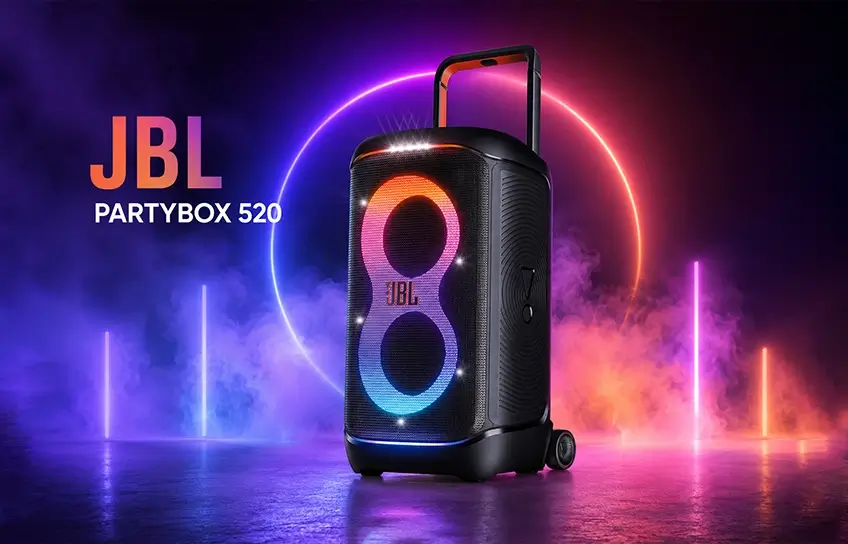
I will be honest with you. When the PartyBox 520 showed up at my door, my first thought was that it was way bigger than I expected. The box alone takes up serious floor space. My second thought, after rolling it out and powering it on for the first time, was that I completely understood why people spend $799 on a party speaker.
I spent a full week with this thing. I ran it at a backyard gathering with around 30 people, used it for a late-night karaoke session in my basement, and pushed it through regular evening listening at home across different volume levels and genres. The unit I tested ran firmware version 25.17.10 with JBL PartyBox app version 3.11.5. This review is everything I noticed, including the parts that surprised me and the parts that genuinely annoyed me.
If you want the short version: the PartyBox 520 is a very good speaker for the right person. But the right person is more specific than the marketing suggests, and I want to help you figure out if that person is you.
JBL PartyBox 520 Quick Specs
| Feature | Detail |
| Output Power | 400W |
| Drivers | 2x 7.5-inch woofers, 2x 1-inch dome tweeters |
| Frequency Response | 40Hz to 20kHz |
| Bluetooth | 5.4 with Auracast |
| Battery Life (rated) | Up to 15 hours |
| Battery Life (real-world) | Around 8 hours with lights and Bass Boost on |
| Battery Type | Removable 99Wh lithium-ion |
| Fast Charge | 10 minutes = approximately 2 hours playback |
| Full Charge Time | Around 3 hours |
| Water Resistance | IPX4 splash resistant |
| Weight | 56.2 lbs / 25.5 kg |
| Wired Inputs | 2x XLR/6.35mm combo, USB-C audio, 3.5mm AUX |
| Daisy Chain | Yes, via 3.5mm |
| App | JBL PartyBox app, iOS and Android |
| Price | $799 |
The First Time You See It
Nothing on the product page quite prepares you for the physical presence of this speaker. It stands roughly two and a half feet tall with a wide base, a metal grille, and subtle orange accents that tie it to the rest of the PartyBox family. The build feels dense and serious throughout. Tapping the housing gives you a solid thud, not the hollow knock you get from cheaper party speakers.
The telescopic handle and rear wheels change the whole experience of moving it. Rolling it across a patio or down a hallway feels like pulling a carry-on suitcase. Smooth, manageable, one-handed. The moment that changes is the second you hit a staircase. At just over 56 pounds, carrying this thing up more than a few steps is a genuine workout. I had to ask for a second pair of hands to get it into my basement, and that is worth knowing before you commit.
One small thing I noticed during the first day: the rubber flap covering the rear input panel kept popping open on its own when I rolled the speaker across the concrete in my driveway. It is not a serious issue but it happened consistently on rougher surfaces. Something to keep an eye on if you plan to move it around regularly outdoors.
The IPX4 splash rating handled a drink spill without any drama, and a light drizzle during the outdoor session did not cause any concern. It is not a speaker you want to leave out in heavy rain, but for real-world party situations the protection holds up fine.
Getting Started Is Genuinely Easy
I had music playing within about 45 seconds of unboxing. Power on, press Bluetooth, find it on my phone, done. There is no mandatory app setup, no account creation, no pairing ritual. For a speaker at this price that has this many features, the out-of-the-box simplicity was a genuine relief.
The top panel is where you spend most of your time. Volume knob on the right, lighting knob on the left, three programmable sound effect buttons in the middle that come preloaded with party drops you can fire off during a gathering. There is a Bass Boost button with two settings, a play and pause button, and the Bluetooth and Auracast controls. Everything is labeled clearly and the knobs have a satisfying, weighted feel when you turn them.
The microphone section has its own separate controls for volume, bass, treble, and echo. That separation matters more than it sounds. At the backyard event I hosted, I was constantly adjusting the mic level between songs without accidentally touching the music volume. It saved a lot of awkward moments.
The JBL PartyBox app is free and worth the two minutes to download. You do not need it to run the speaker, but it unlocks the 7-band EQ, full lighting customization, DJ-style effects through the Sound Lab, and the Auracast multi-speaker setup. I found myself using it primarily for the EQ and lighting, and occasionally triggering sound effects through the effects pad during the backyard session, which got more laughs than I expected.
How It Sounds

This is where my expectations got genuinely recalibrated.
Most speakers this size and this loudly marketed lean so hard into bass that everything else falls apart. The PartyBox 520 does not do that. The sound signature is a mild V-shape, meaning the low and high ends are slightly elevated while the mids stay clean and present. Vocals sit clearly in the mix. The high end is detailed without the harshness that usually shows up at high volumes on competing party speakers.
I tested it across a pretty wide range of music. Playing Uptown Funk by Bruno Mars, the brass stabs came through with real punch and the bassline stayed tight and controlled rather than blooming into a muddy low-end mess. Switching to Hotel California by Eagles, the acoustic guitar fingerpicking separated cleanly and the vocal harmonies were distinct rather than blurring together. Running Kendrick Lamar’s HUMBLE., the 808 bass hits landed with physical impact without losing the clarity of the snare sitting on top.
Indoors at around 15% volume the speaker fills a standard living room easily. Most home listening happens between 15 and 30%, and that range sounds excellent. Outdoors at the backyard event I ran it between 50 and 65% for most of the evening, and it comfortably covered a space with 30 people without anyone struggling to hear each other across the yard.
The AI Sound Boost feature works in the background while you listen. It analyzes the incoming signal and adjusts the driver output in real time to reduce distortion as you approach the volume ceiling. Whether or not you care about what it is doing technically, what you notice in practice is that the speaker holds together cleanly at high volumes in a way that cheaper party speakers do not. The sound does not suddenly get harsh or congested when you push past 70 or 75%. It just gets louder and stays composed.
Bass Boost offers two settings. Deep adds a chest-thumping low rumble that works well for hip-hop and electronic music indoors. Punchy tightens the low end for a livelier feel on kick drums that suits rock and live recordings better. I kept it on Deep for most of the outdoor session and switched it off for the karaoke evening, where the added bass was muddying the vocal frequencies more than it was helping.
One thing worth knowing: the speaker is front-facing. Standing directly in front of it gives you the full, wide sound. Moving significantly off to the side, you lose some of that fullness. At the backyard gathering this meant I thought carefully about placement. I positioned it in a corner at a slight angle so both the main gathering area and the side patio got reasonable coverage. It worked, but it required more thought than an omnidirectional speaker would have needed.
Battery Life

JBL rates this speaker at 15 hours of playback. That number is real under very specific conditions: moderate volume around 40%, lights turned off, Bass Boost left alone. Those are not the conditions of a party.
In my real testing across the backyard event and the karaoke session, running the lights, Bass Boost on Deep, and volume sitting between 55 and 65%, the battery came in at just under 8 hours before I switched to AC power. That is still a strong result for a 400W speaker. I was genuinely impressed it lasted that long under those conditions. But it is a meaningful difference from the headline number, and planning a 12-hour outdoor event on a single charge without a backup plan would be a mistake.The
saving grace is the removable battery design. The battery sits behind a tool-free door on the rear of the speaker. Swapping it out takes less than a minute and the speaker does not lose its settings or require re-pairing after a swap. Buying a second JBL Battery 600 and keeping it charged is the most practical solution for long events. You essentially double your unplugged runtime with zero interruption.
Fast charging is also available via USB-C. Ten minutes of charge delivered roughly 90 minutes of real playback in my testing, which is close enough to JBL’s two-hour claim. A full charge from empty took about three hours with the speaker off. You can also run the speaker continuously from AC power, which removes the battery question entirely for indoor setups near an outlet.
Connectivity

The rear panel has more going on than most people expect when they buy this as a Bluetooth party speaker.
The dual XLR and 6.35mm combo jacks are the standout feature for anyone who wants to do more than stream music from a phone. At the karaoke session I ran two microphones simultaneously through these inputs, each with their own volume and echo settings. The vocals stayed clean and separated from the music playback even at louder levels. Adding a moderate amount of reverb through the mic knob gave both singers a warmer, fuller sound that made the whole thing considerably more fun than it would have been with dry, unprocessed vocals.
The USB-C port handles both audio playback and phone charging at 30W. That dual function is quietly useful. During the backyard event I had a phone plugged in for audio playback and charging at the same time, which kept the host’s phone topped up without needing a separate power bank nearby.
Auracast multi-speaker connectivity works reliably. I tested it briefly with a second compatible JBL speaker and the sync was stable with no noticeable lag between units. For larger venues where a single speaker cannot cover the whole space, this is a genuine practical feature rather than a marketing checkbox.
The daisy chain sockets let you wire multiple speakers together with standard 3.5mm cables for a larger connected setup. It is a more old-fashioned approach compared to Auracast but it works with any speaker that has an AUX input regardless of brand.
If you want a smaller companion speaker for a secondary room or a quieter zone, the JBL Flip 5 pairs well as a secondary speaker while the 520 handles the main space. For everyday portable use away from events, the JBL Go 5 is the kind of compact option that fills in where the 520 is clearly overkill.
The Light Show Is Better Than I Expected

I went into this review expecting the LED effects to be fine but not remarkable. I was wrong.
The front panel has a large figure-eight light bar that wraps around both woofers, white strobes across the grille, and reactive strips along the top and bottom edges. Six preset modes cover different visual personalities: Rock is aggressive and fast, Chill is slow and atmospheric, Flow creates smooth color gradients, and Rave does exactly what the name suggests. All of them sync to the beat of the music automatically.
In a dark room or after sunset outdoors, the effect is genuinely impressive. The colors are vivid, the diffusion is smooth, and nothing about it looks cheap or toy-like. At the backyard gathering, people who had never seen a PartyBox before walked up to look at it up close. The lights were a conversation starter on their own.
Through the app you can customize colors, toggle individual lighting zones on and off, and build combinations that suit the mood of the event. If you want no lights at all, pressing the center button on the lighting knob turns everything off in one press. For people who only care about sound, the lights are completely optional and easily ignored.
How It Compares to the Alternatives
I have spent time with enough speakers in this category to put the 520 in honest context.
| Speaker | Price | Output | Battery | Key Difference |
| JBL PartyBox 520 | $799 | 400W | 15hr rated / ~8hr real | Best all-round balance of power and portability |
| JBL PartyBox Stage 320 | ~$499 | 240W | 18hr rated | Lighter, longer battery, no XLR inputs |
| JBL PartyBox 710 | ~$699 | 800W | None, AC only | More bass, zero portability without power |
| JBL PartyBox 720 | ~$999 | 800W | 15hr rated | More power, heavier, costs $200 more |
| Soundboks 4 | ~$999 | 216W | 40hr rated | Far longer battery, much less output, no XLR |
The Stage 320 is the most common alternative buyers consider. It is lighter and lasts longer on a charge, but the step down in output is significant, and the lack of XLR inputs removes the microphone and instrument flexibility entirely. For casual use at smaller gatherings it makes sense. For anything larger, the gap in capability shows quickly.
The 710 is the one I get asked about most. It is louder and the sub-bass goes deeper, but it has no battery at all. Running extension cables to power a speaker at an outdoor event is a real practical headache, and for most buyers the 520’s 400W is already more power than they will ever fully use. The 710 makes sense for a fixed indoor venue. Not much else.
The Soundboks 4 is the most interesting comparison. It is lighter, the battery lasts dramatically longer, and it handles rougher outdoor conditions. If you are carrying a speaker on foot to a park, beach, or camping trip, the Soundboks wins that specific argument. But it delivers less than half the output of the 520, has no XLR inputs, and costs more. For events with a power source nearby and real output demands, the 520 is the stronger choice.
For a solid step down in price without completely sacrificing the PartyBox experience, the JBL Boombox 3 is worth looking at. It handles smaller outdoor gatherings well and moves much more easily. The JBL Charge 4 sits below that, built for personal and small-group use rather than event coverage.
Who This Speaker Is Actually For
The ideal buyer hosts outdoor or large indoor events with some regularity. Not once a year. Regularly. Backyard barbecues, birthday parties, garage hangouts, family reunions where the crowd is big enough that a regular Bluetooth speaker disappears in the noise. Someone who wants to plug in a microphone, a guitar, or a DJ mixer without buying separate equipment. Someone who wants battery freedom for outdoor venues without power access.
This speaker is probably not the right choice if you mostly entertain a small group indoors, if you need to carry it by hand up and down stairs regularly, or if your budget is already stretched to reach $799. At smaller volumes in a smaller space, you are paying for power you will never actually use.
The weight is the most honest limiting factor. Wheels help enormously on flat ground. On stairs, in a car trunk, or anywhere that requires lifting, 56 pounds is 56 pounds and there is no clever engineering that changes that reality.
Final Thoughts
After a full week of real use across different settings, the PartyBox 520 delivered on the things that matter most. The sound quality is better than you expect from a speaker marketed this aggressively toward parties. The battery is genuinely flexible in ways that most competing speakers are not. The connectivity goes deeper than casual Bluetooth listening. The light show is better in person than any photo communicates.
The limitations are real. It is heavy. The honest battery life under party conditions is roughly half the headline number. The front-facing design requires more thought about placement than an omnidirectional speaker. The rubber flap on the rear panel is loose enough to become a minor irritation outdoors.
None of those are dealbreakers for the person this speaker is built for. If you host regularly, need real output, and want a speaker that handles microphones, instruments, and multi-speaker setups without extra equipment, the $799 is justified. The best speakers at this price range rarely do all of this in one package.
If you are still on the fence about whether this is the right size, spend a week honestly thinking about how often and where you actually use a speaker. The answer to that question will tell you whether the 520 makes sense or whether something smaller and cheaper does the same job for your life.
