


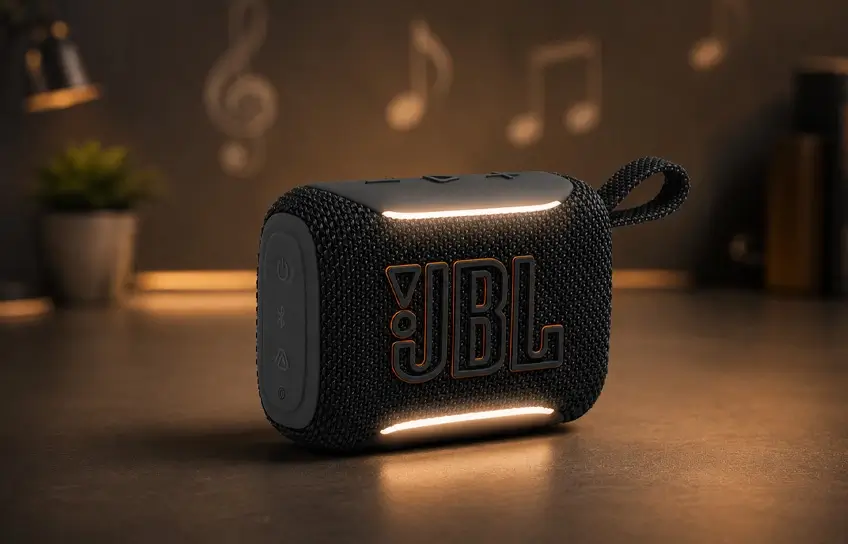
Playing music through your phone speaker in 2026 is the audio equivalent of eating a great meal off a paper plate. It technically works. Nobody’s impressed. The JBL Go 5 exists to fix that problem for under $55, and after spending serious time with it, the verdict is mostly good news.
The JBL Go 5 is a palm-sized Bluetooth speaker that launched in April 2026 at $54.95 / £39.99. It fits in a jacket pocket, survives a pool splash, runs for up to 10 hours, and sounds dramatically better than anything built into your phone. If you’re shopping for the JBL Clip 4 or similar compact speakers, the Go 5 deserves a look before you decide.
But here’s the thing nobody says clearly: a single Go 5 is a solid personal speaker. Two Go 5s together are a completely different product. That distinction matters more than any spec on the sheet.
JBL Go 5 Specifications
| Specification | Detail |
| Price | $54.95 / £39.99 |
| Driver | 45mm full-range |
| Output Power | 4.8W RMS |
| Frequency Response | 100Hz to 19kHz (-6dB) |
| Bluetooth | 6.0 (SBC, AAC, LC3) |
| USB-C Audio | Yes, lossless wired playback |
| Battery | 8 hrs / 10 hrs with Playtime Boost |
| Charge Time | ~3 hours |
| IP Rating | IP68, dust-proof, drop-proof |
| Dimensions | 101 x 77.4 x 43mm |
| Weight | 230g |
| Microphone | No |
| Stereo Pairing | AirTouch (tap two Go 5s together) |
| Multi-Speaker | Auracast |
| Colors | Black, Blue, Pink, Purple, Red, Squad (camo), White |
| App | JBL Portable (iOS and Android) |
Design and Build Quality

Pick up the Go 5 and the first thing you notice is that it’s heavier than it looks. At 230g, it has a density that cheap speakers don’t. The chassis uses 80% post-consumer recycled plastic, the grille is 100% recycled fabric, and the whole thing feels built to survive actual life rather than just sit on a shelf.
The design is almost identical to the Go 4 at a glance. Same boxy-but-rounded shape, same mesh grille, same integrated loop strap on the side. JBL hollowed out the front logo this time, which reportedly helps sound projection, and rounded the edges slightly for a better in-hand feel. It’s not a dramatic reinvention. It’s a careful refinement.
The two LED strips running along the top and bottom of the grille are the most obvious visual change. Four lighting modes are available through the JBL Portable app:
- Bounce: pulses loosely in rhythm with music
- Loop: a smooth, continuous flow pattern
- Freeze: static ambient glow at set brightness
- Switch: alternates between top and bottom strips
One honest limitation worth knowing upfront: you cannot change the LED color. The Blue model glows blue. The Pink model glows pink. If you want RGB customization, the Tribit StormBox Mini+ offers that for $15 less. The Go 5’s lighting looks clean and intentional, but it is not customizable beyond pattern.
The loop strap is non-adjustable but durable. It handles bag clips, bike handles, and a lot of casual spinning on a finger without showing wear. Controls sit logically on the unit: volume and playback on top, power and Bluetooth and Auracast down the left side. Everything responds on the first press.
One thing missing from the box: no USB-C cable. You will need to supply your own, which is increasingly standard across the industry but still worth knowing.
How Does the JBL Go 5 Sound?

This is where the review actually matters, and where most buyers are going to be surprised.
The Go 5 runs a 4.8W amplifier through a single 45mm full-range driver. Output power is up 14% over the Go 4’s 4.2W, and the difference is audible. Vocals are cleaner. The midrange has more presence. Bass is tighter and more defined, though you need to be realistic about what a 45mm driver at 100Hz can physically do.
Listening across a range of genres gives a clear picture of what this speaker does well and where it hits its ceiling.
Track-by-track breakdown:
- Pop and R&B: vocals sit front and center with real clarity. “First Light” by Lana Del Rey felt genuinely intimate through the Go 5, with the string section coming through with agility rather than getting compressed into mush. The “T” and “S” sounds stayed crisp without turning harsh.
- Rock: dense, layered tracks like Evanescence’s “Who Will You Follow” tested the Go 5 against a wall of competing sound. Distorted guitars had actual grit, and Amy Lee’s vocals didn’t get swallowed by the arrangement. Compression appears at top volume, but it doesn’t tip into tinny or shrill.
- Electronic and house: the Go 5 handles rhythmic material well. High-frequency percussion comes through with good attack and definition. Bass drops are present and clean rather than muddy, though don’t expect to feel them in your chest.
- Podcasts and spoken word: genuinely excellent. The midrange clarity that benefits vocals makes the Go 5 one of the better desk speakers for talk content at any price in this category.
The 7-band EQ in the JBL Portable app rewards a few minutes of tuning. A small bump in the low-mid range adds warmth without sacrificing clarity. The JBL Signature preset is a reasonable starting point, but spending time on the custom EQ gets you closer to how you actually want things to sound for your listening habits.
One thing competitors don’t say clearly enough: Playtime Boost kills the bass. It extends battery to 10 hours by cutting low-end output significantly. What Hi-Fi? described it as a “break glass in case of emergency” option, and that’s accurate. Use it when you’re running low on power and need to stretch a session. Don’t use it as a default setting.
Wired USB-C audio is a genuinely rare feature at this price. Hold the play button while plugging in a USB-C cable and the speaker switches to direct digital audio, bypassing Bluetooth compression entirely. Lossless playback through Apple Music or Tidal shows cleaner transients and a slightly more open midrange compared to Bluetooth. It’s not a transformative difference, but it’s audibly better and the kind of spec that audiophile-minded buyers don’t expect to find for under $60.
The Real Case for Buying Two
Here’s where the Go 5 separates itself from every other speaker in this price range.
AirTouch lets you tap two Go 5 units together end-to-end. They chime, flash their LEDs, and automatically assign left and right channels. The whole process takes about two seconds. No app needed, no Bluetooth menu, no pairing codes.
What Hi-Fi? noted that stereo sync is significantly improved over earlier JBL implementations, with no audible delay between speakers during music playback. Trusted Reviews tested the pair a meter apart on a kitchen counter and described a believable left-right stereo image, particularly on tracks with wide mixes. The stereo pair is wider, louder, and more atmospheric than a single unit, and it splits the workload between two drivers so neither one strains at higher volumes.
If you’re buying one Go 5, it’s a solid personal speaker. If you’re buying two, you have a compact stereo setup that competes with larger single speakers at higher prices.
Auracast extends things even further. The Go 5 can broadcast audio to multiple compatible JBL speakers simultaneously, including the Flip 7, Charge 6, and Xtreme 5. For anyone already in the JBL ecosystem, this makes the Go 5 a natural addition rather than a standalone purchase.
JBL Go 5 vs the Competition

Before spending $55, it helps to know what else is in the room.
| Speaker | Price | Battery | IP Rating | Stereo Pairing | Lossless Audio |
| JBL Go 5 | $54.95 | 10 hrs (Boost) | IP68 + drop-proof | AirTouch (tap) | Yes, USB-C |
| JBL Go 4 | ~$39 on sale | 9 hrs (Boost) | IP67 | No AirTouch | No |
| Tribit StormBox Mini+ | $39 | 13 hrs | IP67 | No | No |
| Tribit StormBox Micro 2 | $59 | 12 hrs | IP67 | No | No |
| Soundcore Select 4 Go | $34.99 | 20 hrs | IP67 | No | No |
The battery story is honest and not flattering for the Go 5. The Tribit StormBox Mini+ lasts 13 hours for $15 less. The Soundcore Select 4 Go nearly doubles the runtime at a fraction of the cost. If battery life is your single deciding factor, there are stronger options at this price.
What the Go 5 trades battery life for: better sound quality, Bluetooth 6.0 with LC3 codec support, lossless USB-C audio, IP68 plus drop-proofing, AirTouch stereo pairing, and Auracast ecosystem compatibility. None of the Soundcore or Tribit alternatives offer the two-speaker stereo trick, and none of them connect into JBL’s wider speaker lineup.
For Go 4 owners: the upgrade probably isn’t worth it unless you’re planning to buy a second unit for AirTouch. The improvements are real but incremental. For first-time buyers in this category, the Go 5 is the better pick if the price gap over the Go 4 is small.
Need more volume and deeper bass? The JBL PartyBox 110 operates in an entirely different category, and the JBL PartyBox 310 is designed for outdoor events at scale. For serious bass without going full party speaker, the JBL Boombox 3 covers that ground. The Go 5 is not competing with those. It’s the pocketable option for personal listening, travel, and everyday outdoor use.
Battery Life

JBL rates the Go 5 at 8 hours of standard playback, rising to 10 hours with Playtime Boost active. Real-world numbers at moderate volume land close to those figures. Tom’s Guide reported 9 hours at roughly 50% volume before hitting the low-battery warning, which lines up with what other reviewers found.
Charge time from empty is about 3 hours over USB-C. There’s no fast charging, and no power bank function, that’s reserved for JBL’s Charge and Xtreme models. Running two Go 5s as a stereo pair doesn’t meaningfully accelerate battery drain on either unit; each one depletes at roughly the same rate as a solo speaker.
Running the LED lighting on active modes like Bounce or Switch shaves roughly an hour off the rated battery life. Turning lights off entirely is the easiest way to push toward the full 8-hour figure. For a commute, a day at the beach, or an afternoon at a friend’s place, 8 hours is genuinely fine. For multi-day trips without easy charging access, the Tribit options hold a clear edge.
Who Should Buy the JBL Go 5?
Buy it if:
- You want a pocketable speaker that handles the beach, pool, shower, or hiking trail without anxiety about water or drops
- You’re buying two, because AirTouch stereo pairing turns two Go 5s into a compact stereo system for $110 total
- You’re already in the JBL ecosystem and want a speaker that connects to your Flip 7, Charge 6, or Xtreme 5 via Auracast
- Sound quality matters more to you than raw battery runtime in the sub-$60 category
- You want lossless wired playback from a speaker that still fits in your jacket pocket
Look elsewhere if:
- Battery life is your top priority, the Tribit StormBox Mini+ lasts 13 hours for $39
- You need a built-in microphone for calls, the Go 5 has none; consider the JBL Clip 3 tier or above
- You want fully customizable LED colors, lighting matches the speaker’s body color only
- You need room-filling sound from a single unit, step up to a larger model in JBL’s lineup
Conclusion
The JBL Go 5 is not trying to be something it isn’t. It’s a pocket speaker that sounds like a genuinely good pocket speaker. It doesn’t fill rooms, it doesn’t shake walls, and if raw bass depth is the priority there are bigger options worth considering. What it does better than almost anything at this size and price: sound quality, build quality, durability, and a stereo pairing trick that makes two of them something worth buying on purpose.
The lossless USB-C audio is a feature you genuinely don’t expect at $55. Buy one for everyday personal listening and it earns its keep. Buy two and the Go 5 becomes the most interesting portable audio purchase under $110.
